- Animals
- ›Arthropods
- ›Myriapods
- ›Millipedes
- ›Chilognathan Millipedes
- ›Worm-like Millipedes
- ›Eugnatha
- ›Merocheta
- ›Flat-backed Millipedes
- ›Strongylosomatidea
- ›Paradoxical keeled millipedes
- ›Paradoxosomatinae
- ›Sulciferini
- ›Oxidus
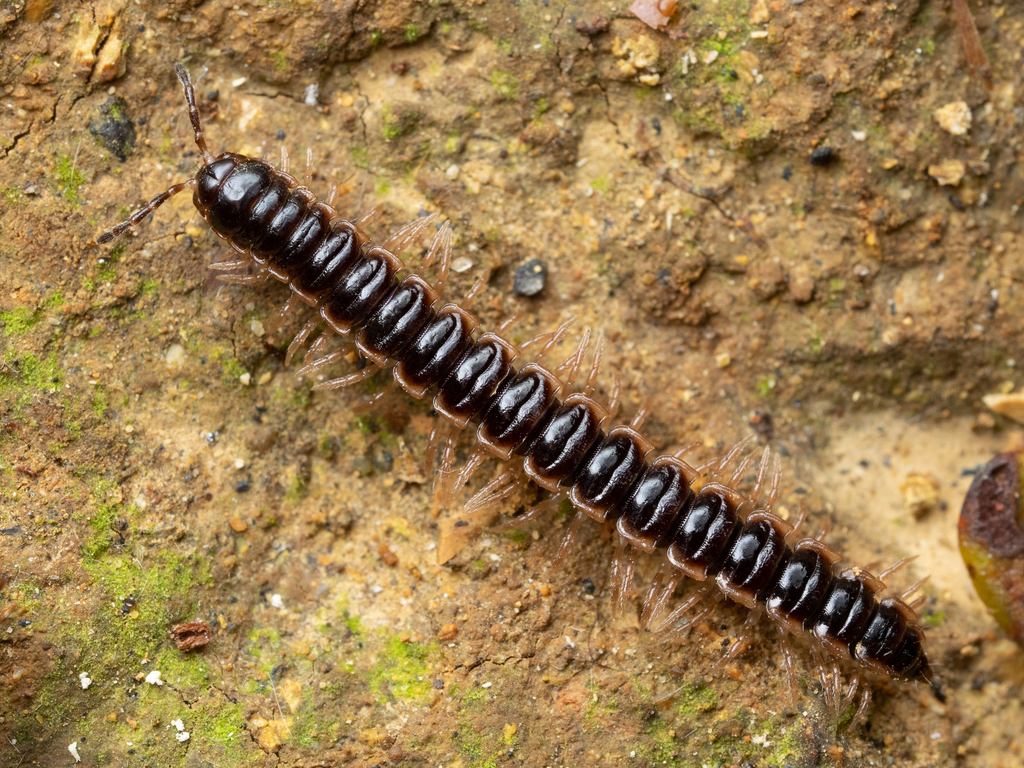
Greenhouse Millipede
Oxidus gracilis
The greenhouse millipede (Oxidus gracilis), also known as the hothouse millipede, short-flange millipede, or garden millipede, is a species of millipede in the family Paradoxosomatidae that has been widely introduced around the world, and is sometimes a pest in greenhouses.
From the article Greenhouse millipede on Wikipedia (CC BY-SA), quoted section by section
Description
The greenhouse millipede is also referred to as the flat-back millipede as it possesses a flat body and a hard exterior skeleton. They are brown in color with pale cream-colored legs and paranota (lateral "keels" extending from each segment). Greenhouse millipedes achieve lengths of 18 to 23 mm (0.71 to 0.91 in) as adults, and widths from 2 to 2.5 mm (0.079 to 0.098 in). When fully grown it will have 60 legs and about 15 body segments. The dorsal section of each segment has a transverse groove, a trait found in most paradoxosomatids. The greenhouse millipede is also blind and without eyes and as a result, it moves through its habitat using its antennae as its sensory organ. The greenhouse millipede got its name from the fact that it survives optimally in greenhouses. They are normally found in Asia, but it can also be found in the Americas and Europe as an invasive species.
Range & habitat
Oxidus gracilis originates from the tropics but has spread to southern and western states as well as Northern Europe. These creatures thrive in various habitats ranging from tropical rainforests to temperate climates like the UK. Despite their small size, they play a crucial role in nutrient cycling and decomposition in these ecosystems. Their ability to adapt to different environments and their ecological importance make them notable inhabitants of both natural and urban landscapes.
Wikipedia: “Geographic range”
What it does
The reproductive process of millipedes in general is not an easy subject to study; thus, specifics of greenhouse millipede reproduction have been a challenge for researchers to gather. It is known that this specific millipede species reproduces sexually. The anatomical structures at play during this process are interestingly specific to the greenhouse millipede. When the female millipede is 6–7 months of age, she will reach physical maturity and will be ready to mate. Male millipedes utilize the "lock and key" method of fertilization. During this process, the males have specialized legs that become sexual appendages to help with bodily stability during mating. These are typically the legs around the seventh segment. This helps increase the effectiveness of the mating action. These specific legs are called gonopods and they help clasp and hold the female in place while the male injects his sperm into the female.The females, after their eggs are fertilized by the male sperm, release a sticky substance that seals the vulvae closed and keeps the eggs from being prematurely released from the female. After mating, the females will lay anywhere from forty to fifty fertilized eggs. These eggs will develop over the course of six to eight weeks in cool, dark, and moist soil. …
Wikipedia: “Reproduction”
Where it lives
Recorded sightings
—
geo-referenced records in GBIF, from museums, herbaria and field observers.
Drag the globe to turn it. Dots are where records exist, not a range map; darker means more records.
In the stacks
Searching the stacks…
Every page naming Oxidus gracilis in the Biodiversity Heritage Library →
This page is assembled live from iNaturalist, GBIF, Wikipedia, the Source Library and the Internet Archive. It is not yet part of the hand-edited codex. iNaturalist taxon 143390.