- Plants
- ›Vascular Plants
- ›flowering plants
- ›Dicots
- ›Legumes, Milkworts, and Allies
- ›Legumes
- ›Faboideae
- ›Desmodieae
- ›Lespedezinae
- ›Kummerowia
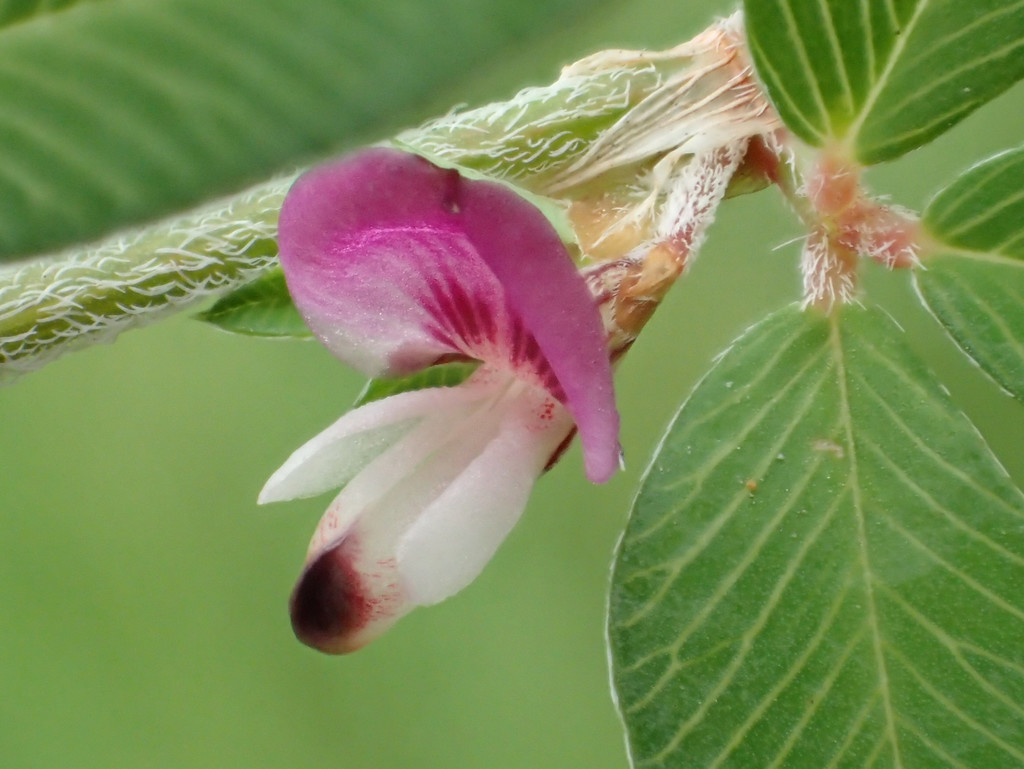
Japanese Clover
Kummerowia striata
Kummerowia striata is a species of flowering plant in the legume family known by the common names Japanese clover and common lespedeza. It is native to much of Asia and it is present in the eastern United States as an introduced species.
This annual herb grows prostrate, spreading, or erect stems. It grows up to 40 cm (16 in) tall. The leaves are made up of three oval leaflets. Flowers occur in the leaf axils. There are cleistogamous flowers, which self-fertilize and never open, and chasmogamous flowers, which open and receive pollen from other plants. The fruit is a small legume pod containing one seed.
From the article Kummerowia striata on Wikipedia (CC BY-SA), quoted section by section
Description
Kummerowia striata can grow to be 16 inches (41 cm) tall. Leaves grow alternate from one another, and only grow to be 0.75 inches (19 mm) long. The leaf edges have no teeth or lobes. The tops of the leaves are dark green, and the bottom of the leaf is light green. The plant grows 0.2–0.3 inches (5.1–7.6 mm) long flowers in three different colors, pink, purple, and white. Flowers sprout from leaf axils in clusters of 1–3. The petals and sepals are fused at the base to form a cup like structure. K. striata has both male and female parts and can either self-pollinate or be pollinated by insects. Each flower has five petals and a light green calyx with five teeth. The plant has two types of flowers, one has colored petals and the other has no petals. K. striata blooms for approximately two months (August to September), from the summer into the fall. In the following two months (October to November) the seeds ripen. The fruits are 0.2 inches (5.1 mm) long and each contain one seed. The fruit is dry and stays intact when ripe. The plant is an annual, but re-seed prolifically.
Range & habitat
Kummerowia striata is native to China, and Japan. The plant is invasive in North America, and it is distributed along the east coast from New York to Florida. It reaches as far west as New Mexico. It was first noticed in Charleston, Virginia in the 1840s. Kummerowia striata is most likely to be found in fields, woods, on the side of roads, or other areas where the ground may have been disturbed. It is uncommon to find a single Kummerowia striata; it is more likely to find a group of them. Kummerowia striata will grow best in moist sandy soil with direct sunlight, but can still grow in other conditions. Kummerowia striata can grow in the 4.5–7.0 pH range, but thrives at 6.0–6.5.
Wikipedia: “Distribution and habitat”
At the table
Kummerowia striata is a food source for numerous species across the food chain from pollinators to herbivores. Most of the pollination is done by bees and they are the only ones who leave the plant intact after they visit. Species of caterpillars, beetles, and moths all eat the leafy parts of this plant at some point in their life stages. The seeds of K. striata are consumed by the Prairie Deer Mouse, gamebirds, and songbirds. Deer, and other herbivores also munch on this plant, choosing to eat the leaves and other foliage. Kummerowia striata has also been used by farmers for grazing. Grazing or cutting K. striata should occur when the plant is in the half bloom stage, and it is best to leave the bottom three inches of the plant intact. The legume is useful for grazing because of its bloom time, it is in bloom from summer to fall, and is an alternative to the grazing grasses that are only available in the cooler months. Kummerowia striata is also edible to humans, although it only ranks a two out of five on edibility, based on one scale of edibility. The leaves and seeds of the plant are edible when cooked. The seeds can also be turned into meal and used in baking.
== References ==
Wikipedia: “Food source”
In medicine
Kummerowia striata is used in traditional Chinese medicine as an anti-inflammatory. The plant promotes blood circulation, removes heat, and detoxes blood. It has been historically used to treat dysentery, sores, abscesses, and to stop diarrhea, among other ailments. The plant can also be used to treat fever, headache, vertigo, and loss of appetite.
Wikipedia: “Medical”
How it is grown
Kummerowia striata is a natural nitrogen fixer, meaning it fixes atmospheric nitrogen out of the air and converts it to plant available nitrogen. Nitrogen is released into the soil when the plant dies. Kummerowia striata can also be used for erosion control. If planting for Nitrogen enrichment, pair the legume with bunch type grasses. Do not pair with any sod like grasses, they out compete K. striata. Although the plant re-seeds itself, when being used as a source for grazing it must be reseeded manually to keep the plant numbers high enough to provide adequate food for grazers. The best time to plant K. striata is mid spring. When planting K. striata the seed should be soaked in warm water for 12 hours before the seed is planted.
Wikipedia: “Agricultural”
Where it lives
Recorded sightings
—
geo-referenced records in GBIF, from museums, herbaria and field observers.
Drag the globe to turn it. Dots are where records exist, not a range map; darker means more records.
In the stacks
Searching the stacks…
Every page naming Kummerowia striata in the Biodiversity Heritage Library →
This page is assembled live from iNaturalist, GBIF, Wikipedia, the Source Library and the Internet Archive. It is not yet part of the hand-edited codex. iNaturalist taxon 143558.