- Fungi Including Lichens
- ›Basidiomycete Fungi
- ›Higher Basidiomycetes
- ›Mushrooms, Bracket Fungi, Puffballs, and Allies
- ›Agaricomycetidae
- ›Common Gilled Mushrooms and Allies
- ›Agaricineae
- ›Field Mushrooms and Allies
- ›Agariceae
- ›Agaricus
- ›Agaricus
- ›Agaricus
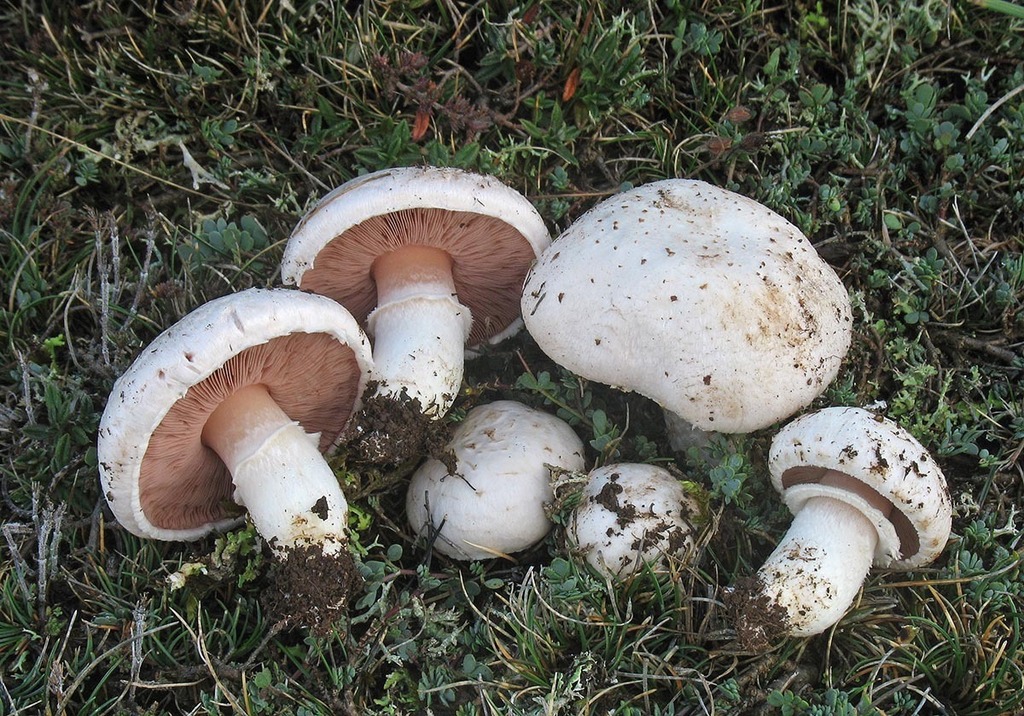
Meadow Mushroom
Agaricus campestris
Agaricus campestris is a widely eaten gilled mushroom closely related to the cultivated A. bisporus (button mushroom). A. campestris is commonly known as the field mushroom or, in North America, meadow mushroom.
The cap is white and up to 12 centimetres (4+3⁄4 inches) across. The species is found in grassy areas around the world. It is considered a choice edible but resembles some poisonous species.
From the article Agaricus campestris on Wikipedia (CC BY-SA), quoted section by section
Description
The cap is white, may have fine scales, and is 3 to 12 centimetres (1+1⁄4 to 4+3⁄4 inches) in diameter; it is first hemispherical in shape before flattening out with maturity. The gills are initially pink, then red-brown and finally a dark brown, as is the spore print. The stipe is 3 to 10 cm (1+1⁄4 to 4 in) tall, 1–2 cm wide, predominantly white and bears a single thin ring. The taste is mild. The white flesh bruises a dingy reddish brown, as opposed to yellow in the poisonous Agaricus xanthodermus and similar species. The thick-walled, dark brown, elliptical spores measure 5.5–8 μm by 4–5 μm. Cheilocystidia are absent.
Similar species. Several species may be confused with A. campestris. The most dangerous confusion may be with the deadly Amanita virosa (a 'destroying angel') or the deadly Amanita hygroscopica (pink-gilled destroying angel). Amanita species may be distinguished from Agaricus by a volva at the base, remnants of a universal veil. Such a veil may also be seen surrounding adjacent smaller button mushrooms, if present. It's recommended to look for smaller sibling buttons nearby, and slice one of them lengthwise to examine their anatomy. They may also be distinguished by a white or off-white spore print while mushrooms in the family Agaricacea are dark brown. In the United States, the poisonous Agaricus californicus and A. hondensis may be similar. …
Range & habitat
A. campestris is found in fields and grassy areas after rain from late summer onwards worldwide. It is often found on lawns in suburban areas, appearing in small groups, in fairy rings, or solitary. Owing to the demise of horse-drawn vehicles and the subsequent decrease in the number of horses on pasture, the old "white outs" of years gone by are becoming rare events. This species is rarely found in woodland. The mushroom has been reported from Europe, Asia, northern and southern Africa, Australia, New Zealand, and North America, including Mexico.
Wikipedia: “Habitat and distribution”
At the table
Although edible and choice, this mushroom is not commercially cultivated on account of its fast maturing and short shelf life. Care is needed to distinguish it from poisonous species. There have been cases (notably in France) in which the deadly Amanita virosa was consumed by individuals who mistook it for this species. Additionally, specimens collected from lawns could be contaminated by pesticides or other chemicals. Culinary uses include eating it sautéed or fried, in sauces, or even sliced raw and included in salads. Older mushrooms are used in stews and soups. In flavor and texture, this mushroom is similar to the white button mushroom (A. bisporus) available in grocery stores in most Western countries.
Other uses. In the past, slices of A. campestris were applied to scalds and burns in parts of Scotland. It has also been used for the treatment of ulcers and bed sores.
Bioactive properties. Water extracts of A. campestris have been shown to enhance the secretion of insulin, and to have insulin-like effects on glucose metabolism in vitro, although the mechanism is not understood.
Wikipedia: “Uses”
Where it lives
Recorded sightings
—
geo-referenced records in GBIF, from museums, herbaria and field observers.
Drag the globe to turn it. Dots are where records exist, not a range map; darker means more records.
In the old herbals & bestiaries

In the stacks
Searching the stacks…
Every page naming Agaricus campestris in the Biodiversity Heritage Library →
This page is assembled live from iNaturalist, GBIF, Wikipedia, the Source Library and the Internet Archive. It is not yet part of the hand-edited codex. iNaturalist taxon 143563.