- Plants
- ›Vascular Plants
- ›flowering plants
- ›monocots
- ›Agaves, Orchids, Irises, and Allies
- ›iris family
- ›Crocoideae
- ›Ixieae
- ›Crocinae
- ›Crocus
- ›Crocus
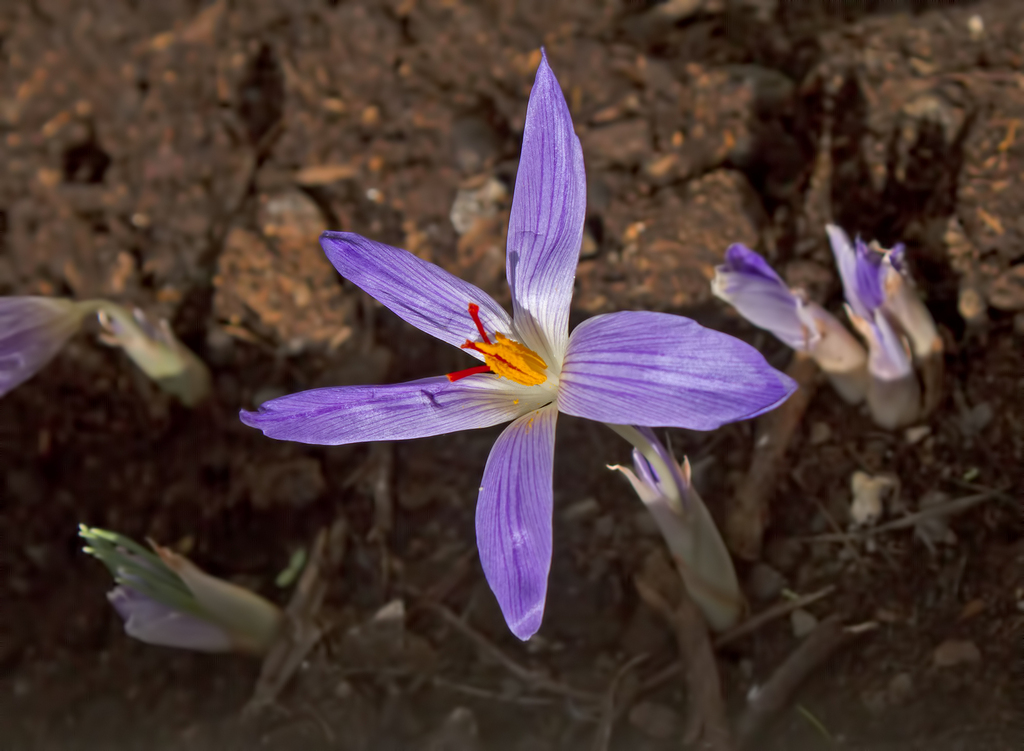
Crocus dispathaceus
Crocus dispathaceus is species of flowering plant growing from a corm, with a native range from southern Turkey to northern Syria.
From the article Crocus dispathaceus on Wikipedia (CC BY-SA), quoted section by section
Description
Crocus dispathaceus is a herbaceous perennial geophyte growing from a corm, which is relatively large for a crocus species. Corms are surrounded by fine reticulate tunics, which develop multi-layered, mat-forming, shredding sheathing leaves from past years of growth. The tunic rises above the corm and around the sheath of the flowers. Deep purple flowers, with veins; have a reddish, double basal spathe (a large sheathing bract enclosing the flower). Petals are narrow. The branches of the stigma are unusually short and do not rise above the throat of the flower and end below the bases of the anthers. The anthers are long, yellow, with reddish filaments. Corms produce 10 to 12 narrow leaves which grow during or shortly after flowering. C. dispathaceus blooms from September to November.
== References ==
Where it lives
Recorded sightings
—
geo-referenced records in GBIF, from museums, herbaria and field observers.
Drag the globe to turn it. Dots are where records exist, not a range map; darker means more records.
In the stacks
Searching the stacks…
Every page naming Crocus dispathaceus in the Biodiversity Heritage Library →
This page is assembled live from iNaturalist, GBIF, Wikipedia, the Source Library and the Internet Archive. It is not yet part of the hand-edited codex. iNaturalist taxon 1435955.