- Fungi Including Lichens
- ›Basidiomycete Fungi
- ›Higher Basidiomycetes
- ›Mushrooms, Bracket Fungi, Puffballs, and Allies
- ›Agaricomycetidae
- ›Common Gilled Mushrooms and Allies
- ›Agaricineae
- ›Webcaps
- ›Phlegmacium
- ›Phlegmacium
- ›Phlegmacioida
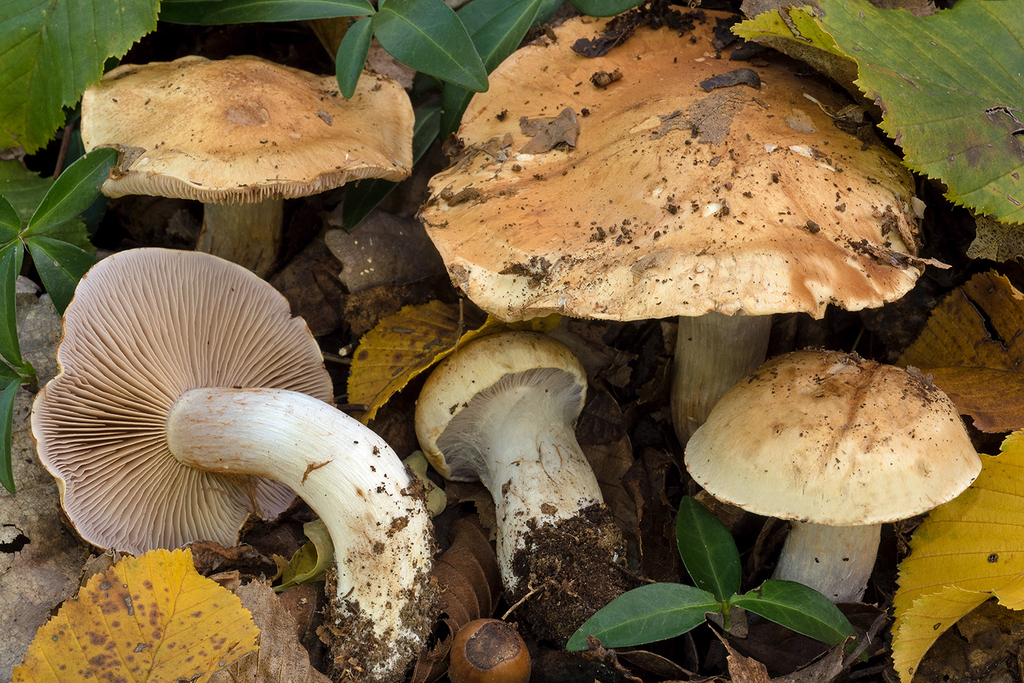
Phlegmacium brunneiaurantium
Phlegmacium brunneiaurantium is a species of mushroom-forming fungus in the family Cortinariaceae, endemic to southern Finland. First described scientifically in 2014 and originally placed in the genus Cortinarius, it was reassigned to Phlegmacium in 2022 following DNA-based analyses. The fungus produces mushrooms with medium-sized caps coloured in shades of ochre to pale brown, initially dome-shaped and sticky but becoming flatter and drier with age. It grows on nutrient-rich clay soils among broadleaf trees such as lime and oak, typically fruiting in autumn.
From the article Phlegmacium brunneiaurantium on Wikipedia (CC BY-SA), quoted section by section
Description
The cap of Phlegmacium brunneiaurantium measures between 4 and 9 cm across. Initially shaped as a hemisphere, it gradually becomes flattened and convex with maturity. Its surface starts off somewhat sticky (viscid) but soon dries, developing small, flattened scales near the centre, while becoming finely fibrous (fibrillose) closer to the edge. The cap colour is a pale ochre-brown. Underneath the cap, the gills (lamellae) are crowded closely together and attach to the stem with a notch-like indentation (emarginate). Initially, they appear bluish or pale grey, transitioning later to a pale brown shade. The stem (stipe) ranges from 4 to 9 cm in height, and its thickness varies between 0.8 and 1.5 cm near the top, widening gradually to between 1.2 and 2 cm at its base, resulting in a club-shaped (clavate) appearance. Its colour shifts from white when young to pale brown as it ages. A universal veil—a protective layer of tissue enveloping young mushrooms—is present but rather sparse, initially white and quickly turning brownish. Internally, the mushroom tissue (context) appears white within the cap and typically bluish within the upper stem. No distinct odour has been noted. A chemical reaction occurs when applying potassium hydroxide (KOH) solution to the tissue, producing a yellow colour. …
Range & habitat
Phlegmacium brunneiaurantium is found only in south Finland, where it grows in deciduous forests and fruits in autumn. Close relatives include C. sobrius, C. balteatus, C. brunneoviolaceus, C. pseudonaeovosus and C. clarobaltoides var. longispermus.
== References ==
Wikipedia: “Habitat and distribution”
Where it lives
Recorded sightings
—
geo-referenced records in GBIF, from museums, herbaria and field observers.
Drag the globe to turn it. Dots are where records exist, not a range map; darker means more records.
In the stacks
This page is assembled live from iNaturalist, GBIF, Wikipedia, the Source Library and the Internet Archive. It is not yet part of the hand-edited codex. iNaturalist taxon 1437664.