- Fungi Including Lichens
- ›Basidiomycete Fungi
- ›Higher Basidiomycetes
- ›Mushrooms, Bracket Fungi, Puffballs, and Allies
- ›Agaricomycetidae
- ›Common Gilled Mushrooms and Allies
- ›Agaricineae
- ›Webcaps
- ›Thaxterogaster
- ›Scauri
- ›Purpurascentes
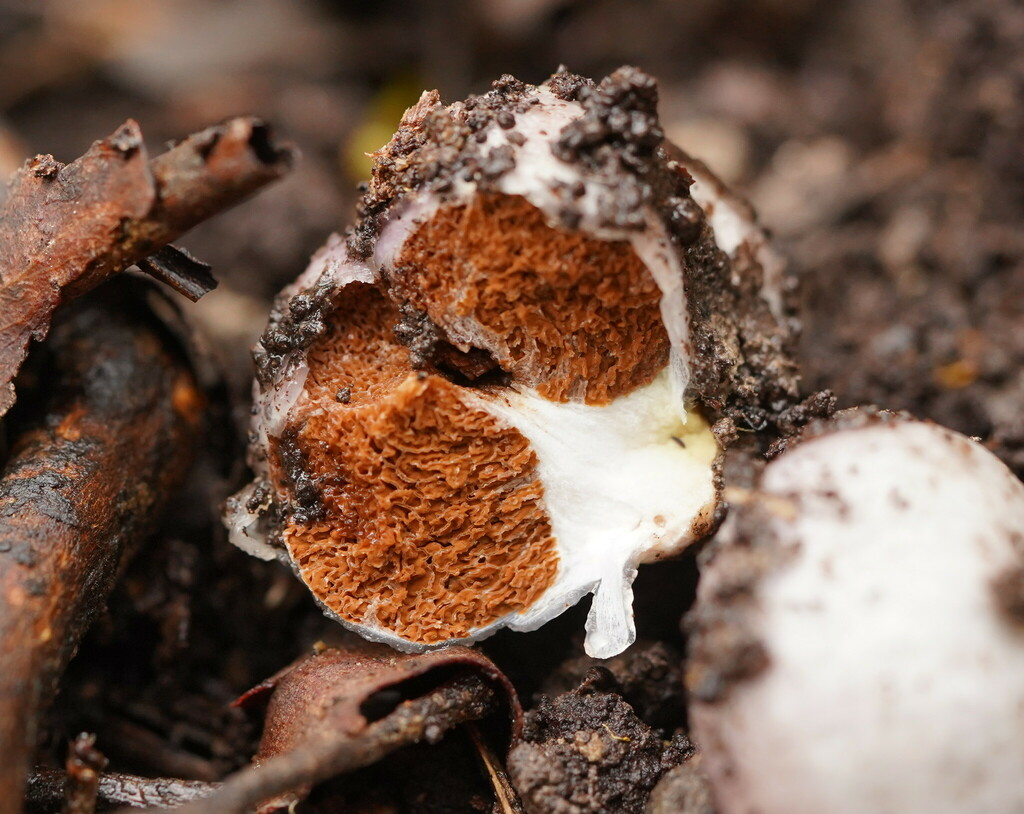
Thaxterogaster cinereoroseolus
Thaxterogaster cinereoroseolus is a species of truffle-like fungus in the family Cortinariaceae. Found in New South Wales, Australia, the species was described as new to science in 2010. The species was formerly classified in the genus Cortinarius, but it was reassigned to Thaxterogaster by a 2022 study.
From the article Thaxterogaster cinereoroseolus on Wikipedia (CC BY-SA), quoted section by section
Description
Thaxterogaster cinereoroseolus has a sequestrate fruit body, meaning that its spores are not forcibly discharged from the basidia, and it remains enclosed during development, including at maturity. The shape of the caps ranges from irregularly spherical to like an inverted cone, and they measure 1.1–2.7 cm (0.4–1.1 in) long by 1.1–2.4 cm (0.43–0.94 in) in diameter. A white to silvery-grey partial veil connects the cap to the stipe. The colour of the outer skin of the cap (the pellis) is cream mixed with pale pink, lilac, and grey, and it is smooth with a finely hairy texture. Remnants of the greyish silky universal veil are readily rubbed off with handling. The flesh is white to cream and 3–8 mm (0.1–0.3 in) thick. The internal spore-bearing tissue of the cap (the hymenophore) is pale brown at first, but darkens as the spores mature. A white stipe extends into the fruit body through its entire length; it measures 5–11 mm (0.2–0.4 in) long by 3–6 mm (0.1–0.2 in) thick, with a bulbous base that extends 3 mm (0.1 in) below the cap. Fruit bodies have no distinctive taste, but smell somewhat of flowers or like chlorine. The spores are broadly egg-shaped and measure 7–8.9 by 5.1–6.4 μm. They are covered irregularly with nodules up to 1.5 μm high. …
Range & habitat
The fruit bodies of Thaxterogaster cinereoroseolus grow in the ground under litterfall in subalpine areas of the Kaputar Plateau. Plants typically associated with the fungus include Eucalyptus dalrympleana, E. pauciflora and Poa sieberiana with scattered Acacia melanoxylon, Acacia sp., Hibbertia obtusifolia, Lomatia arborescens, Monotoca scaparia, Olearia rosemanifolia and Pultanea satulosa. The fungus has also been collected in wet sclerophyll forests where Acacia melanoxylon, Blechnum cartilagineum, Coprosma quadrifida, Cyathea australis, Lomandra multiflora, Lomatia arborescens and Poa sieberiana are the predominant plants.
Wikipedia: “Habitat and distribution”
Where it lives
Recorded sightings
—
geo-referenced records in GBIF, from museums, herbaria and field observers.
Drag the globe to turn it. Dots are where records exist, not a range map; darker means more records.
In the stacks
This page is assembled live from iNaturalist, GBIF, Wikipedia, the Source Library and the Internet Archive. It is not yet part of the hand-edited codex. iNaturalist taxon 1438528.