- Animals
- ›Arthropods
- ›Crustaceans
- ›Typical Crustaceans
- ›Malacostracans
- ›Decapods, Isopods, and allies
- ›Decapods and Krill
- ›Decapods
- ›Crabs, Lobsters, Shrimps, and Allies
- ›Anomurans
- ›Hermit Crabs
- ›Left-handed Hermit Crabs
- ›Dardanus
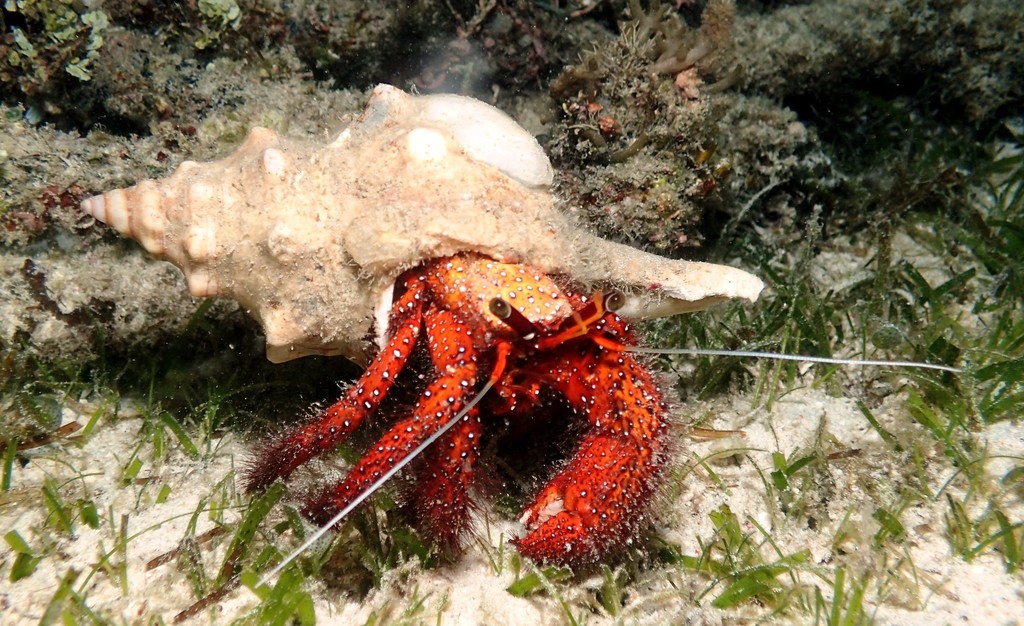
White-spotted Hermit Crab
Dardanus megistos
Dardanus megistos, the white-spotted hermit crab or spotted hermit crab, is a species of hermit crab, living in reefs in the Indo-Pacific region from Africa to the South China Sea and Hawaii.
From the article Dardanus megistos on Wikipedia (CC BY-SA), quoted section by section
Description
Dardanus megistos can reach a body length of about 20 cm (7.9 in). These large crabs have a bright red body with small white eyespots surrounded by black. Their bodies are covered with long erect coarse hairs of a dark red color. They have a pair of long white primary antennae or antennules, a pair of secondary antennae, stalked green brown eyes and three pairs of mouth appendages. The stalks of the eyes are reddish with a basal white spot. The soft, asymmetrical abdomen is spiral-shaped, useful in keeping in the shell, with a five-piece tail (telson and uropods). Like all decapod crustaceans, they have ten legs. The first pair of legs carries the pincers ( chelipeds). The left plier is bigger than the right one.
Range & habitat
This species is present in the Indo-Pacific region from East Africa to the South China Sea, Australia and east to Hawaii.
Wikipedia: “Distribution”
In human culture
The genus name Dardanus refers to the son of Zeus and Electra in Greek mythology, while the species name megistos is the superlative of the Greek word mega, therefore it means the largest.
Wikipedia: “Etymology”
Where it lives
Recorded sightings
—
geo-referenced records in GBIF, from museums, herbaria and field observers.
Drag the globe to turn it. Dots are where records exist, not a range map; darker means more records.
In the stacks
Searching the stacks…
Every page naming Dardanus megistos in the Biodiversity Heritage Library →
This page is assembled live from iNaturalist, GBIF, Wikipedia, the Source Library and the Internet Archive. It is not yet part of the hand-edited codex. iNaturalist taxon 143945.