- Plants
- ›Vascular Plants
- ›flowering plants
- ›Dicots
- ›Roses, Elms, Figs, and Allies
- ›rose family
- ›brambles, roses, strawberries, and allies
- ›strawberries, cinquefoils, and allies
- ›cinquefoil subtribe
- ›Ivesia
Tweedy's ivesia
Ivesia tweedyi
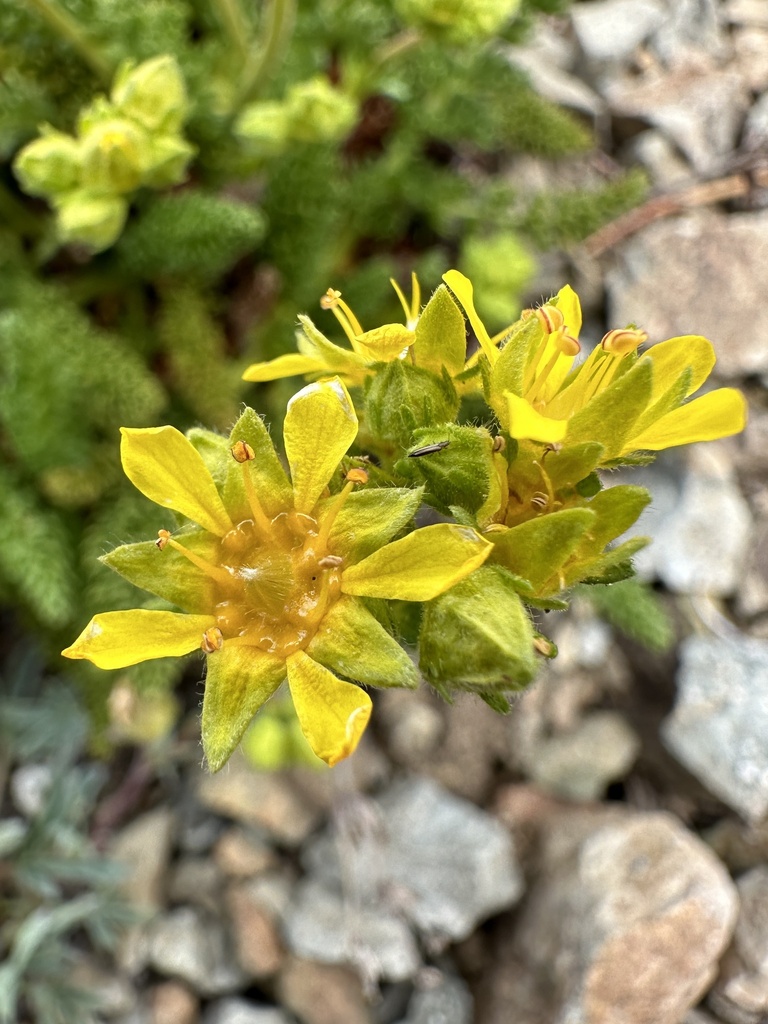
Potentilla tweedyi, also known as Tweedy's mousetail and Tweedy's ivesia, is a species of perennial herb in the rose family. It is native to the Pacific Northwest in the United States, from Washington east to westernmost Montana.
From the article Potentilla tweedyi on Wikipedia (CC BY-SA), quoted section by section
Description
Potentilla tweedyi is a perennial herb to 20 cm (7.9 in) from a stout taproot. It has finely-dissected, pinnate basal leaves which often lie somewhat flat, appearing to radiate from the central root crown. The reddish or purplish stems are glandular and usually finely hairy above, each with 1 to 3 small leaves and topped with a cluster of several flowers. Each flower has five yellow petals surrounded by a shallow bowl-shaped hypanthium. Potentilla tweedyi is similar to Potentilla gordonii, with which it cooccurs in the Pacific Northwest. However, the latter is much more widespread. The finely-dissected flat-lying basal leaves of Tweedy's ivesia are a useful distinguishing character. Also, its petals are oblanceolate or spoon shaped (spatulate) or even broadly obovate, and wider than the petals of I. gordonii, which are narrowly lanceolate or narrowly spatulate at most. The calyx (hypanthium) of Potentilla tweedyi is also much shallower than that of Potentilla gordonii, and the petals are longer than the triangular green to yellow-green sepals. The "mousetail" in the common name refers to the cylindric arrangement of the many small leaflets around the leaf rachis.
Range & habitat
Potentilla tweedyi is endemic to the Pacific Northwest in the United States, growing in central and northeastern Washington, northern Idaho, and northwestern-most Montana (Mineral County). It grows on dry, gravelly to rocky flats, slopes, alpine ridges, and in subalpine conifer woodlands. It is notable for its occurrence on serpentine.
Wikipedia: “Distribution and habitat”
How it is grown
Tweedy's ivesia is suitable for rock gardens. It does best in dry sunny spots "with a good rock to cover the taproot".
== References ==
Wikipedia: “Cultivation”
In human culture
Per Axel Rydberg gave the species epithet tweedyi in honor of Frank Tweedy, who made the first collection, in the Yakima area of Washington Territory in 1883. At that time Tweedy was working as a topographer on the Northern Transcontinental Survey.
Wikipedia: “History”
Where it lives
Recorded sightings
—
geo-referenced records in GBIF, from museums, herbaria and field observers.
Drag the globe to turn it. Dots are where records exist, not a range map; darker means more records.
In the stacks
Searching the stacks…
Every page naming Ivesia tweedyi in the Biodiversity Heritage Library →
This page is assembled live from iNaturalist, GBIF, Wikipedia, the Source Library and the Internet Archive. It is not yet part of the hand-edited codex. iNaturalist taxon 144081.