- Plants
- ›Vascular Plants
- ›flowering plants
- ›Dicots
- ›saxifrages, stonecrops, and allies
- ›saxifrage family
- ›brookfoam tribe
- ›Boykinia
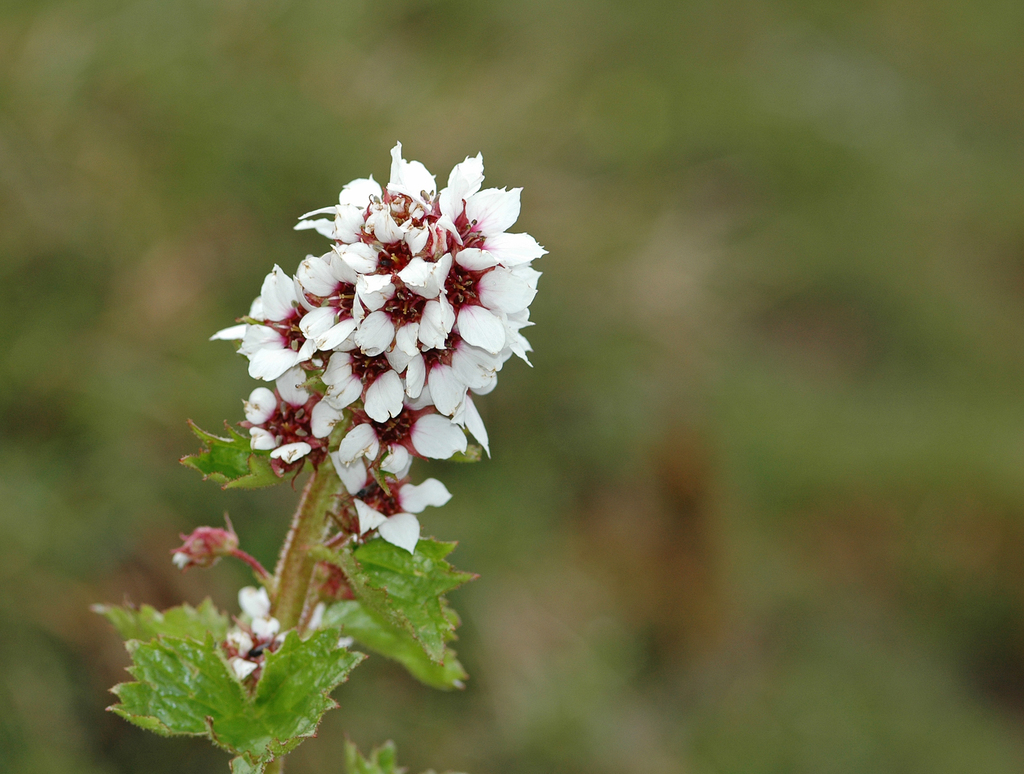
Richardson's Brookfoam
Boykinia richardsonii
Boykinia richardsonii is a species of flowering plant in the family Saxifragaceae, endemic to Alaska and the adjacent Canadian territory of Yukon. It is commonly known as Richardson's brookfoam, but has also been called Alaska boykin, bearflower, Richardson's boykin and Richardson's saxifrage. "Bearflower" reflects its popularity with grizzly bears as forage in the summer months when it flowers.
The species is named for Scottish naturalist John Richardson, who first identified it on his mid-1820s exploration of the western Canadian Arctic coast with John Franklin. William Jackson Hooker first described it in Flora Boreali-Americana, the 1833 account of plant species identified on that expedition. It was originally misclassified as part of the genus Saxifraga.
From the article Boykinia richardsonii on Wikipedia (CC BY-SA), quoted section by section
Description
From a system of dark brown rhizomes spreading underground the plant's stem rises 10–60 centimetres (3.9–23.6 in), with capitate trichomes. Reniform basal leaves, 2–7 cm long by 5–11 cm wide, generally one and a half times as wide, sprout from trichomous petioles 2.5–10 cm long. The leaves, glandular-pubescent below and glabrate above with frequent stomata, are shallowly lobed and 2–3 times dentate on the margins. Stipules, 2–5 millimeters long, are either a dilation of the petiole base or foliaceous; the smaller ones are fringed with subulate bristles. Cauline leaves are similar to the stipules, fringed with brown hair. The plant's inflorescence is narrowly cylindrical, with three flowers on each branch. Its pedicels are densely stipitate-glandular. At the end of each pedicel is a calyx 6–14 mm long, divided at about half its length into sepals, triangular to lanceolate, another 3–7 mm. The free portion of the hypanthium is another 2–3 mm; its nectary is greenish or purple with an inferior ovary. Petals are white, sometimes with pink veins, ovate, 8–12 by 3–7 mm (generally double or triple the lengths of the sepals) with a cuneate or clawed base. Stamens are 3–5 mm long, generally equal or slightly shorter than the sepals. Filaments are 2–4 times the length of the undehisced anthers. The plant's capsules are ovoid, turbinate or urceolate. …
Range & habitat
Delineations of the species' range vary but most agree on an area running across the Alaska North Slope into the foothills of the Brooks Range up to elevations of 400 m (1,300 ft), thence across the Canada–United States border through the Arctic National Wildlife Refuge (ANWR) into northern Yukon and Ivvavik National Park, where it turns south through Vuntut National Park, then bending southwest through the Porcupine River valley to finish at the Alaska Range, found as high up the slopes as 1,700 m (5,600 ft) in Denali National Park and Preserve. Some maps show isolated areas on the Seward Peninsula and the Norton Sound coast. Others extend it along the Arctic coast into the Northwest Territories to the Coppermine, the area where Richardson's team found the first specimens identified, or the entirety of northern Alaska. Two early 20th century expeditions reported finding specimens across the Bering Strait, in eastern Siberia. While Eric Hultén did not confirm this, he found it "very probable" that B. richardsonii would occur there as well. But it is not reported in either of the two most comprehensive Soviet-era catalogs of plants. As a result, it is believed today that the two earlier reports of its occurrence in Siberia were mistaken. …
Wikipedia: “Distribution and habitat”
What it does
In the Denali area, B. richardsonii has been observed to be popular grizzly bear forage in the summertime, so much so that it has come to be known locally as bearflower. A University of Montana graduate student who devoted his master's thesis to the feeding habits of grizzlies on barren ground in the Alaskan Arctic said the species was by far the most popular plant with them (although in some areas the bears ignored it in favor of the local grasses). A similar study that followed bears with radiocollars around the Firth River valley in Ivvavik National Park, near the northern end of the plant's range, found they were likewise the most popular plant with the bears there. Adolph Murie observed the plant's popularity with grizzlies during his studies in Alaska, once watching a bear spend two hours leisurely consuming richardsonii in a large patch (although it was more common for bears to consume it as part of a rotation of whatever plants were locally available, especially when that included horsetail, another favorite). He noted the flowers seemed to particularly interest the bears, often to the exclusion of the rest of the plant, although in one case he saw a bear discard the flowers and concentrate on the stems and leaves. In 1963, Murie recalled, he found even greater evidence than usual of richardsonii's popularity with grizzlies. …
Wikipedia: “Ecology”
In human culture
The species' binomial name recognizes two prominent early 19th-century naturalists. The Boykinia generic name honors plant collector Samuel Boykin of Milledgeville, Georgia. Hooker gave it its specific epithet after Richardson, under whose leadership it was first identified. Three of its vernacular names also recognize Richardson's role in the form of an initial possessive; they differ in what kind of flower to call it. "Saxifrage" recalls its original generic from before Boykinia was identified and "boykin" is derived from its generic name. "Brookfoam", probably the most commonly used, is the vernacular name for most Boykinia species. Within Alaska, two other names are common. "Bearflower" reflects its popularity as forage with grizzly bears during the summer months. Hultén, and some other sources, use "Alaska boykinia". "I'm definitely learning that if it is found in Alaska, it's going to end up with some variation of 'Alaska' or 'Alaskan' in a name," wildlife photographer Lee Petersen remarked on this name in 2021, "and that's what Alaskans will call it, no matter how widely distributed it is."
Wikipedia: “Etymology”
Where it lives
Recorded sightings
—
geo-referenced records in GBIF, from museums, herbaria and field observers.
Drag the globe to turn it. Dots are where records exist, not a range map; darker means more records.
In the stacks
Searching the stacks…
Every page naming Boykinia richardsonii in the Biodiversity Heritage Library →
This page is assembled live from iNaturalist, GBIF, Wikipedia, the Source Library and the Internet Archive. It is not yet part of the hand-edited codex. iNaturalist taxon 144147.