On eBird ↗
Tasmanian Nativehen
Live sightings near you, the range map, bar charts of when it is seen, and Macaulay Library photos and recordings.
Tasmanian Nativehen
Tribonyx mortierii
The Tasmanian nativehen (Tribonyx mortierii) (alternative spellings: Tasmanian native-hen or Tasmanian native hen), also known by its palawa kani name piyura, is a flightless rail and one of twelve species of birds endemic to Australia's island state of Tasmania. Although many flightless birds have a history of extinction at the hands of humans, the species has actually benefited from the introduction of European-style agricultural practices in Tasmania. Its success may also be attributed to the recent extinction of its main predator, the thylacine.
From the article Tasmanian nativehen on Wikipedia (CC BY-SA), quoted section by section
Description
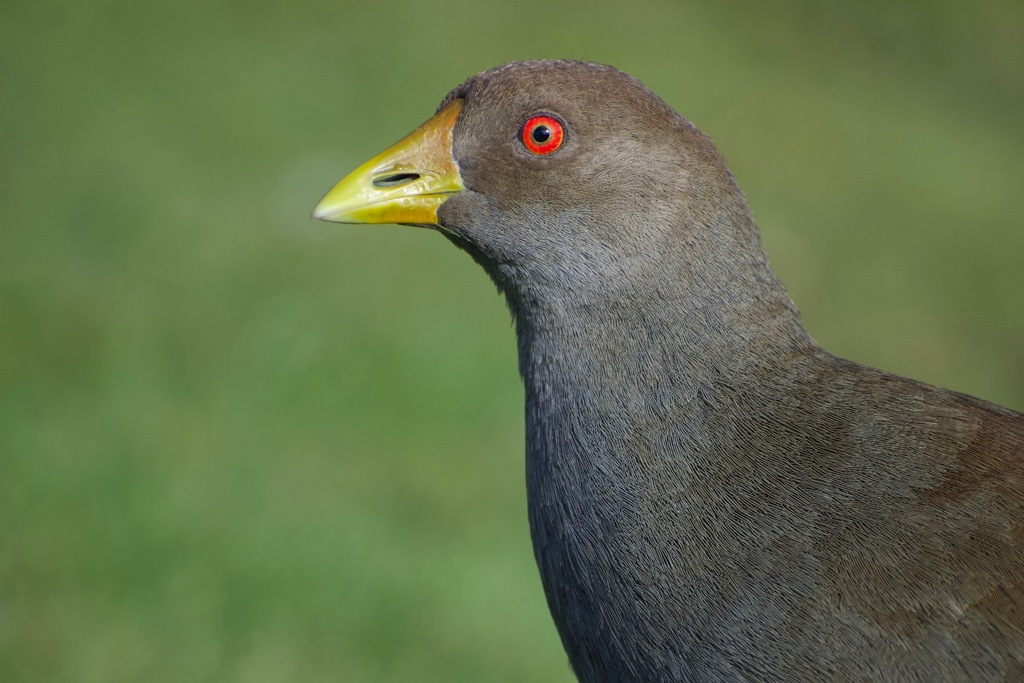
The Tasmanian nativehen is a stocky flightless bird between 43 and 51 centimetres (17 and 20 in) in length. The upperparts are olive-brown with a white patch on the flank. The underparts are darker with a bluish-grey tinge. The short tail is close to black and mostly held erect. The legs are thick and powerful, with a grey scaly appearance and sharp claws. The eyes are bright red. The bill has a small greenish-yellow frontal shield. The juvenile bird is similar in appearance to the adult, though the colours are more subdued on the body and the underparts have fine white spots. The bill is greenish-yellow and the eyes bright red. Male birds generally have longer bills and legs, though there is enough overlap that the sexes are indistinguishable, even in the hand.
Voice. The species has 14 separate calls, ranging from low grunts to high pitched alarm calls as well as a see-sawing duet performed in unison, rising to a crescendo of harsh screeching notes, It also calls at night.
Range & habitat
The species is endemic to, and widespread in, Tasmania apart from the west and south-west regions. It is sedentary, living around open grassy areas close to water. It is not found on King or Flinders Island in the Bass Strait, though Michael Sharland does record it as being on Flinders Island. A population introduced to Maria Island is now well established. It is generally common and easily seen around bodies of water that have grassy verges. Fossil records indicate that it was found on the Australian mainland until around 4,700 years ago. Suggested reasons for its extirpation have included human overhunting, the introduction of the dingo, or an extremely dry period.
Wikipedia: “Distribution and habitat”
What it does
The nativehen's social organisation has been extensively studied. They live in groups of between two and five, plus the young birds from the previous breeding season, which tend to stay with the group and contribute to the care of the young until they move off to establish their own territories after approximately one year. The sedentary nature of the species means that groups hold sharply defined territories of up to 5 acres (2.0 ha), and repel transgression into their territory vigorously with calls and displays. Fights can also occur, where birds will jump, peck and kick at each other violently, sometimes drawing blood and pulling feathers. Although flightless, the bird is capable of running quickly and has been recorded running at speeds up to 35 kilometres per hour (22 mph). It uses its wings when running fast to help it to balance.
Breeding. The breeding structure may be monogamous or polygamous, usually polyandrous. Each group contains a single breeding female who will mate with all the males of the group. The unusual social structure based on groups who stay together is not known to occur in many other species; the high ratio of male chicks to female chicks hatched is thought to be a possible explanation for this. The breeding season begins in the period from July to September, depending upon rainfall and the availability of food. …
Wikipedia: “Behaviour and social organisation”
Listen
Looking for field recordings…
Where it lives
Recorded sightings
—
geo-referenced records in GBIF, from museums, herbaria and field observers.
Drag the globe to turn it. Dots are where records exist, not a range map; darker means more records.
In the stacks
Searching the stacks…
Every page naming Tribonyx mortierii in the Biodiversity Heritage Library →
This page is assembled live from iNaturalist, GBIF, Wikipedia, the Source Library and the Internet Archive. It is not yet part of the hand-edited codex. iNaturalist taxon 144481.