On eBird ↗
White-eyed River Martin
Live sightings near you, the range map, bar charts of when it is seen, and Macaulay Library photos and recordings.
White-eyed River Martin
Pseudochelidon sirintarae
The white-eyed river martin (Pseudochelidon sirintarae) is a passerine bird, one of only two members of the river martin subfamily of the swallows. Since it has significant differences from its closest relative, the African river martin, it is sometimes placed in its own genus, Eurochelidon. First found in 1968, it is known only from a single wintering site in Thailand, and may be extinct, since it has not been seen since 1980 despite targeted surveys in Thailand and neighbouring Cambodia. It may possibly still breed in China or Southeast Asia, but a Chinese painting initially thought to depict this species was later reassessed as showing pratincoles.
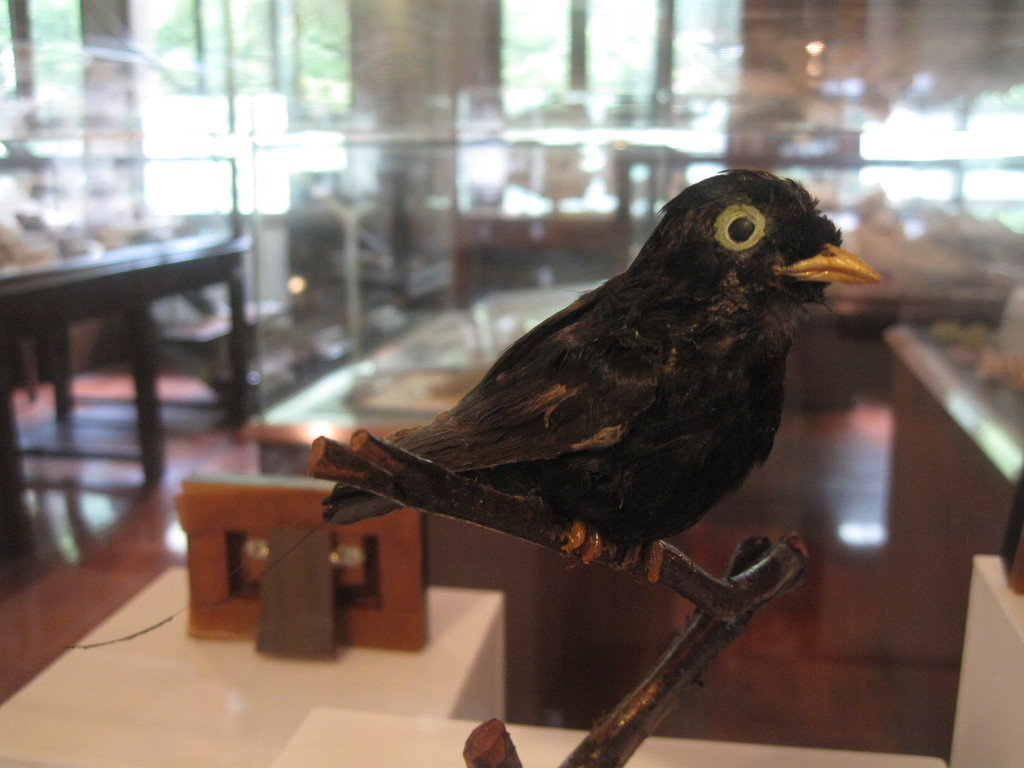
The adult white-eyed river martin is a medium-sized swallow, with mainly glossy greenish-black plumage, a white rump, and a tail which has two elongated slender central tail feathers, each widening to a racket-shape at the tip. It has a white eye ring and a broad, bright greenish-yellow bill. The sexes are similar in appearance, but the juvenile lacks the tail ornaments and is generally browner than the adult. Little is known of the behaviour or breeding habitat of this martin, although like other swallows it feeds on insects caught in flight, and its wide bill suggests that it may take relatively large species. It roosts in reed beds in winter, and may nest in river sandbanks, probably in April or May before the summer rains. It may have been overlooked prior to its discovery because it tended to feed at dawn or dusk rather than during the day.
From the article White-eyed river martin on Wikipedia (CC BY-SA), quoted section by section
Description
The adult white-eyed river martin is a medium-sized swallow, 18 cm (7 in) long, with mainly silky black plumage and a white rump. The back is green-glossed black, and is separated from the similarly coloured upper tail by a narrow bright white rump band. The head is darker than the back, with a velvet-black chin leading to blue-green glossed black underparts. The wings are black, with brown inner edges to the flight feathers, and the tail is green-glossed black with two elongated, slender, central tail feathers, up to 9 cm (3.5 in) long. These expand slightly at the tips to give narrow racquets 4.9–8.5 cm (1.9–3.3 in) long. The wing length averages 11.5 cm (4.5 in), the tail is 10.7 cm (4.2 in) long, and the tarsus averages 1.1 cm (0.43 in). The iris and eyelid are white, giving the appearance of a white eye ring, and the broad, bright greenish-yellow bill has a black hooked tip to the upper mandible. The large, strong feet and legs are flesh-coloured. This species is silent when wintering, and its breeding vocalisations are unknown. The sexes are similar, but the juvenile lacks the tail racquets, has a brown head and chin, and is generally browner than the adult. …
Range & habitat
The white-eyed river martin was discovered in 1968 by Kitti Thonglongya, who obtained nine specimens netted by professional bird-hunters as part of a migratory bird survey at a night-time roost at Thailand's largest freshwater lake, Bueng Boraphet, in Nakhon Sawan Province. It was first seen in the wild by ornithologists at the same wintering site in 1977. The species has only been seen at the lake, always between the months of November and February, and the wintering habitat is assumed to be in the vicinity of open fresh water for feeding, with reed beds for the night-time roost. The white-eyed river martin may be migratory, and if the breeding habitat resembles that of the African river martin, it is likely to be the forested valleys of large rivers; these can provide sandbars and islands for nesting, and woodland over which the birds can catch insect prey. The breeding grounds and habitat are unknown, although river valleys in northern Thailand or southwestern China are possibilities. A claimed depiction of this species in a Chinese scroll painting initially appeared to support the possibility of the martin breeding in China. The bird in the painting had a similarly shaped head and bill, a white eye and a long tail, although it lacked the white rump, did not show the correct bill colour, and elongated the outer, rather than central, tail feathers. …
Wikipedia: “Distribution and habitat”
What it does
Since its breeding grounds are undiscovered, nothing is known about the white-eyed river martin's breeding biology, although it is suggested that it may nest in burrows in river sandbars, probably in April or May before the monsoon rain raises water levels. However, distinct differences in foot and toe morphology from its African relative have led some authorities to speculate that even the assumption that it nests in burrows could be incorrect. In winter, it roosts with barn swallows in reed beds. Like other swallows, the white-eyed river martin feeds on insects, including beetles, which are caught on the wing. Given its size and unusual mouth structure, it may well take larger insects than other swallows. This species is described as graceful and buoyant in flight, and, like its African relative, appears reluctant to use perches, behaviour that, together with its unusual toe-shape and the fact that mud was found on the toes of one of the first specimens, suggest that this species may be relatively terrestrial. Pamela C. Rasmussen suggested that, given its unusually large eyes, the species might be nocturnal or at least crepuscular, a factor that could make it very inconspicuous, and thus partly explain how it remained undetected for so long. …
Wikipedia: “Behaviour”
Listen
Looking for field recordings…
Where it lives
Recorded sightings
—
geo-referenced records in GBIF, from museums, herbaria and field observers.
Drag the globe to turn it. Dots are where records exist, not a range map; darker means more records.
In the stacks
Searching the stacks…
Every page naming Pseudochelidon sirintarae in the Biodiversity Heritage Library →
This page is assembled live from iNaturalist, GBIF, Wikipedia, the Source Library and the Internet Archive. It is not yet part of the hand-edited codex. iNaturalist taxon 144779.