- Plants
- ›Vascular Plants
- ›flowering plants
- ›Dicots
- ›Gentians, Dogbanes, Madders, and Allies
- ›Dogbane Family
- ›milkweeds
- ›Marsdenieae
- ›Leichhardtia
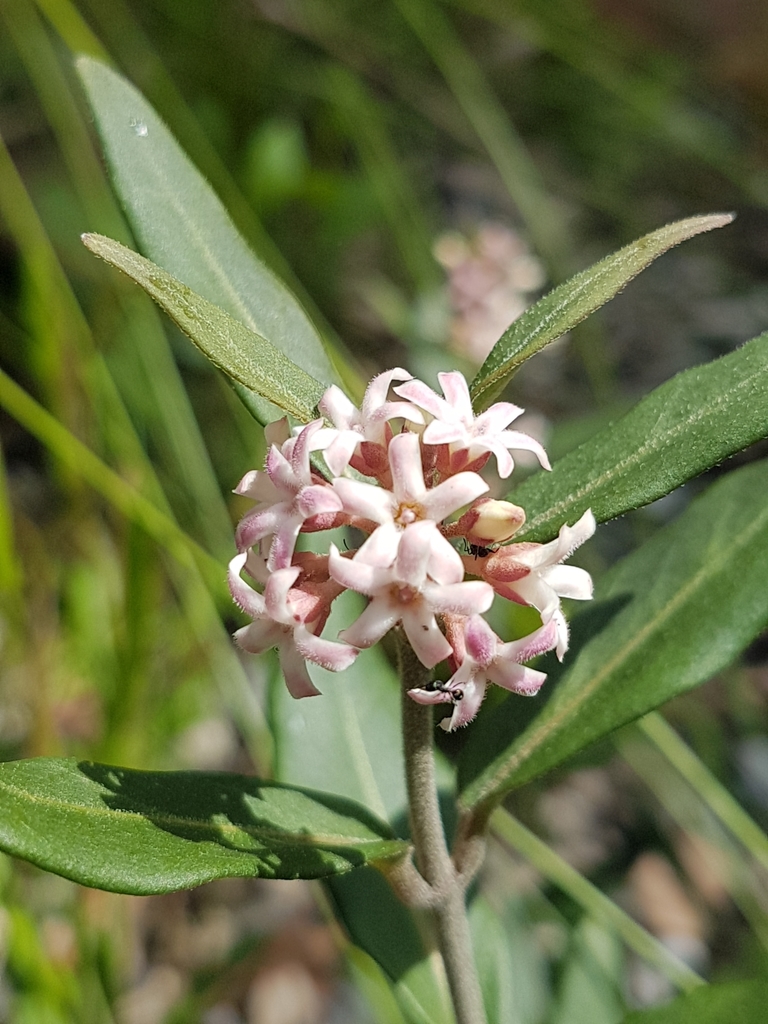
Scented Marsdenia
Leichhardtia suaveolens
Leichhardtia suaveolens, synonym Marsdenia suaveolens, commonly known as the scented milk vine, is a small vine found in New South Wales, Australia. It is found in a variety of habitats in relatively high rainfall areas, from Bega to Port Macquarie. The original specimen was collected at Sydney on 11 May 1802.
From the article Leichhardtia suaveolens on Wikipedia (CC BY-SA), quoted section by section
Description
Leichhardtia suaveolens grows as a vine in forest or small upright shrub in heathland, reaching 1 m (3 ft) high. The stem is up to 3 mm (1⁄8 in) in diameter, and the internodes are up to 17 cm (6+3⁄4 in). The plant exudes a white milky sap when cut or damaged. The (oppositely arranged) leaves arise in pairs off the stem. The dark green, spear-shaped (lanceolate to oblong-lanceolate) leaves have rounded bases and measure 2–7 cm (3⁄4–2+3⁄4 in) long by 0.6–2.5 cm (1⁄4–1 in) wide. The leaf margins roll downwards. The cream-white flowers appear from October to February, being most abundant in December, and are 3–8 mm (1⁄8–3⁄8 in) across and 3–5 mm (1⁄8–1⁄4 in) long. They are arranged in umbels. The peduncles are 1–3.5 cm (3⁄8–1+3⁄8 in) long. Fruiting takes place 2–3 months after flowering. The seed pods are narrow with a tapered tip, and are 5–10 cm (2–4 in) cm long by 0.8–1.4 cm (1⁄4–1⁄2 in) wide. They open to release the feathery seeds from August to January. The seeds are then blown away by the wind.
Range & habitat
The species ranges from Port Macquarie to Bega in eastern New South Wales. It grows in wet sclerophyll forest in association with such species as turpentine (Syncarpia glomulifera), Sydney peppermint (Eucalyptus piperita) and blackbutt (E. pilularis), generally on sandy alluvial soils. It is also found in dry sclerophyll forest with red bloodwood (Corymbia gummifera), stiff-leaf wattle (Acacia obtusifolia) and paperbark tea-tree (Leptospermum trinervium), and can be found in rainforest gullies. The yearly rainfall is over 800 mm.
Wikipedia: “Distribution and habitat”
What it does
Leichhardtia suaveolens resprouts after bushfire, and has been recorded setting fruit five months after a burn. Leichhardtia suaveolens is foraged upon by caterpillars of the common crow (Euploea core).
Wikipedia: “Ecology”
How it is grown
In 1820, The Botanical Register reported that Leichhardtia suaveolens (then known as Marsdenia suaveolens) flowered in the United Kingdom in Colville Nursery in Chelsea. The flower's fragrance was greatly praised and compared to that of Heliotropium peruvianum (now Heliotropium arborescens). It can be grown in well-drained soil in a spot with some shelter in the garden.
== References ==
Wikipedia: “Cultivation”
Where it lives
Recorded sightings
—
geo-referenced records in GBIF, from museums, herbaria and field observers.
Drag the globe to turn it. Dots are where records exist, not a range map; darker means more records.
In the stacks
Searching the stacks…
Every page naming Leichhardtia suaveolens in the Biodiversity Heritage Library →
This page is assembled live from iNaturalist, GBIF, Wikipedia, the Source Library and the Internet Archive. It is not yet part of the hand-edited codex. iNaturalist taxon 1448735.