On eBird ↗
Emerald Starling
Live sightings near you, the range map, bar charts of when it is seen, and Macaulay Library photos and recordings.
Emerald Starling
Lamprotornis iris
The emerald starling (Lamprotornis iris), also known as the iris glossy starling, is a species of starling occurring in West Africa, where it inhabits lowlands and savanna of Côte d'Ivoire, Guinea and Sierra Leone. It was formerly sometimes treated in its own monotypic genus Coccycolius, but genetic studies have now shown it to be a typical member of the glossy starlings in the genus Lamprotornis.
From the article Emerald starling on Wikipedia (CC BY-SA), quoted section by section
Description
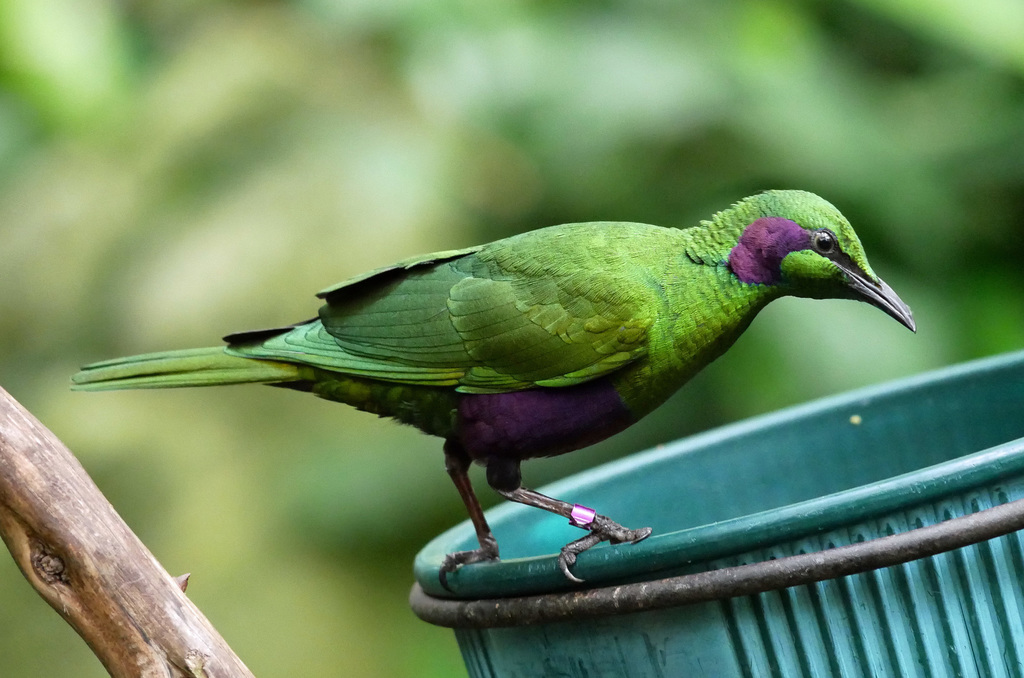
It is a medium-small sized starling, at 21 cm long similar in size to the common starling. It has an iridescent metallic green crown, upper body, wings and tail. The ear-coverts and underparts are metallic purple. The bill and the legs are black. Both sexes are similar; the juveniles are glossy olive-green above, but duller, matt greyish-brown below, lacking the iridescent gloss of the adults there.
What it does
The emerald starling feeds on figs, Haronga berries and other fruit, seeds, ants and other small insects. The cup-shaped nest is built in a tree cavity. The male and female cooperate in building the nest from leaves, and both bring food to chicks after they hatch.
Wikipedia: “Behaviour”
Listen
Looking for field recordings…
Where it lives
Recorded sightings
—
geo-referenced records in GBIF, from museums, herbaria and field observers.
Drag the globe to turn it. Dots are where records exist, not a range map; darker means more records.
In the stacks
Searching the stacks…
Every page naming Lamprotornis iris in the Biodiversity Heritage Library →
This page is assembled live from iNaturalist, GBIF, Wikipedia, the Source Library and the Internet Archive. It is not yet part of the hand-edited codex. iNaturalist taxon 145109.