 NL·0596
Herbarium of the Nature Library
- Name
- Setophaga kirtlandii
- Family
- Parulidae
- Native to
- Breeds mainly in northern Lower Michigan, with small numbers in Michigan's Upper Peninsula, Wisconsin and Ontario; winters in the Bahamas and Turks and Caicos
- Habitat
- Young jack pine forest, Caribbean coppice and scrub (winter)
On eBird ↗
Kirtland's Warbler
Live sightings near you, the range map, bar charts of when it is seen, and Macaulay Library photos and recordings.
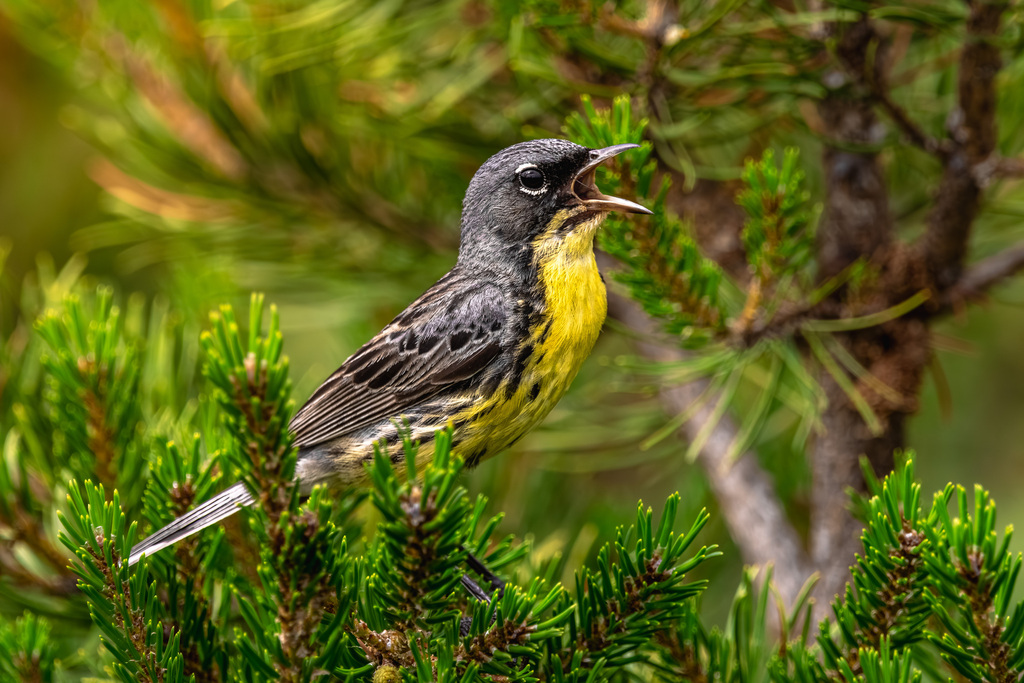
Kirtland's warbler
Setophaga kirtlandii
Also calledChipe de Kirtland (Spanish) · Paruline de Kirtland (French) · Jack pine warbler (English)
A rare, tail-pumping warbler that nests only in young jack pine stands on sandy soils, mostly in northern Michigan, and winters in the Bahamas. It fell to fewer than 200 singing males in the 1970s and recovered through habitat management and cowbird control.
Kirtland's warbler, also known in Michigan by the common name jack pine bird, or the jack pine warbler, is a small songbird of the New World warbler family (Parulidae). Nearly extinct just years ago, populations have recovered due to the conservation efforts of the Kirtland's Warbler Conservation Team and its members. The birds require large areas, greater than 160 acres, of dense young jack pine for breeding habitat. This habitat was historically created by wildfire, but today is created through the harvest of mature jack pine, and planting of jack pine seedlings. Wikipedia
What it can do
- iDepends on jack pine stands roughly 5–20 years old, a habitat historically created by wildfire
- iiNests on the ground beneath the low living branches of young pines
- iiiConstantly bobs its tail while foraging
- ivMigrates about 2,000 km between Michigan and the Bahamas
In the field
Field marks
- aBlue-grey upperparts streaked with black
- bBright yellow throat and breast, black streaks on the sides
- cBroken white eye-ring; males have black lores
- dConstant tail-pumping
- Voice
- A loud, low-pitched, rich chatter rising at the end, e.g. 'chip-chip-che-way-o'.
- Not to be confused with
- Magnolia Warbler has a white wing patch and a white tail band. Prairie Warbler also pumps its tail but is smaller with a yellow face and olive back. Canada Warbler has a necklace and no streaks above.
- Where to see it
- Guided tours from Grayling (Michigan Audubon) and Mio (US Forest Service), Michigan, May–early July; Bahamian islands such as Eleuthera in winter.
- When
- Breeds in Michigan May–Aug; winters in the Bahamas Oct–Apr
Listen
Looking for field recordings…
Life & habits
- Diet
- Insects and larvae; fruit on the wintering grounds
- Habitat
- Dense young jack pine on sandy outwash plains; low scrub in the Bahamas
- Size
- 14–15 cm; 12–16 g
Brown-headed Cowbird parasitism once affected most nests; trapping cowbirds from 1972 was key to recovery.
Where it lives
Recorded sightings
—
geo-referenced records in GBIF, from museums, herbaria and field observers.
Native range
Breeds mainly in northern Lower Michigan, with small numbers in Michigan's Upper Peninsula, Wisconsin and Ontario; winters in the Bahamas and Turks and Caicos
Drag the globe to turn it. Dots are where records exist, not a range map; darker means more records.
In the old herbals & bestiaries
No plate in the Source Library names this exact species, so these show its closest relatives as the old naturalists drew them: same genus, or the same kind of animal. Click a plate to read the page it came from, with translation.


In the stacks
Searching the stacks…
Every page naming Setophaga kirtlandii in the Biodiversity Heritage Library →
Marginalia
It is named for Jared Potter Kirtland, the Ohio naturalist on whose farm near Cleveland the first specimen was collected in 1851; it was removed from the US endangered species list in 2019 after decades of recovery work.
Curiosity
Its nesting grounds were not discovered until 1903, when a nest was found in Oscoda County, Michigan.
Kinship



Fact-checked: 1 correction made to this sheet. Photographs: iNaturalist contributors under the licences shown. Records: GBIF.org. Historical plates: Source Library (CC BY-SA 4.0; originals public domain). Summary text: Nature Library editors and Wikipedia (CC BY-SA). Medicinal and edibility notes are historical and educational, not advice. iNaturalist taxon 145230.