- Plants
- ›Vascular Plants
- ›flowering plants
- ›Dicots
- ›Legumes, Milkworts, and Allies
- ›Legumes
- ›Acacias, Mimosas, Mesquites, and Allies
- ›Acacia
- ›Alatae
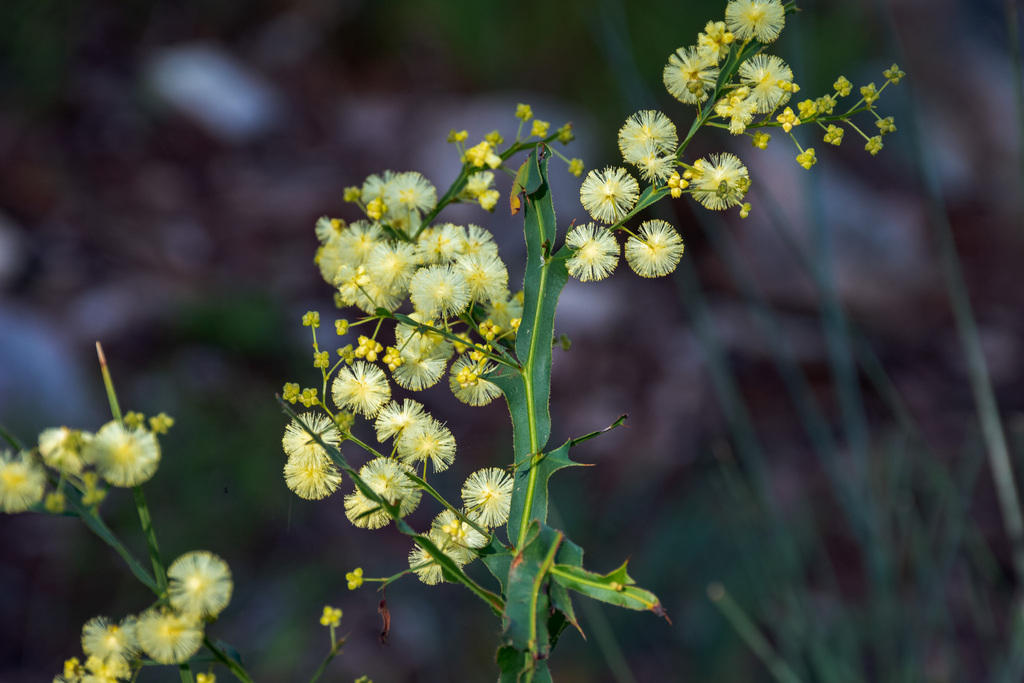
Winged Wattle
Acacia alata
Acacia alata, commonly known as winged wattle, is a species of flowering plant in the family Fabaceae and is endemic to the south-west of Western Australia. It is a much-branched shrub, its phyllodes continuous with the branches and arranged on either side of them, flowers arranged in racemes of 2 spherical heads of white to golden-yellow flowers, and flat, curved, crusty pods 20–80 mm (0.79–3.15 in) long.
From the article Acacia alata on Wikipedia (CC BY-SA), quoted section by section
Description
Acacia alata is a much-branched shrub, typically growing to a height of 0.3–2.1 m (1 ft 0 in – 6 ft 11 in) with zig-zag branches. The phyllodes are continuous with the braches and are arranged on either side of them, 2–20 mm (0.079–0.787 in) wide, but narrowest in the flower-bearing regions. The free ends of the phyllodes are 5–70 mm (0.20–2.76 in) long, sometimes with a spiny tip. There are 1 to 3 prominent glands on a triangular spur. There are 1 or 2 spherical heads of flowers in axils on a peduncle 4–12 mm (0.16–0.47 in) long, the heads with 4 to 15 white to golden-coloured flowers. Flowering time varies with variety, and the fruit is a flat, curved pod, 20–80 mm (0.79–3.15 in) long and 5–11 mm (0.20–0.43 in) wide, crust-like and densely hairy containing oblong to elliptic seeds 2.5–4.5 mm (0.098–0.177 in) long with an aril on the end.
Range & habitat
Acacia alata grows in a variety of soils near water, rocky hills, breakaways, slat pans and clay flats between Port Gregory and Albany in the Avon Wheatbelt, Geraldton Sandplains, Jarrah Forest, Swan Coastal Plain and Warren bioregions of south-western Western Australia. Variety alata often grows near creeks in forest and woodland and has a discontinuous distribution, between Perth, Collie, Cape Naturaliste and Manjimup, between Denmark and Albany, with an outlier near Three Springs. Variety biglandulosa grows in loam and sand, usually in heath, between Port Gregory and Mount Michael about 35 km (22 mi) south-east of Geraldton. Variety platyptera grows in clay, loam or gravel in gullies, hills and flats near Mogumber, and var. tetrantha usually grows near watercourses in low, open forest and woodland between Eneabba and Cervantes with a disjunct population at Yanchep.
Wikipedia: “Distribution and habitat”
Where it lives
Recorded sightings
—
geo-referenced records in GBIF, from museums, herbaria and field observers.
Drag the globe to turn it. Dots are where records exist, not a range map; darker means more records.
In the stacks
Searching the stacks…
Every page naming Acacia alata in the Biodiversity Heritage Library →
This page is assembled live from iNaturalist, GBIF, Wikipedia, the Source Library and the Internet Archive. It is not yet part of the hand-edited codex. iNaturalist taxon 145418.