- Plants
- ›Vascular Plants
- ›flowering plants
- ›Dicots
- ›Sunflowers, Bellflowers, Fanflowers, and Allies
- ›triggerplant family
- ›Stylidium
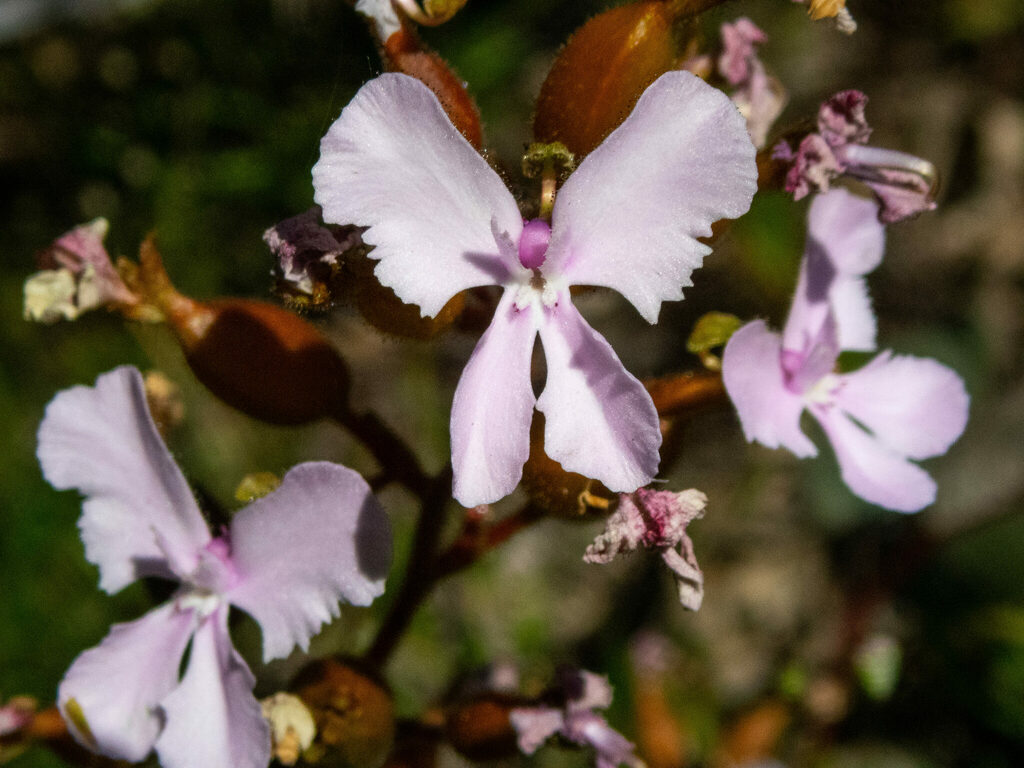
Queen Triggerplant
Stylidium affine
Stylidium affine is a species in the genus Stylidium (family Stylidiaceae) that is endemic to Western Australia.
From the article Stylidium affine on Wikipedia (CC BY-SA), quoted section by section
Description
Stylidium affine is a perennial plant that possesses long erect or recurved lanceolate leaves. Leaves are 12–30 cm (4.7–11.8 in) long, 2–4 mm wide, and arranged in groups of 2–4, emerging from a basal papery sheath, having the overall appearance of a tuft. Inflorescences are paniculate, 20–30 cm (7.9–11.8 in) long, and densely glandular. Peduncles have 1–3 flowers, which are rose pink to mauve coloured with vertically-paired corolla lobes (anterior and posterior lobes both 8–11 mm long). It has 4 throat appendages, the upper two of which are white, wing-like, and around 4 mm long. It has a diploid chromosome number of 2n=14. Stylidium affine flowers in October.
Range & habitat
Stylidium affine grows in lateritic soils often near granite outcrops in association with Eucalyptus wandoo in open woodland. It is native to an area from east of Gingin south-east to Kojonup and west to Dunsborough. In the southern part of its range, S. affine is found in open woodland in association with E. wandoo or Corymbia calophylla. Its distribution is separate and west of related species like S. caricifolium.
Wikipedia: “Distribution and habitat”
In human culture
The species now known as S. affine was first described by Robert Graham as Stylidium drummondii in an 1841 volume of the Edinburgh New Philosophical Journal. Graham based his new species description on plants raised from seed that were sent from James Drummond to a Mr Low of Clapton, England. Mr Low sent a plant to Graham in October 1839. The specimen first flowered in November 1840. The exact provenance of the seed sent to Mr Low is not explicitly stated by Graham in his description, but it is speculated that the seed came from Drummond's travels in the Swan, Avon, Helena, and Toodyay valleys, which are within the bounds of the known distribution of S. affine. In 1845, Otto Wilhelm Sonder published the name Stylidium affine. Since then, it has been used in multiple publications including Johannes Mildbraed's 1908 taxonomic monograph on the family, whereas S. drummondii has only been used sparingly. While preparing a revision of the family for the Flora of Australia series, Juliet Wege discovered that the description and illustration of S. drummondii is synonymous with and antedates that of S. affine, thus making S. drummondii the proper name for the species under strict priority nomenclature rules regulated by the International Code of Botanical Nomenclature (ICBN). Citing the extensive use of S. affine over S. …
Wikipedia: “Taxonomy and botanical history”
Where it lives
Recorded sightings
—
geo-referenced records in GBIF, from museums, herbaria and field observers.
Drag the globe to turn it. Dots are where records exist, not a range map; darker means more records.
In the stacks
Searching the stacks…
Every page naming Stylidium affine in the Biodiversity Heritage Library →
This page is assembled live from iNaturalist, GBIF, Wikipedia, the Source Library and the Internet Archive. It is not yet part of the hand-edited codex. iNaturalist taxon 145501.