- Plants
- ›Vascular Plants
- ›flowering plants
- ›Dicots
- ›myrtles, evening primroses, and allies
- ›myrtle family
- ›Myrtoideae
- ›Chamelaucieae
- ›Chamelauciinae
- ›Darwinia
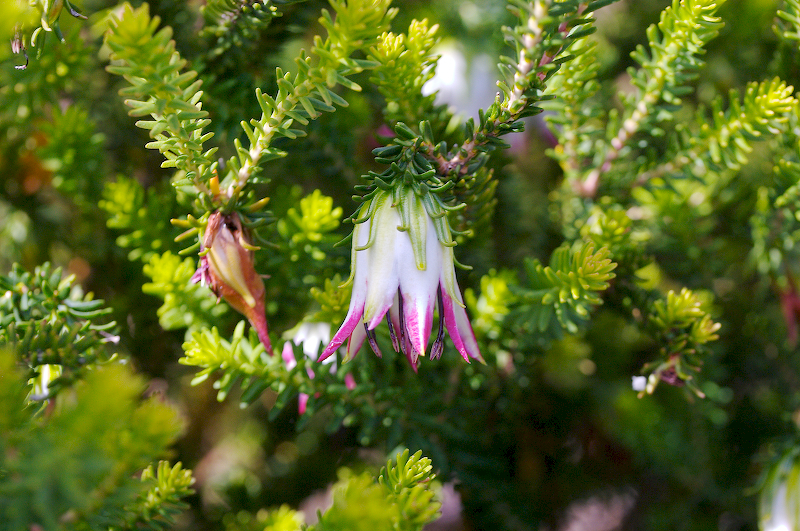
Cranbrook Bell
Darwinia meeboldii
Darwinia meeboldii (Cranbrook Bell) is a shrub which is endemic to the south-west of Western Australia. It has an erect and straggly habit, growing to between 0.5 and 3 metres high. The bracts around the flowers form a pendent "bell" which is usually white with red tips. A group of 8 small flowers are concealed inside. These are primarily produced between August and November.
From the article Darwinia meeboldii on Wikipedia (CC BY-SA), quoted section by section
Description
Darwinia meeboldii is an erect, spindly shrub that typically grows to a height of 0.5–3 m (1 ft 8 in – 9 ft 10 in). It has erect, crowded leaves up to about 10 mm (0.39 in) long and 2 mm (0.079 in) wide. The flowers are small and pendent, arranged in groups of 8 surrounded by relatively large red, white and green bracts. Flowering occurs between August and November.
Range & habitat
Cranbrook bell occurs on peaty soils on slopes in the western part of the Stirling Range National Park.
Wikipedia: “Distribution and habitat”
How it is grown
The species requires good drainage and protection from direct sun. It is difficult to propagate from seed, but cuttings strike readily. Grafting on stocks of Darwinia citriodora may be carried out in areas with unsuitable growing conditions including high humidity.
== References ==
Wikipedia: “Use in horticulture”
Where it lives
Recorded sightings
—
geo-referenced records in GBIF, from museums, herbaria and field observers.
Drag the globe to turn it. Dots are where records exist, not a range map; darker means more records.
In the stacks
Searching the stacks…
Every page naming Darwinia meeboldii in the Biodiversity Heritage Library →
This page is assembled live from iNaturalist, GBIF, Wikipedia, the Source Library and the Internet Archive. It is not yet part of the hand-edited codex. iNaturalist taxon 145508.