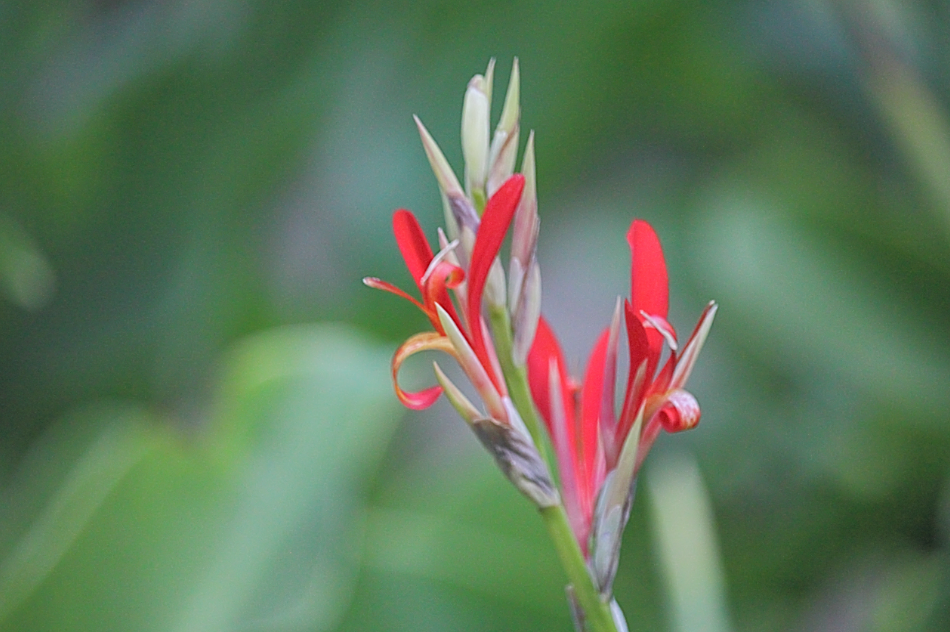
Indian shot
Canna indica
Canna indica, commonly known as Indian shot, African arrowroot, edible canna, purple arrowroot, Sierra Leone arrowroot, is a plant species in the family Cannaceae. It is native to much of South America, Central America, the West Indies, Mexico, and the southeastern United States (Florida, Texas, Louisiana, and South Carolina). It is also naturalized in much of Europe, sub-Saharan Africa, Southeast Asia, and Oceania.
From the article Canna indica on Wikipedia (CC BY-SA), quoted section by section
Description
Canna indica is a perennial growing to between 0.5 and 2.5 metres (1+1⁄2 and 8 feet), depending on the variety. It is hardy to zone 10 and is frost tender. The plants form an upright, unbranched stem or the overlapping leaf sheaths form a pseudo trunk. It forms branched rhizomes 60 centimetres (24 inches) long that are divided into bulbous segments and covered in two lines by pale green or purple flaky leaves. The surface of the rhizome is carved by transverse grooves, which mark the base of scales that cover it. From the lower part white and apex rootlets emerge, where there are numerous buds, the leaves sprout, the floral stem and the stems. The very large grains of starch can supposedly be seen with the naked eye. The alternate and spiral or two-line arranged, very large, simple leaves are divided into leaf sheaths, short petioles and leaf blades. The leaf blade has a length of 30 to 60 cm (12 to 24 in) and a width of 10 to 20 cm (4 to 8 in). The parallel leaf veins arise from the midrib (not typical of monocots). The leaves are broad, green or violet green, with elliptical sheets, which can measure 30 to 60 cm (12 to 24 in) long and 10 to 25 cm (3.9 to 9.8 in) wide, with the base obtuse or narrowly cuneate and the apex is shortly acuminate or sharp.
Flowers. The flowers are hermaphrodite. The mostly large flowers are zygomorphic and threefold. …
Range & habitat
Canna indica is native to much of South America: Colombia, Venezuela, Ecuador, Peru, Brazil, Uruguay and Argentina as well as the West Indies and Central America. In modern times, it is also naturalized in the southeastern United States (Florida, Texas, Louisiana, and South Carolina), and much of Europe, sub-Saharan Africa, Southeast Asia, and Oceania. C. indica is reportedly naturalized in Austria, Portugal, Spain, Azores, Canary Islands, Cape Verde, Madeira, most of tropical Africa, Ascension Island, St. Helena, Madagascar, China, Japan, Taiwan, the Bonin Islands, India, Nepal, Sri Lanka, Cambodia, Laos, Thailand, Vietnam, Burma, Java, Malaysia, the Philippines, Christmas Island, the Bismarck Archipelago, Norfolk Island, New South Wales, Queensland, Fiji, Tonga, Vanuatu, Kiribati, the Cook Islands, the Society Islands, the Caroline Islands and Hawaii. Canna can be cultivated from sea level to 2,700 m (8,860 ft) above sea level, but thrives in temperate, tropical or subtropical mountain climates, between 1,000 and 2,000 m (3,280 and 6,560 ft) above sea level (in humid tropical climates for higher elevations) at a mean temperature of 14 to 27 °C. The plant prefers a mean annual rainfall between 1,000–4,500 millimetres (3+1⁄2–15 ft), but it can tolerate 500–5,000 mm per year. Canna prefers light sandy-loamy soils, but can also grow on heavy soils, as far as they are not wet. …
Wikipedia: “Distribution and habitat”
At the table
The edible rhizomes consist of 73% water. In addition to 24% starch, they still contain 1% protein, 0.6% crude fiber and 1.4% minerals. They can be eaten raw, but are usually baked. Cooked, the rhizomes become translucent, mucilaginous, and sweet. Starch is produced by grinding or pounding the roots and soaking them in water, separating the starch granules from fibers in the roots. The starch granules of C. indica are also translucent and the largest known from any plant. The starch is occasionally marketed commercially as "arrowroot", a name also applied to the starch of other similar roots crops such as Maranta arundinacea. It was an ingredient in mid-19th-century recipes such as cakes and was called tous-les-mois. The starch is easily digestible and therefore well suited as a health and baby food. The starch is also suitable for baking. In South America, the leaves are used to wrap pastries (tamales, humitas, quimbolitos, juanes, etc.), similar to banana leaves or maize leaves. In Colombia, Achira cakes, breads, and cookies are traditional, typical in the south-central part of the country, specifically in the departments of Huila and Tolima.
History. …
Wikipedia: “Culinary”
How it is grown
Canna indica (achira) has been cultivated by indigenous peoples of the Americas in tropical America for thousands of years. The place of the first domestication may have been the northern Andes, as may be true of other similar root crops such as Calathea allouia and M. arundinacea. The Cauca River valley of Colombia was a center of early domestication. Archaeological evidence has been found of the cultivation of achira in 3000 BCE by people of the Las Vegas culture of coastal Ecuador. As the Las Vegas region is arid and semiarid, achira was not likely a native plant, but imported from more humid climates. Achira was also being cultivated by 2000 BCE by the people of the Casma/Sechin culture in the extremely arid region of coastal Peru, also an area in which achira was probably not native.
Field and climate requirements. Canna indica requires a growing substrate which is rich, humiferous, and light. The optimal substrate consists of a deep, rich and well-drained soil in a sunny place with a pH between 5.5 and 7.5. The rhizomes are planted at 10 cm deep, after the last frost. Although it can tolerate dry periods, occasional irrigation is beneficial for yield. C. indica is a plant that can withstand low temperatures (down to -10 °C in regions with a mild climate). Nevertheless, the foliage can already be affected at 0 °C.
Propagation. …
Wikipedia: “Cultivation”
Where it lives
Recorded sightings
—
geo-referenced records in GBIF, from museums, herbaria and field observers.
Drag the globe to turn it. Dots are where records exist, not a range map; darker means more records.
In the old herbals & bestiaries

Introductio Generalis in Rem Herbariam
Augustus Quirinus Rivinus · 1690 · p.196

Introductio Generalis in Rem Herbariam
Augustus Quirinus Rivinus · 1690 · p.197

Introductio Generalis in Rem Herbariam
Augustus Quirinus Rivinus · 1690 · p.198

History of the Plants of New Spain, Volume 3
Francisco Hernández (1517-1587) · 1946 · p.51

Rariorum Plantarum Historia (with Fungorum Historia)
Carolus Clusius · 1601 · p.463

History of Rare Plants
Carolus Clusius · 1601 · p.457

Hortus Eystettensis
Basilius Besler · 1640 · p.354

Hortus Eystettensis
Basilius Besler · 1640 · p.355

De Indiae utriusque re naturali et medica
Willem Piso · 1658 · p.240

Illustrated Investigation of the Names and Realities of Plants (Volume 25)
吳其濬 · 1848 · p.41
In the stacks
Searching the stacks…
Every page naming Canna indica in the Biodiversity Heritage Library →
This page is assembled live from iNaturalist, GBIF, Wikipedia, the Source Library and the Internet Archive. It is not yet part of the hand-edited codex. iNaturalist taxon 146643.