- Animals
- ›Molluscs
- ›Gastropods
- ›Heterobranchs
- ›Euthyneura
- ›Tectipleura
- ›Eupulmonata
- ›Common Land Snails and Slugs
- ›Helicina
- ›Helicoidei
- ›Helicoidea
- ›Camaenidae
- ›Camaeninae
- ›Amphidromus
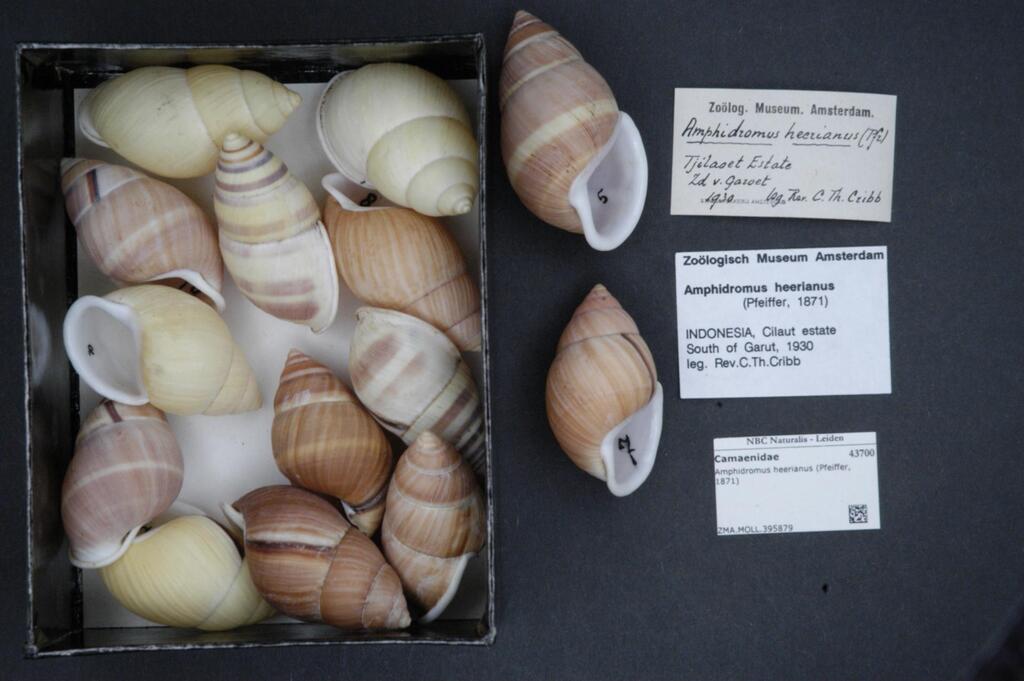
Amphidromus javanicus
Amphidromus javanicus is a species of large-sized air-breathing tree snail, an arboreal gastropod mollusk in the family Camaenidae.
It is closely related to Cambodian, Thailand's, and Laos's Amphidromus xiengensis. This explains the [color similarities of the two species.
From the article Amphidromus javanicus on Wikipedia (CC BY-SA), quoted section by section
Description
This snail is known for its vibrant, helicoid shell, typically 3–5 cm long. This is the common size, but the size depends on the snail's environment. Its shell is light brown with dark brown stripes and medium stripes in the middle. The shell can be either sinistral or dextral, imperforate or nearly so, and solid, presenting an ovate-pyramidal shape. Its surface is closely streaked with dull crimson, chestnut, and blackish markings on an olivaceous buff, ochre-tinted, or livid ground, with the streaks often breaking into a mottled pattern. The early whorls and a border below the sutures appear white, pink, or pale. Several blackish varices, followed by whitish streaks, are generally present, but inconspicuous within the overall streaked pattern. The surface is glossy and distinctly striate. The spire appears rather straightly conic; comprising six to seven and a half slightly and equally convex whorls, separated by moderately impressed sutures marked with a white hairline. The aperture is but slightly oblique and ovate, appearing bluish inside. The peristome is white, expanded, and subreflexed with a blunt edge; the columella is nearly straight; and the parietal callus is white and deeply entering.
Wikipedia: “Characteristics”
Range & habitat
Java, Indonesia but it is most commonly found in Northwest Java near Depok and in Depok.
Wikipedia: “Distribution”
What it does
This snail's behaviour varies from season to season. They regularly appear during the wet season right after rain occurs, but in the time periods, wet season or not, where there isn't rain or when it is not right after rain, they will hide under rocks and wooden sticks, and some might even burrow underground to avoid drying up. These snails form a substance around their shell in order to keep moisture inside.
Wikipedia: “Behaviour”
Where it lives
Recorded sightings
—
geo-referenced records in GBIF, from museums, herbaria and field observers.
Drag the globe to turn it. Dots are where records exist, not a range map; darker means more records.
In the stacks
Searching the stacks…
Every page naming Amphidromus javanicus in the Biodiversity Heritage Library →
This page is assembled live from iNaturalist, GBIF, Wikipedia, the Source Library and the Internet Archive. It is not yet part of the hand-edited codex. iNaturalist taxon 1467366.