- Plants
- ›Vascular Plants
- ›flowering plants
- ›Dicots
- ›Woodsorrels, Quandongs, and Allies
- ›Woodsorrel Family
- ›Averrhoa
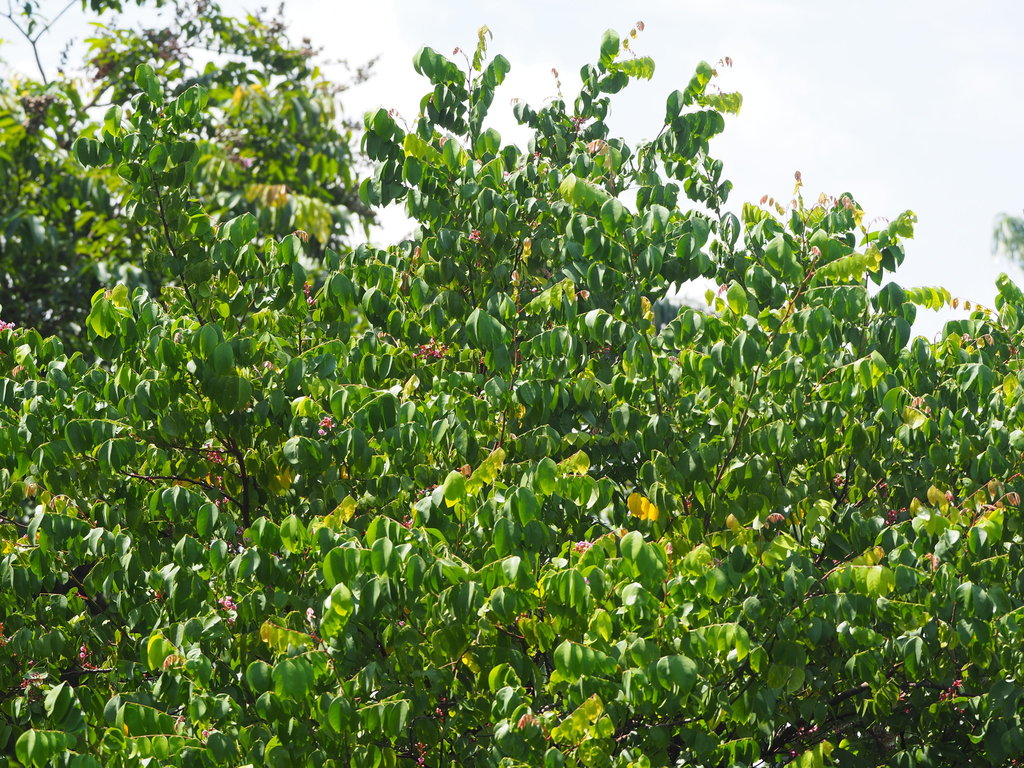
Starfruit
Averrhoa carambola
Averrhoa carambola is a species of tree in the family Oxalidaceae native to tropical Southeast Asia; it has a number of common names, including carambola, star fruit and five-corner. It is a small tree or shrub that grows 5 to 12 m (16 to 39 ft) tall, with rose to red-purple flowers. The flowers are small and bell-shaped, with five petals that have whitish edges. The flowers are often produced year round under tropical conditions. The tree is cultivated in tropical and semitropical regions for its edible fruits.
From the article Averrhoa carambola on Wikipedia (CC BY-SA), quoted section by section
Description
Averrhoa carambola is a small, slow-growing evergreen tree with a short-trunk or a shrub. The branches are drooping and the wood is white and turns reddish. It has a bushy shape with many branches producing a broad, rounded crown. The compound leaves are soft, medium-green, they are spirally arranged around the branches in an alternate fashion. The pinnate leaves have a single terminal leaflet and 5 to 11 nearly opposite leaflets, each leaf is 15–20 cm long, and the 3.8–9 cm long leaflets are ovate or ovate-oblong in shape. The top sides of the leaves are smooth and the undersides are finely hairy and whitish. The leaflets are reactive to light and tend to fold together at night, they are also sensitive to abrupt shock and when shaken tend to close up also. The lilac or purple-streaked, downy, flowers are produced in the axils of leaves at the end of twigs. The flowers are arranged in small clusters on the ends of the branches or sometimes on the larger stems and trunk, each cluster is attached to the tree with red stalks. The bell-shaped, perfect flowers, are produced in loose panicles that are much-branched with pedicellate flowers; each flower is around 6 mm wide, with five petals that have recurved ends. The fruits are showy with an oblong shape: they are longitudinally five to six-angled and 6.35–15 cm long and up to 9 cm wide. …
Range & habitat
The center of diversity and the original range of Averrhoa carambola is tropical Southeast Asia, where it is cultivated since ancient times. It might have been introduced to the Indian subcontinent and Sri Lanka by Austronesian traders, along with ancient Austronesian cultigens like langsat, and santol. It is native to Southeast Asia, however, because this plant is not found in the wild it is difficult to pinpoint where exactly it originated.
Wikipedia: “Distribution”
At the table
Averrhoa carambola is best known as the star fruit, as it is best known for the star-like shape it has when cut. In addition to being eaten, the fruit is used in traditional Asian medicine to treat chickenpox, intestinal parasites, headaches, and other illnesses. Star fruit contains oxalate, too much of which can be dangerous. Starfruit juice can be used to remove stains from linen.
Cultivation. Averrhoa carambola has a number of different forms differing in fruit taste, texture, and shape, some are very acidic and others are sweet. The plant is grown in Malaysia and Taiwan, with smaller concentrations in Thailand, Israel, The United States, Brazil, Philippines, China, Australia, Indonesia and the warmer parts of India and other areas of the world with the same climate. It has become a commercial crop in many of these locations, grown for its edible fruits. The flowers need cross-pollination to produce fruit, thus seed raised plants are variable. Plants may flower and bear fruit in about a year after seed germination. Larger plants may bloom year-round in tropical areas as long as environmental conditions are suitable, plants may have flowers, unripe and ripe fruit at the same time. Under other climate and environmental conditions, plants tend to bloom in spring, and then off and on again during the rest of the year. …
Wikipedia: “Uses”
Toxicity
Like several other plants of the family Oxalidaceae, its fruits are rich in oxalic acid, which is toxic in high concentrations. There have been reports of intoxication in dialysis and uremic patients caused by a neurotoxin called caramboxin present in the fruit. Such toxin is normally filtered by the kidneys, but patients in dialysis or suffering from kidney deficiencies may show severe symptoms, in a few cases fatal, after drinking the fruit juice.
== References ==
Wikipedia: “Toxicology”
Where it lives
Recorded sightings
—
geo-referenced records in GBIF, from museums, herbaria and field observers.
Drag the globe to turn it. Dots are where records exist, not a range map; darker means more records.
In the old herbals & bestiaries


In the stacks
Searching the stacks…
Every page naming Averrhoa carambola in the Biodiversity Heritage Library →
This page is assembled live from iNaturalist, GBIF, Wikipedia, the Source Library and the Internet Archive. It is not yet part of the hand-edited codex. iNaturalist taxon 146977.