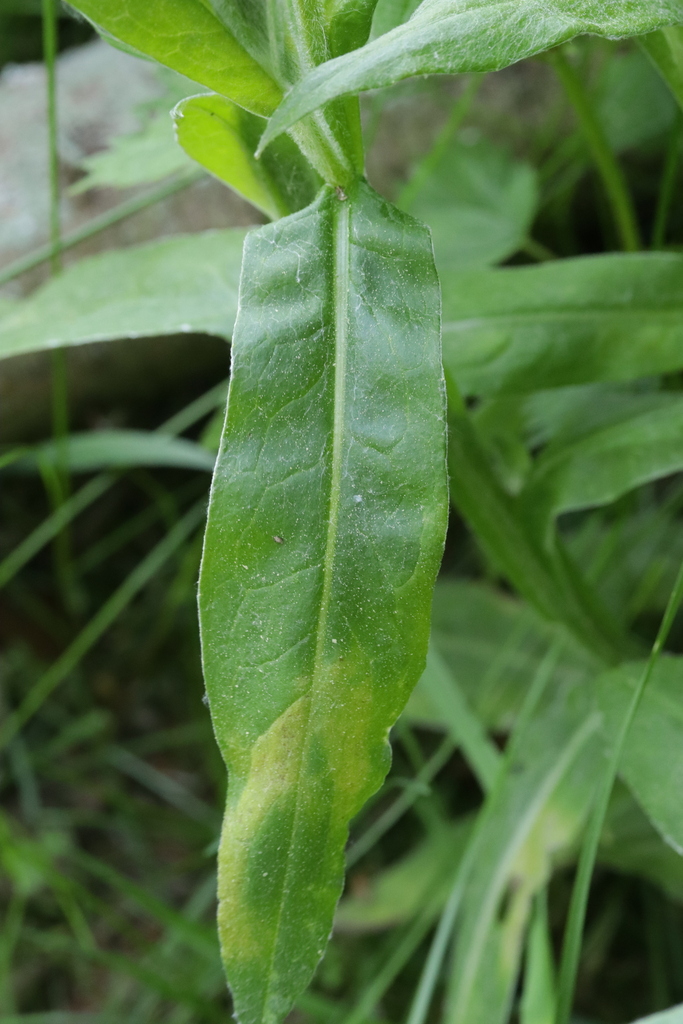
Bremia centaureae
Bremia lactucae is a plant pathogen. This microorganism causes a disease of lettuce (Lactuca sativa) denominated as downy mildew. Some other strains can be found on 36 genera of Asteraceae including Senecio and Sonchus. Experiments using sporangia from hosts do not infect lettuce and it is concluded that the fungus exists as a quantity of host-specific strains (formae speciales). Wild species, such as Lactuca serriola, or varieties of Lactuca can hold strains that infect lettuce, but these pathogens are not sufficiently common to seriously infect the plant.
The severity of damage caused by Bremia can vary depending on environmental conditions. High humidity and cool temperatures are optimal for infection and spread of the disease.
From the article Bremia lactucae on Wikipedia (CC BY-SA), quoted section by section
Description
Coarse intercellular mycelium. Haustoria are sac-shaped, many times they are present in each host cell. Sporangiophores emerge singly or in small groups through the stomata and branch dichotomously. Tip of each branch expands to form a cup-shaped disc bearing short cylindrical sterigmata at the margin and occasionally in the centre, and from these the hyaline sporangia arise. Germination of the sporangia is usually by means of a germ tube which forms an appressorium to penetrate epidermal cells or it enters through a stoma. Zoospore formation has been reported but not confirmed. Sexual reproduction is usually heterothallic, but homothallic strains also exist. Oospores are formed in leaf tissue and remain viable for 12 months.
Where it lives
Recorded sightings
—
geo-referenced records in GBIF, from museums, herbaria and field observers.
Drag the globe to turn it. Dots are where records exist, not a range map; darker means more records.
In the stacks
Searching the stacks…
Every page naming Bremia centaureae in the Biodiversity Heritage Library →
This page is assembled live from iNaturalist, GBIF, Wikipedia, the Source Library and the Internet Archive. It is not yet part of the hand-edited codex. iNaturalist taxon 1471137.