- Plants
- ›Vascular Plants
- ›flowering plants
- ›monocots
- ›Aroids, Water Plantains, Seagrass, and allies
- ›Arum Family
- ›Skunk Cabbages and Golden-clubs
- ›Lysichiton
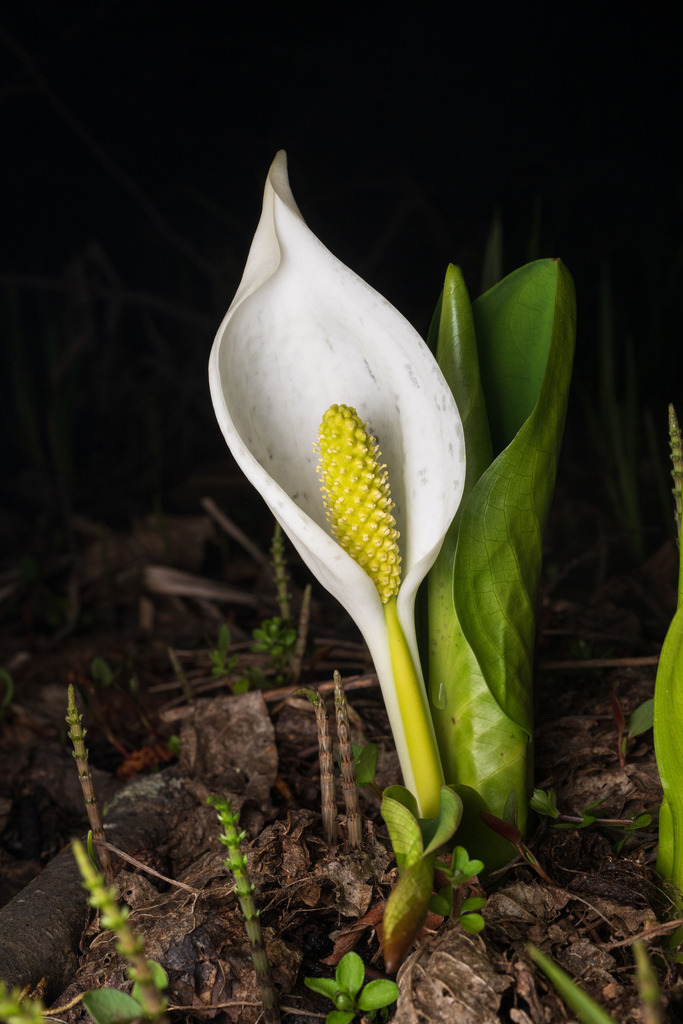
White Skunk Cabbage
Lysichiton camtschatcensis
Lysichiton camtschatcensis, common name Asian skunk cabbage, white skunk cabbage, Far Eastern swamp lantern or Japanese swamp lantern, is a plant found in swamps and wet woods, along streams and in other wet areas of the Kamchatka Peninsula, the Kuril Islands, Sakhalin and northern Japan. The common name "skunk cabbage" is used for the genus Lysichiton, which includes L. americanus, the western skunk cabbage, noted for its unpleasant smell. The Asian skunk cabbage is more variable: plants have been reported in different cases to smell disgusting, not at all, and sweet. In Japanese it is known as mizubashō (lit. "water-banana") from a supposed similarity to the Japanese banana, a name with poetic rather than malodorous associations. It is not closely related to the true cabbage.
From the article Lysichiton camtschatcensis on Wikipedia (CC BY-SA), quoted section by section
Description
It is a robust herbaceous perennial growing to 75 cm (30 in) tall and wide, with strongly veined, glossy leaves 50–100 cm (20–40 in) long. In early spring each plant produces a fragrant, pointed white spathe up to 40 cm (16 in) long, surrounding a green spadix.
How it is grown
Like its close relative, L. americanus, it is used as a marginal aquatic plant in gardens in Great Britain and Ireland. It has gained the Royal Horticultural Society's Award of Garden Merit. Hybrids between L. camschatcensis and L. americanus, called Lysichiton × hortensis, are also cultivated. These have larger spathes than either of the parents.
Wikipedia: “Cultivation”
Where it lives
Recorded sightings
—
geo-referenced records in GBIF, from museums, herbaria and field observers.
Drag the globe to turn it. Dots are where records exist, not a range map; darker means more records.
In the stacks
Searching the stacks…
Every page naming Lysichiton camtschatcensis in the Biodiversity Heritage Library →
This page is assembled live from iNaturalist, GBIF, Wikipedia, the Source Library and the Internet Archive. It is not yet part of the hand-edited codex. iNaturalist taxon 147285.