- Plants
- ›Vascular Plants
- ›flowering plants
- ›Dicots
- ›Mustards, Capers, and Allies
- ›mustard family
- ›Brassicoideae
- ›Brassicodae
- ›Thelypodieae
- ›Hesperidanthus
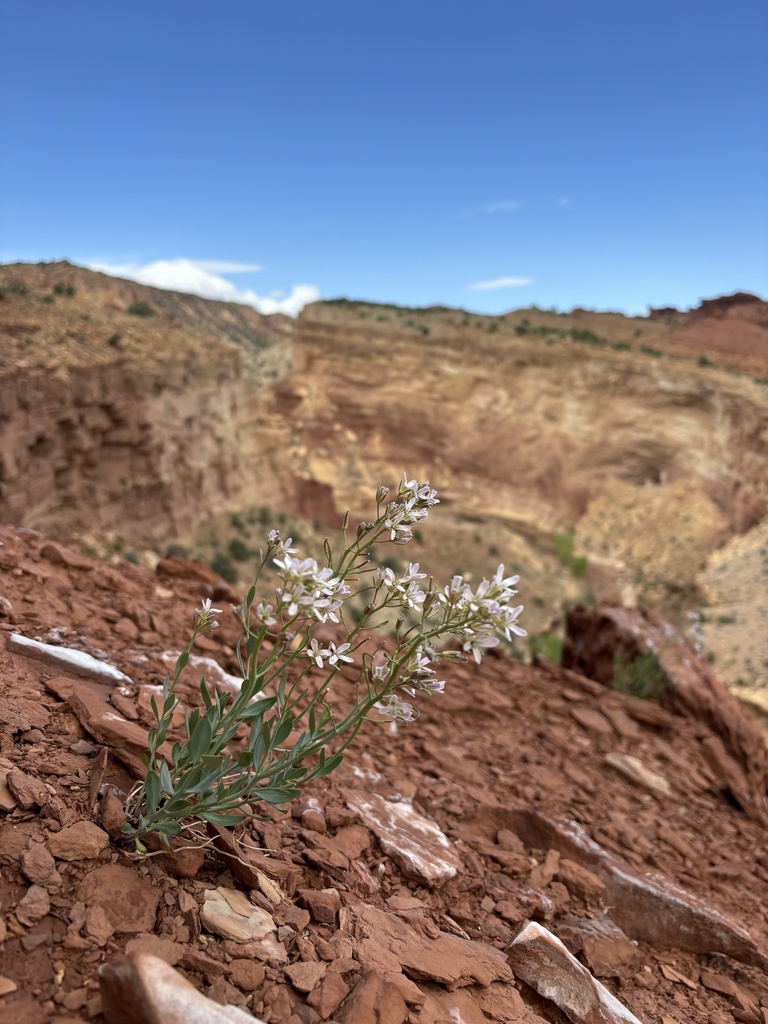
Barneby reed-mustard
Hesperidanthus barnebyi
Hesperidanthus barnebyi, syn. Schoenocrambe barnebyi, is a species of flowering plant in the mustard family, known by the common names Barneby reed-mustard, Syes Butte plainsmustard, and Barneby thelypody. It is endemic to Utah in the United States, where it is known only from Emery and Wayne Counties. It is threatened by habitat degradation and destruction. It is federally listed as an endangered species of the United States.
This is a perennial herb with multiple erect stems growing 10 to 38 centimeters tall from a caudex. The leaves are oblong or oval in shape with smooth or slightly toothed edges, the blades measuring up to 5 centimeters in length. The inflorescence is a raceme of mustardlike flowers. Each flower has green or purple sepals and four white or pale purple petals with purple veining, each petal measuring about a centimeter long. The fruit is a curved silique roughly 2 to 5 centimeters long.
Where it lives
Recorded sightings
—
geo-referenced records in GBIF, from museums, herbaria and field observers.
Drag the globe to turn it. Dots are where records exist, not a range map; darker means more records.
In the stacks
Searching the stacks…
Every page naming Hesperidanthus barnebyi in the Biodiversity Heritage Library →
This page is assembled live from iNaturalist, GBIF, Wikipedia, the Source Library and the Internet Archive. It is not yet part of the hand-edited codex. iNaturalist taxon 148423.