- Plants
- ›Vascular Plants
- ›flowering plants
- ›Dicots
- ›Buttercups, Poppies, and Allies
- ›buttercup family
- ›Columbines and Meadow-Rues
- ›Aquilegia
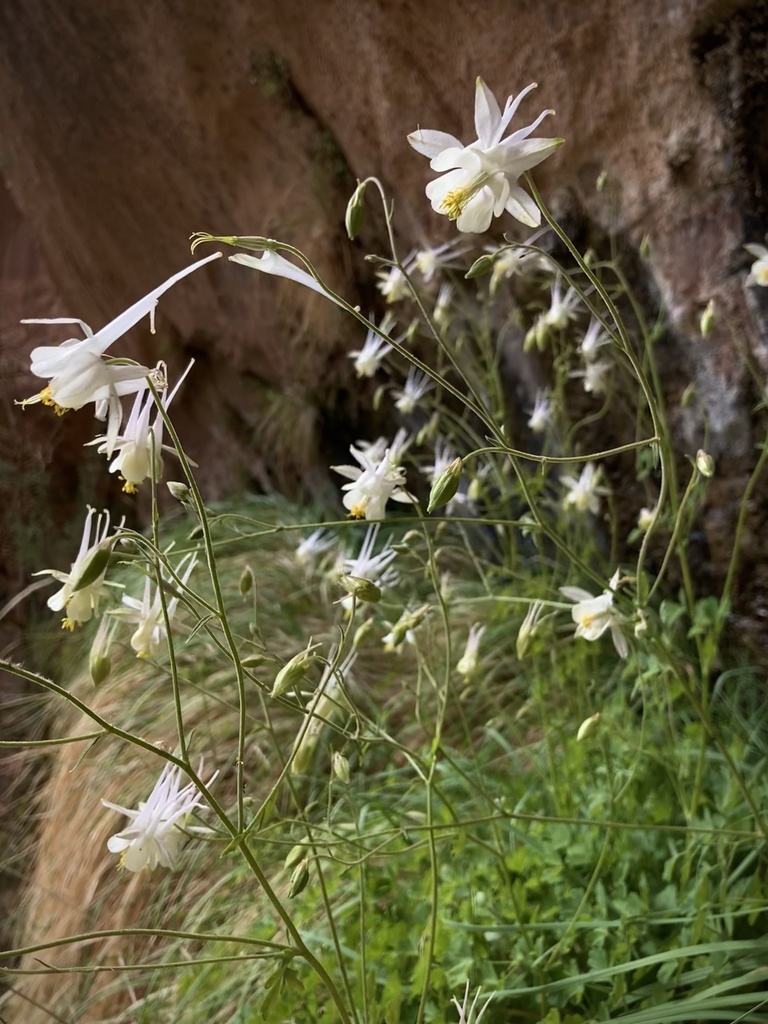
alcove columbine
Aquilegia micrantha
Aquilegia micrantha, the Mancos columbine or Bluff City columbine, is a perennial species of flowering plant in the family Ranunculaceae. It is native to Utah, Colorado, and Arizona. The species grows to between 30 cm (12 in) and 60 cm (24 in) tall and produces flowers that can be white, cream, blue, or pink. The species's flowers bloom during the spring and summer, from April to September. Also known as the alcove columbine, the species can be found on the on steep stone walls in the hanging gardens of the Colorado Plateau and Canyonlands.
A. micrantha was used as a medicinal herb by the Navajo and Kayenta peoples. It was first described by the American botanist Alice Eastwood, who initially discovered a spurless variety (Aquilegia micrantha var. mancosana) of the species in 1891.
From the article Aquilegia micrantha on Wikipedia (CC BY-SA), quoted section by section
Description
Aquilegia micrantha is a perennial herb in the Aquilegia (columbine) genus of the Ranunculaceae family. The species features substantial variance. The stems grow to between 30 cm (12 in) and 60 cm (24 in) in height and between 1 mm (0.039 in) and 3 mm (0.12 in) thick. The leaves projecting from the base of the stem are bi- or triternately compound. Both the stems and the leaves can be slightly hairy. Aquilegia flowers possess five sepals and five petals. In the wild, A. micrantha flowers bloom during the spring and summer, with blooms spanning between April and September. These flowers are nodding or erect and can have white, cream, blue, or pink sepals. The American botanist Philip A. Munz reported that reddish sepals had also been observed. The sepals measure from 8 mm (0.31 in) to 20 mm (0.79 in) in length. The blades are white or cream and 6 mm (0.24 in) to 10 mm (0.39 in) long. The stamens extend beyond the blades by between 3 mm (0.12 in) and 5 mm (0.20 in). The nectar spurs are 15 mm (0.59 in) to 30 mm (1.2 in) long and straight with the tips of the spurs curving inward. They are white or colored like the sepals. A spurless form of the species, Aquilegia micrantha var. mancosana, is also known. The flowers of Aquilegia plants are all bisexual. Fruiting in the genus produces cylindrical follicles. On A. …
Range & habitat
Aquilegia micrantha is endemic to the Southwestern United States (southeastern Utah, southwestern Colorado, and extreme northern Arizona). The species grows only on hanging gardens in the canyons of the Colorado Plateau and Canyonlands where alkaline water seeps from the bases of cliffs. Its favored elevations are between 1,000 m (3,300 ft) and 2,500 m (8,200 ft). This range places it within the ecological environment known as the juniper belt. Due to a lack of any genetic barriers to hybridization in Aquilegia, the species hybridize wherever their ranges overlap. Hybridization occurs with A. elegantula on the eastern limits of A. micrantha's range.
Conservation. As of 2025, Plants of the World Online – utilizing the Angiosperm Extinction Risk Predictions v1 – predicted the extinction risk for Aquilegia micrantha as "not threatened" with a confidence level of "confident". The plant's NatureServe conservation status – last reviewed in 1984 – is G5, meaning its global population is considered "secure". The population of A. micrantha in Colorado was simultaneously evaluated and has a status of S5, identifying it also as "secure".
Wikipedia: “Distribution and habitat”
What it does
A study published in 1983 on pollination of Aquilegia micrantha in the upper Crystal River Canyon in Colorado identified several pollinators. The most effective pollinators observed were bumblebee queens of the species Bombus appositus and Bombus flavifrons which sought nectar from A. micrantha. Hummingbirds and hawkmoths also visited A. micrantha plants, with hummingbirds known to be the most important pollinators at other sites. The study speculated that the infrequency in bumblebees visiting red-flowered Aquilegia elegantula plants was a mechanism to prevent hybridization between them and A. micrantha.
Wikipedia: “Ecology”
At the table
Aquilegia micrantha has been used by the Navajo and Kayenta peoples to assist in childbirth.
Wikipedia: “Uses”
Where it lives
Recorded sightings
—
geo-referenced records in GBIF, from museums, herbaria and field observers.
Drag the globe to turn it. Dots are where records exist, not a range map; darker means more records.
In the stacks
Searching the stacks…
Every page naming Aquilegia micrantha in the Biodiversity Heritage Library →
This page is assembled live from iNaturalist, GBIF, Wikipedia, the Source Library and the Internet Archive. It is not yet part of the hand-edited codex. iNaturalist taxon 149001.