- Plants
- ›Vascular Plants
- ›flowering plants
- ›Dicots
- ›Roses, Elms, Figs, and Allies
- ›rose family
- ›Dryadoideae
- ›Cercocarpus
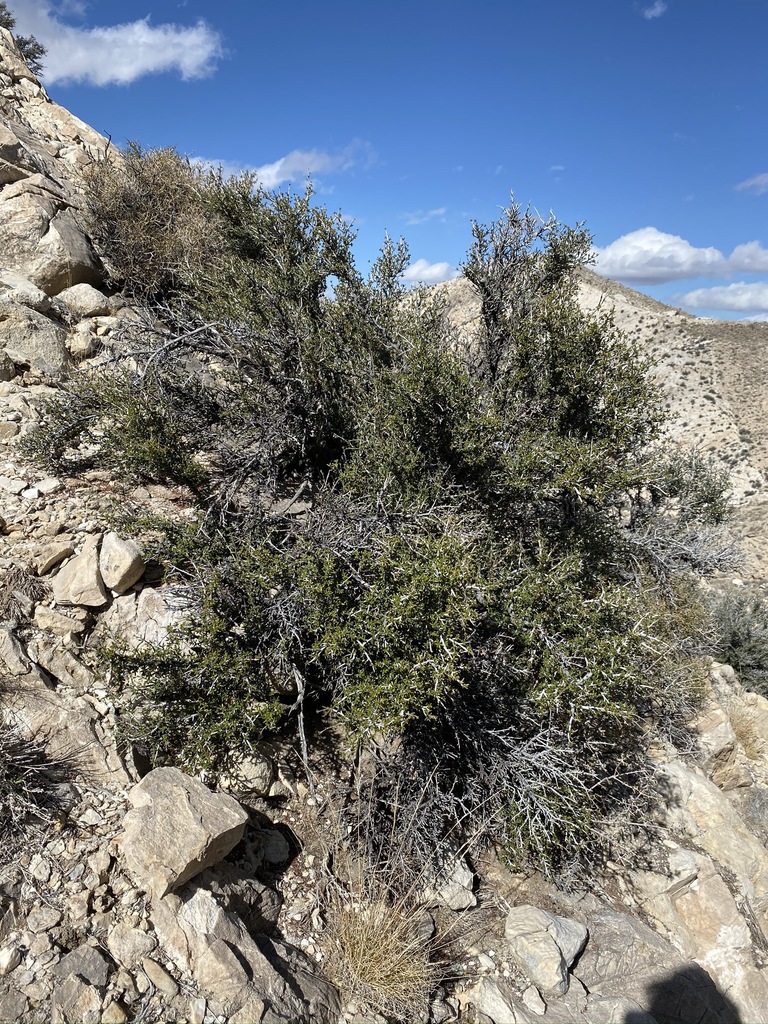
Littleleaf Mountain Mahogany
Cercocarpus intricatus
Cercocarpus ledifolius var. intricatus (little-leaf mountain mahogany, narrowleaf mahogany,: 3 dwarf mountain mahogany: 152 ) is a variety of Cercocarpus ledifolius that is commonly known as little-leaf mountain mahogany.
From the article Cercocarpus ledifolius var. intricatus on Wikipedia (CC BY-SA), quoted section by section
Description
Cercocarpus ledifolius var. intricatus is a thickly branched shrub spreading and growing erect to heights between one and three meters. The many short gray twigs on the branches bear tiny, widely spaced evergreen leaves. Each thick, short leaf is a centimeter long or less, rolled under at the edges, and leathery in texture. The inflorescence has two or three flowers. Each flower is a tiny cup merely a few millimeters wide containing several protruding stamens and one pistil. The style remains after the rest of the flower falls away. It is feathery and up to two centimeters long, with the fruit, an achene, at the tip.
Range & habitat
Cercocarpus ledifolius var. intricatus is native to the Southwestern United States, from California to Colorado, where it grows in mostly dry habitat such as deserts. It can be found in rocky places and slopes of mountain brush, pinyon juniper woodland, and ponderosa pine forest vegetation types.
Wikipedia: “Distribution”
At the table
The Navajo have traditionally produced a reddish-brown vegetable dye from the deep-red bark extracted from the tap-root of the plant, which they used to dye woolen yarns.
Wikipedia: “Uses”
Where it lives
Recorded sightings
—
geo-referenced records in GBIF, from museums, herbaria and field observers.
Drag the globe to turn it. Dots are where records exist, not a range map; darker means more records.
In the stacks
Searching the stacks…
Every page naming Cercocarpus intricatus in the Biodiversity Heritage Library →
This page is assembled live from iNaturalist, GBIF, Wikipedia, the Source Library and the Internet Archive. It is not yet part of the hand-edited codex. iNaturalist taxon 149005.