- Plants
- ›Vascular Plants
- ›flowering plants
- ›Dicots
- ›Roses, Elms, Figs, and Allies
- ›rose family
- ›Amygdaloideae
- ›Neillieae
- ›Physocarpus
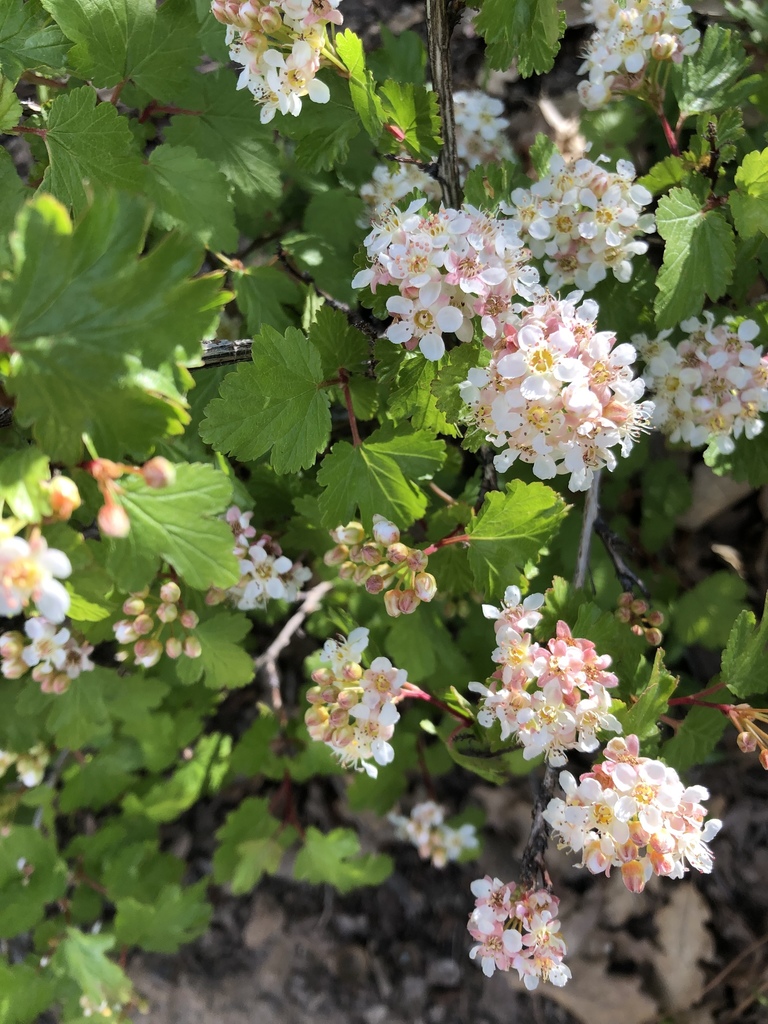
mountain ninebark
Physocarpus monogynus
Physocarpus monogynus, the mountain ninebark or low ninebark, is a flowering shrub of western North America.
From the article Physocarpus monogynus on Wikipedia (CC BY-SA), quoted section by section
Description
The Physocarpus monogynus plant reaches 1.2 meters (3.9 feet) in height and somewhat more in width. The leaves are dull green above and paler below, with 3 to 5 doubly toothed lobes, so they suggest big currant (Ribes) leaves. The bark is brownish and shreds, revealing many layers, hence the name "ninebark" (Elmore 1976). In May or June, mountain ninebark bears "rather lovely" white or rose-colored flowers, with five petals based in a cup-like structure. The flowers have one style, the meaning of "monogynus" (literally "one female part"). They turn red-brown and stay on the plant into the winter. The seed pods are inflated and covered with white hairs (Elmore 1976). The seeds are bean-shaped, about 2 mm long, bright shiny yellowish (USDA 2008).
Range & habitat
Physocarpus monogynus occurs from northern Mexico and west Texas north to Montana and South Dakota and west to Nevada (Elmore 1976, USDA 2008). It grows on slopes, shaded by being in canyons or facing north, at altitudes of 1,700 to 3,000 meters (5,600 to 9,800 ft). The typical habitat, at least in the southern part of its range, is dominated by ponderosa pine and scrub oak (Elmore 1976).
Wikipedia: “Distribution and habitat”
At the table
Indians made a pain-relieving poultice by boiling the roots and placing them on the site while still warm. Rocky Mountain goats eat the twigs when smaller plants are hidden under snow (Elmore 1976).
Wikipedia: “Uses”
Where it lives
Recorded sightings
—
geo-referenced records in GBIF, from museums, herbaria and field observers.
Drag the globe to turn it. Dots are where records exist, not a range map; darker means more records.
In the stacks
Searching the stacks…
Every page naming Physocarpus monogynus in the Biodiversity Heritage Library →
This page is assembled live from iNaturalist, GBIF, Wikipedia, the Source Library and the Internet Archive. It is not yet part of the hand-edited codex. iNaturalist taxon 149008.