On eBird ↗
White-eared Jacamar
Live sightings near you, the range map, bar charts of when it is seen, and Macaulay Library photos and recordings.
White-eared Jacamar
Galbalcyrhynchus leucotis
The white-eared jacamar (Galbalcyrhynchus leucotis) is a species of bird in the family Galbulidae. It is found in Brazil, Colombia, Ecuador and Peru.
From the article White-eared jacamar on Wikipedia (CC BY-SA), quoted section by section
Description
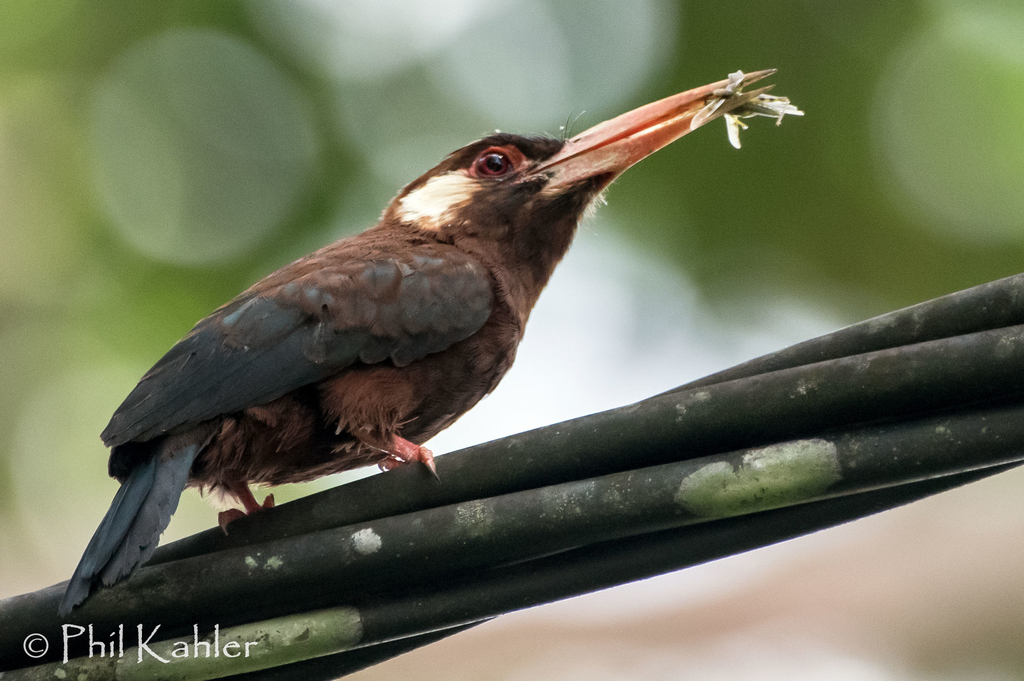
The white-eared jacamar is 18 to 21 cm (7.1 to 8.3 in) long and weighs 44 to 50 g (1.6 to 1.8 oz). It is stouter than many jacamars, and has a more robust bill. It is almost entirely reddish-chestnut, with a bronzy gloss on the crown, wings, and tail. It has large white ear coverts. The juvenile is paler and its bill is shorter.
Range & habitat
The white-eared jacamar is found in the upper Amazon basin from Meta Department in central Colombia south through eastern Ecuador to the Ucayali River in northeastern Peru. It extends east into western Brazil along the Solimões (Upper Amazon) River almost to Manaus. In this humid region, it inhabits terra firme and várzea forest, both primary and secondary. It prefers edges such as around clearings and along waterways. In elevation it ranges up to 500 m (1,600 ft).
Wikipedia: “Distribution and habitat”
What it does
The white-eared jacamar preys on insects, with Hymenoptera and Lepidoptera favored. It perches at mid- to upper canopy height singly or in small groups and sallies out to capture its prey.
Wikipedia: “Feeding”
Listen
Looking for field recordings…
Where it lives
Recorded sightings
—
geo-referenced records in GBIF, from museums, herbaria and field observers.
Drag the globe to turn it. Dots are where records exist, not a range map; darker means more records.
In the stacks
Searching the stacks…
Every page naming Galbalcyrhynchus leucotis in the Biodiversity Heritage Library →
This page is assembled live from iNaturalist, GBIF, Wikipedia, the Source Library and the Internet Archive. It is not yet part of the hand-edited codex. iNaturalist taxon 1501.