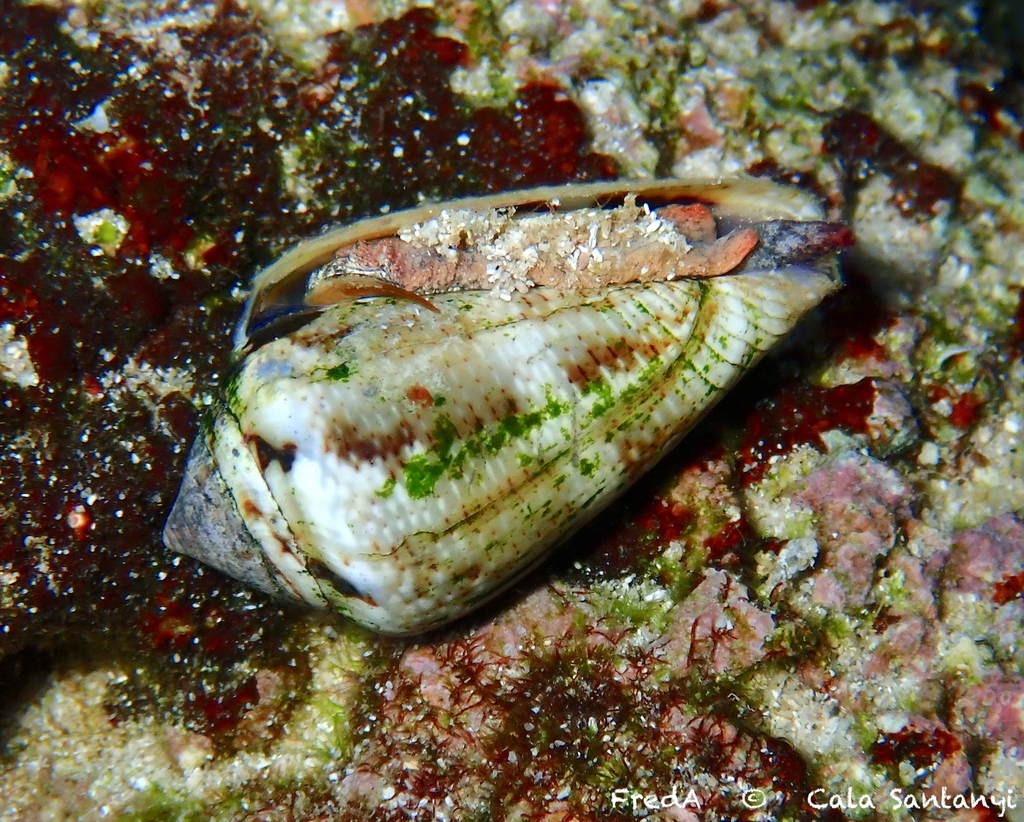
Mediterranean Cone Snail
Conus ventricosus
Conus ventricosus, common name the Mediterranean cone, is a species of sea snail, a marine gastropod mollusk in the family Conidae, the cone snails and their allies.
Conus ventricosus mediterraneus Hwass in Bruguière, 1792, is a recognized subspecies.
From the article Conus ventricosus on Wikipedia (CC BY-SA), quoted section by section
Description
The size of the shell varies between 13 mm and 63 mm. The shell is yellowish brown, pink-brown or olivaceous. It is sometimes chocolate-brown, very closely nebulously spotted and reticulated. And sometimes it is interrupted-lined with chestnut, with a narrow, light band below the middle. The spire is elevated, rudely gradate and maculated. The interior of the aperture is light chocolate, with a light band. The peptide Contryphan-Vn was extracted from the venom of this marine snail. It is part of a complex mixture of poisonous compounds secreted by this cone snailand used in worm hunting.
Range & habitat
This marine species has a wide distribution found in shallow waters ranging in the Mediterranean Sea. It was also found as a fossil from the Pliocene and the Miocene.
Wikipedia: “Distribution”
Where it lives
Recorded sightings
—
geo-referenced records in GBIF, from museums, herbaria and field observers.
Drag the globe to turn it. Dots are where records exist, not a range map; darker means more records.
In the stacks
Searching the stacks…
Every page naming Conus ventricosus in the Biodiversity Heritage Library →
This page is assembled live from iNaturalist, GBIF, Wikipedia, the Source Library and the Internet Archive. It is not yet part of the hand-edited codex. iNaturalist taxon 150382.