On eBird ↗
Reunion Starling
Live sightings near you, the range map, bar charts of when it is seen, and Macaulay Library photos and recordings.
Réunion Starling
Fregilupus varius
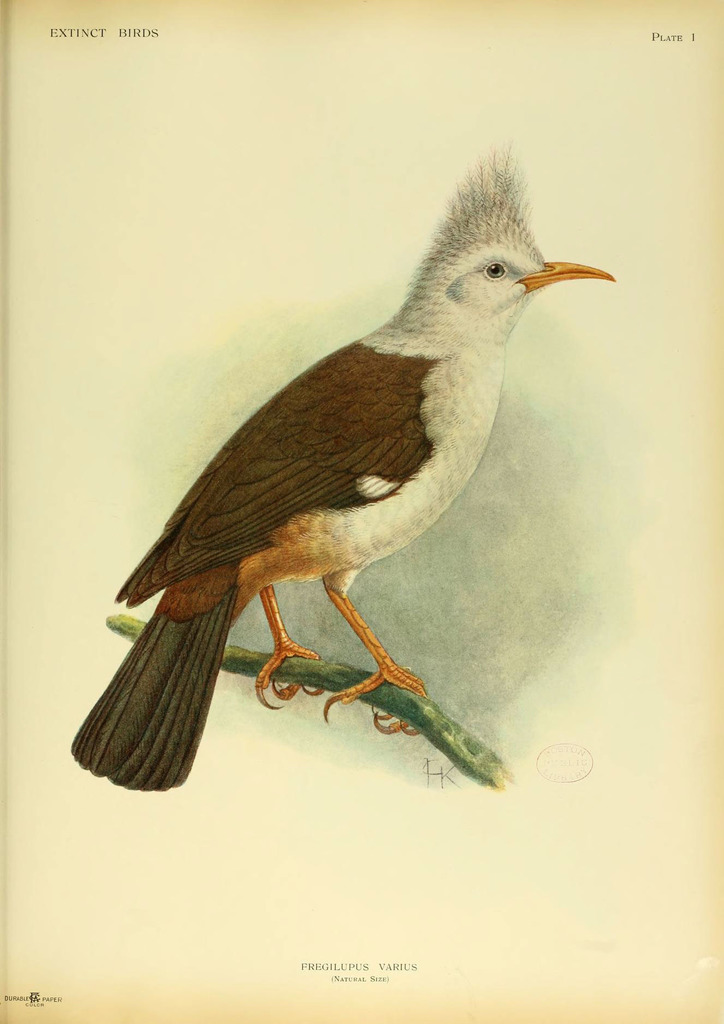
The hoopoe starling (Fregilupus varius), also known as the Réunion starling or the Bourbon crested starling, is a species of starling that lived on the Mascarene island of Réunion and became extinct in the 1850s. Its closest relatives were the also-extinct Rodrigues starling and the Mauritius starling from nearby islands, and the three apparently originated in Southeast Asia. The bird was first mentioned during the 17th century and was long thought to be related to the hoopoe, from which its name is derived. Some affinities have been proposed, but it was confirmed as a starling in a DNA study.
The hoopoe starling was 30 cm (12 in) in length. Its plumage was primarily white and grey, with its back, wings and tail a darker brown and grey. It had a light, mobile crest, which curled forwards. The bird is thought to have been sexually dimorphic, with males larger and having more curved beaks. The juveniles were more brown than the adults. Little is known about hoopoe starling behaviour. Reportedly living in large flocks, it inhabited humid areas and marshes. The hoopoe starling was omnivorous, feeding on plant matter and insects. Its pelvis was robust, its feet and claws large, and its jaws strong, indicating that it foraged near the ground.
From the article Hoopoe starling on Wikipedia (CC BY-SA), quoted section by section
Description
The hoopoe starling was 30 cm (12 in) in length. The bird's culmen was 41 mm (1+5⁄8 in) long, its wing 147 mm (5+13⁄16 in), its tail 114 mm (4+1⁄2 in), and its tarsus about 39 mm (1+9⁄16 in) long. It was the largest of the three Mascarene starlings. A presumed adult male (NHMUK 1889.5.30.15) in the Paris museum has a light ash-grey head and back of the neck (lighter on the hind-neck), with a long crest the same colour with white shafts. Its back and tail are ash-brown, its wings darker with a greyish wash, and its upper tail covert feathers and rump have a rufous wash. Its primary coverts are white with brown tips; the bases (instead of the tips) are brown in other specimens. The superciliary stripe, lore, and most of the specimen's underside is white, with a pale rufous wash on the flanks and undertail coverts. The extent of light rufous on the underside varies by specimen. The beak and legs are lemon-yellow, with yellow-brown claws. It has a bare, triangular area of skin around the eye, which may have been yellow in life. Though the species' iris was described as bluish-brown, it has been depicted as brown, yellow, or orange.
There has been confusion about which characteristics were sexually dimorphic in the species. Only three specimens were sexed (all males), with age and individual variation not considered. …
What it does
Little is known about the behaviour of the hoopoe starling. According to François Levaillant's 1807 account of the bird (which included observations from a Réunion resident) it was abundant, with large flocks inhabiting humid areas and marshes. In 1831, Lesson, without explanation, described its habits as similar to those of a crow. Its song was described as a "bright and cheerful whistle" and "clear notes", indicating a similarity to the songs of other starlings. Vinson's 1877 account relates his experiences with the bird more than 50 years earlier:
Now these daughters of the wood, when they were numerous, flew in flocks and went thus in the rain forests, while deviating little from one another, as good companions or as nymphs taking a bath: they lived on berries, seeds and insects, and the créoles, disgusted by the latter fact, held them for an impure game. Sometimes, coming from the woods to the littoral [coast], always flying and leaping from tree to tree, branch to branch, they often alighted in swarms on coffee trees in bloom, and there was in the past the testimony of an inhabitant of the Island of Bourbon, said the naturalist Levaillant, that they caused big damage in coffee trees by making the flowers fall prematurely. …
Wikipedia: “Behaviour and ecology”
Listen
Looking for field recordings…
Where it lives
Recorded sightings
—
geo-referenced records in GBIF, from museums, herbaria and field observers.
Drag the globe to turn it. Dots are where records exist, not a range map; darker means more records.
In the stacks
Searching the stacks…
Every page naming Fregilupus varius in the Biodiversity Heritage Library →
This page is assembled live from iNaturalist, GBIF, Wikipedia, the Source Library and the Internet Archive. It is not yet part of the hand-edited codex. iNaturalist taxon 15049.