On eBird ↗
Double-toothed Barbet
Live sightings near you, the range map, bar charts of when it is seen, and Macaulay Library photos and recordings.
Double-toothed Barbet
Pogonornis bidentatus
The double-toothed barbet (Pogonornis bidentatus) is a species of bird in the family Lybiidae. It is found in Angola, Benin, Burundi, Cameroon, Central African Republic, Republic of the Congo, Democratic Republic of the Congo, Ivory Coast, Equatorial Guinea, Ethiopia, Gabon, Ghana, Guinea, Guinea-Bissau, Kenya, Liberia, Mali, Nigeria, Rwanda, Sierra Leone, South Sudan, Tanzania, Togo, and Uganda. Within Pogonornis bidentatus, there are two subspecies: Pogonornis bidentatus bidentatus and Pogonornis bidentatus aequatorialis.
From the article Double-toothed barbet on Wikipedia (CC BY-SA), quoted section by section
Description
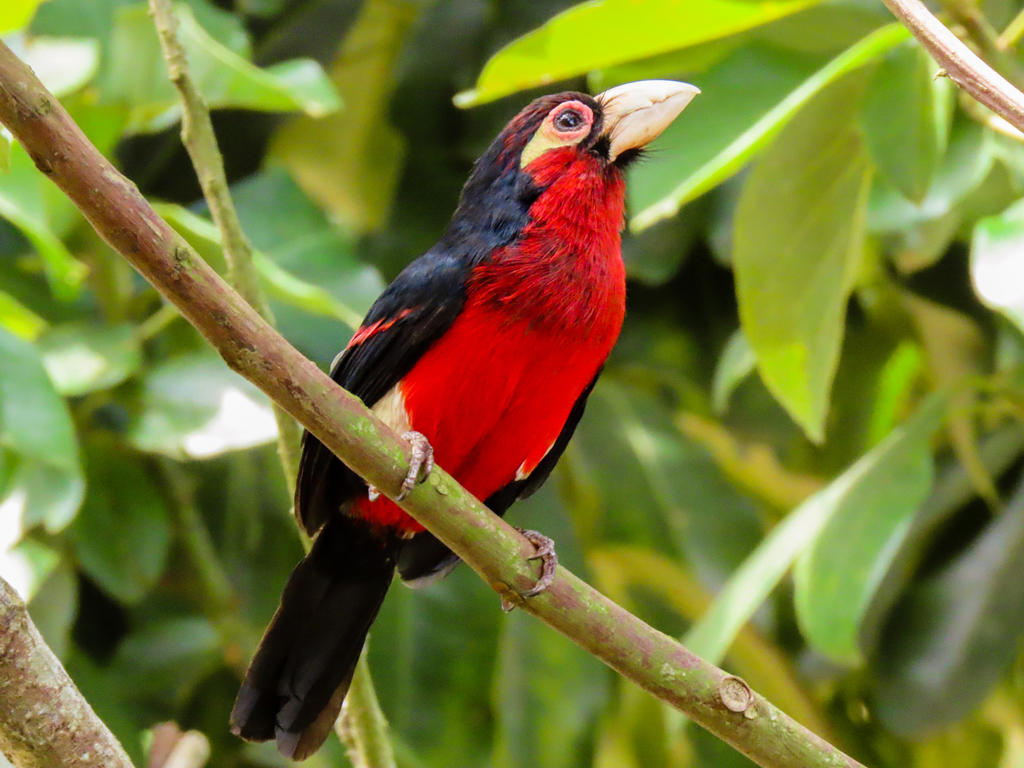
Pogonornis bidentatus is a barbet with black and red coloring. Its bill is large and off-white, and the skin around its eyes is yellow. The double-toothed barbet is black on the top side of its body with a patch of white feathers on its back. Its breast is red, with a white patch on its side. Females and males have similar markings, except that females have lines of black feathers on the white side patch. Juveniles of the species are duller; their feathers are dark grey. Its song is somewhat like a cat's purr. Sometimes pairs of double-toothed barbets will sing together. Double-toothed barbets generally live in the understory of dense woodland. They occupy the edges of the woods, riparian forest, and secondary forest. Some may go into gardens and forage for fruit. The double-toothed barbet is most likely to be confused with the black-breasted barbet or the bearded barbet. In flight, it's ungraceful.
Wikipedia: “Description and habitat”
What it does
Pogonornis bidentatus eats fruits and insects. They search in the foliage for food, usually staying below ten meters. Of insects, they eat beetles, termites, ants, and Hemiptera, which they find in the tree bark or in clusters of leaves. Often a double-toothed barbet will capture winged ants or termites while in flight. They also eat fruits: figs, papayas, avocados, and the fruits of the umbrella tree Musanga cecropioides and of Solanum. Double-toothed barbets will eat the seeds of some fruits. These barbets can be found in pairs or small family groups with helpers; lone double-toothed barbets are rare. Their territories are large. Double-toothed barbets roost communally, as all the barbets in a group roost in the same hole. Nests are made by excavating a tree, often rotting, at above two metres (7 ft). Both barbets in a pair will dig out the nesting hole, and both will defend it. The entrance to the nest is circular, five or more centimetres across. Some nests have an entrance tunnel. At maximum, a nest is 46 cm (18 in) deep.
Wikipedia: “Behavior and diet”
Listen
Looking for field recordings…
Where it lives
Recorded sightings
—
geo-referenced records in GBIF, from museums, herbaria and field observers.
Drag the globe to turn it. Dots are where records exist, not a range map; darker means more records.
In the stacks
Searching the stacks…
Every page naming Pogonornis bidentatus in the Biodiversity Heritage Library →
This page is assembled live from iNaturalist, GBIF, Wikipedia, the Source Library and the Internet Archive. It is not yet part of the hand-edited codex. iNaturalist taxon 1506317.