- Animals
- ›Chordates
- ›Vertebrates
- ›Birds
- ›Woodpeckers and Allies
- ›Woodpeckers
- ›Typical woodpeckers
- ›Pied woodpeckers and allies
- ›Dendropicos
On eBird ↗
Olive Woodpecker
Live sightings near you, the range map, bar charts of when it is seen, and Macaulay Library photos and recordings.
Olive Woodpecker
Dendropicos griseocephalus
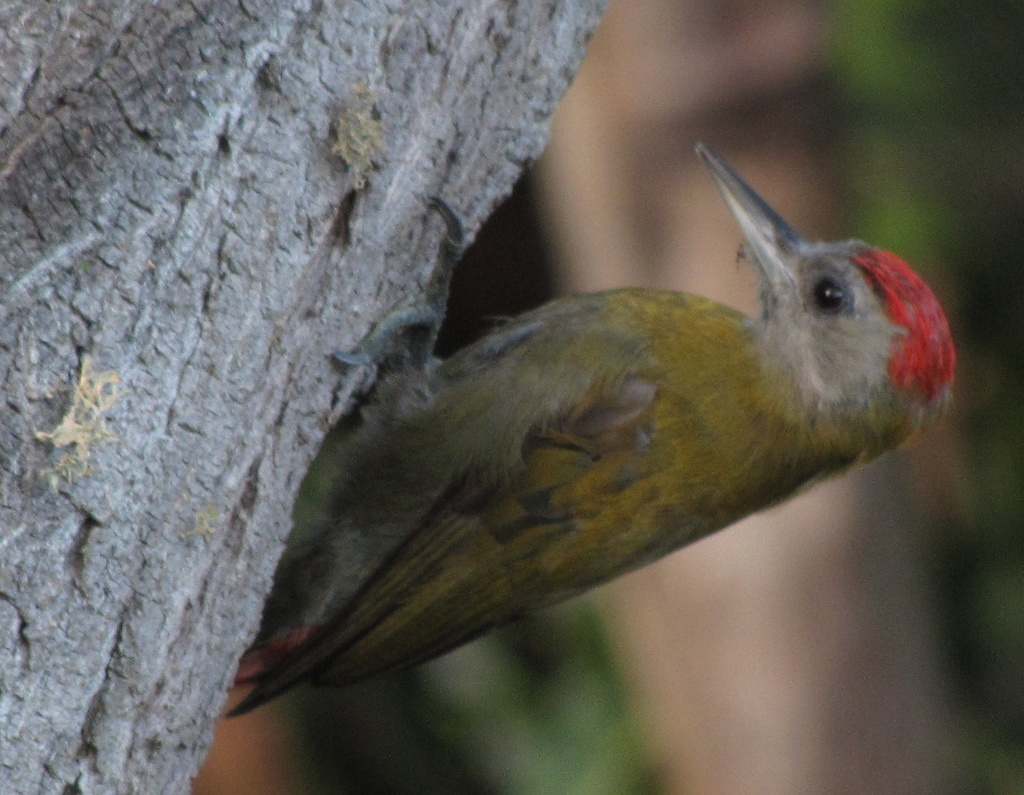
The olive woodpecker (Dendropicos griseocephalus) is a species of bird in the woodpecker family Picidae. It is in the Dendropicos genus, which comprises small woodpeckers native to Sub-Saharan Africa. There are three described subspecies, all inhabiting various regions of southeast Africa; the red-bellied olive woodpecker (D. g. ruwenzori), the montane olive woodpecker (D. g. kilimensis), and the southern olive woodpecker (D. g. griseocephalus).
The olive woodpecker can be characterized by its bright red rump, and bronze coloured upper body. The red-bellied subspecies is known to be slightly brighter in colour, with a more prominent belly patch. The montane subspecies is the smallest of the three recognized subspecies.
From the article Olive woodpecker on Wikipedia (CC BY-SA), quoted section by section
Description
The olive woodpecker is mostly plain, and lacks many of the patterns typically observed in other woodpecker species. It is characterized by a bright scarlet rump and upper-tail coverts, better revealed in flight. These scarlet feathers often have grey bases, and black subterminal bars. It has a darkish grey forecrown, hindneck, chin and neck, sometimes with black markings on its forehead. The olive woodpecker's belly is dark grey and olive coloured, with lighter golden tones on the breast. It displays a red or pink belly-patch which can vary in size. Its mantle is typically olive-coloured, with darker golden and bronze tones. Flanks occasionally feature whitish barring. Wings are bronze or dark brown with subtle white spotting and barring on flight feathers. Flight feathers often feature olive green or reddish edges. Wing coverts have pale, bronzy green edges. Underwing is a pale brown. The olive woodpecker's tail is blackish brown and lacks barring. Some tail feathers feature an olive green edge. Undertail is brownish, with greyer undertail coverts. The olive woodpecker has a grey upper mandible, and bluish lower mandible. Its bill is long and straight. The olive woodpecker has greyish or olive coloured legs. Its irises are typically brown.
The olive woodpecker does exhibit sexual dimorphism. …
Range & habitat
The olive woodpecker inhabits forests characterized by dense woodlands and evergreen thickets that border rivers and streams. It prefers open areas, like Hagenia-dominated forests. Further, it tends to prefer to inhabit separated forest patches, over continuous forests. The olive woodpecker is more likely to be found inland, evergreen forests rather than in coastal areas. However, this woodpecker is the only member of the picidae family found in coastal, South African bush. This bird occurs at altitudes of 450m to 3,700m. It is a resident species, and migration is limited to local and short-distance movements. The olive woodpecker is native to central, east and southern Africa, from the Ruwenzori Mountains to the Western Cape. It is found in Angola, Burundi, DRC, Eswatini, Malawi, Mozambique, Namibia, Rwanda, South Africa, Tanzania, Uganda, Zambia, and Zimbabwe.
Wikipedia: “Habitat and distribution”
What it does
The olive woodpecker feeds mostly on insects and their larvae, especially ants and beetles. This species often forages for food in pairs, and sometimes in family groups of up to six. It has also been reported to forage in interspecific feeding flocks. This woodpecker is strictly an arboreal forager, using its bill to laterally peck and probe at moss and lichen growing on tree bark. It generally prefers to forage in small trees, or small branches in larger trees. This allows the olive woodpecker to move quickly through a tree, shifting backwards or sideways as it feeds. It prefers to feed at heights of 10m to 15m, but can be found foraging anywhere from 1–24 m from the ground.
Wikipedia: “Diet and foraging”
Listen
Looking for field recordings…
Where it lives
Recorded sightings
—
geo-referenced records in GBIF, from museums, herbaria and field observers.
Drag the globe to turn it. Dots are where records exist, not a range map; darker means more records.
In the stacks
Searching the stacks…
Every page naming Dendropicos griseocephalus in the Biodiversity Heritage Library →
This page is assembled live from iNaturalist, GBIF, Wikipedia, the Source Library and the Internet Archive. It is not yet part of the hand-edited codex. iNaturalist taxon 1506403.