On eBird ↗
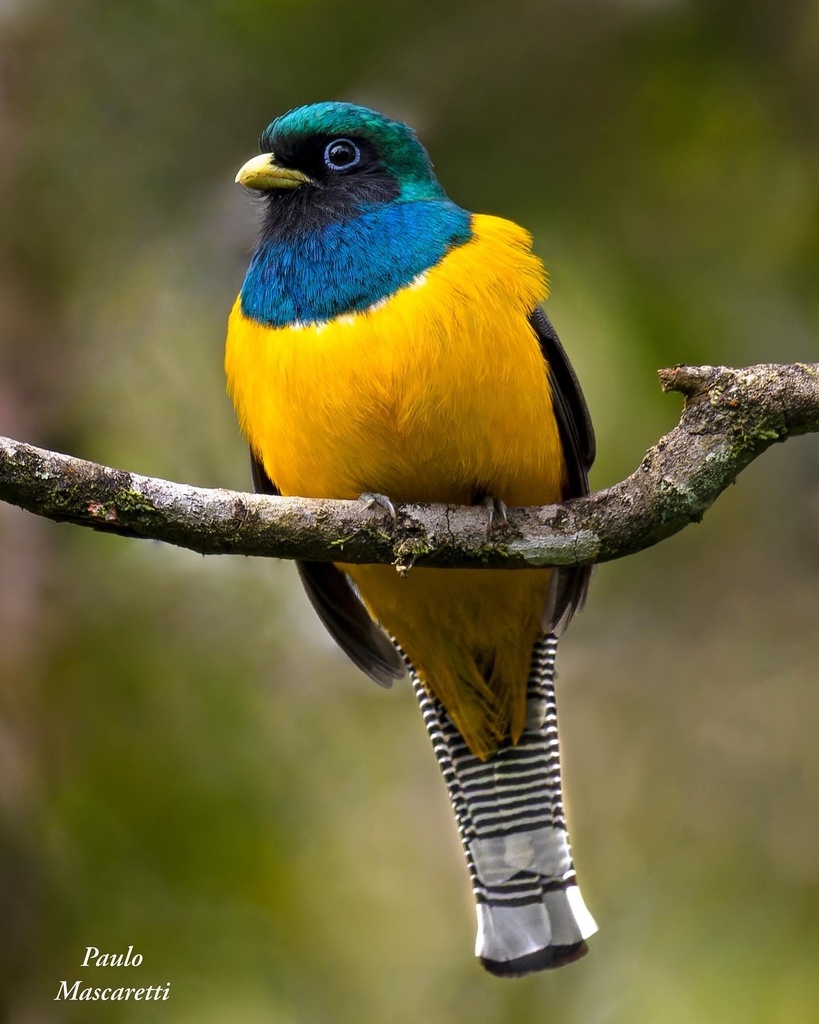
Atlantic Black-throated Trogon
Live sightings near you, the range map, bar charts of when it is seen, and Macaulay Library photos and recordings.
Atlantic Black-throated Trogon
Trogon chrysochloros
The Atlantic black-throated trogon (Trogon chrysochloros) is a bird in the family Trogonidae, the trogons and quetzals. It is found in Argentina, Brazil, and Paraguay.
From the article Atlantic black-throated trogon on Wikipedia (CC BY-SA), quoted section by section
Description
Like most trogons, the Atlantic black-throated has distinctive male and female plumages with soft colorful feathers. This relatively small species is 24 to 25 cm (9.4 to 9.8 in) long and weighs 49 to 66 g (1.7 to 2.3 oz). Adult males of the nominate subspecies have a black forehead and face with a pale blue ring of bare skin around their eye. They are metallic green on their crown, back, lesser wing coverts, rump, and uppertail coverts. Their flight feathers, primary coverts, and secondary coverts are various patterns of black and white. The upper side of their central pair of tail feathers is olive with wide black tips. The next two pairs are similar with the addition of black inner webs. The outermost three pairs have black bases, white tips, and black and white bars between. The underside of their tail has narrow black and white bars and a wide white tip. Their chin and throat are black, their upper breast metallic green, and their lower breast and belly are yellow, sometimes with a thin white band below the upper breast. Adult females have mostly olive to brownish upperparts; their crown is darker and their rump and uppertail coverts lighter. Their face is olive to brownish with a whitish to pale blue ring of bare skin around their eye. Their primaries are mostly fuscous-black with a narrow white edge on their outer webs. …
Range & habitat
The Atlantic black-throated trogon as a disjunct distribution. The nominate subspecies has by far the larger range of the two. It is found in Brazil from Bahia south to northern Rio Grande do Sul and west to southern Mato Grosso do Sul, eastern Paraguay almost to the Paraguay River, and Misiones and Corrientes provinces in far northeastern Argentina. It has been extirpated from Minas Gerais. Subspecies T. c. muriciensis is found in a small part of northeastern Brazil's Alagoas state. The nominate subspecies inhabits humid primary forest and mature secondary forest in lowlands and foothills. Subspecies T. c. muriciensis is a bird of the Atlantic Forest, and is known only at an elevation of about 500 m (1,600 ft).
Wikipedia: “Distribution and habitat”
What it does
"Trogons and quetzals perch erectly with tail hanging downward, and they may remain motionless and quiet for protracted periods." (emphasis in original)
Movement. The Atlantic black-throated trogon is a year-round resident throughout its range.
Feeding. The Atlantic black-throated trogon feeds primarily on insects and also small amounts of fruit (11% and 38% of its diet in two studies). It usually captures insects and plucks fruit by sallying or hovering from a perch and returning to it or another perch to eat. It has been observed following foraging South American coatis (Nasua nasua) to capture prey disturbed by their movements. It also follows army ant swarms, apparently for the same reason.
Breeding. The Atlantic black-throated trogon's breeding season in the southern part of the nominate subspecies' range includes at least October and November. Few nests are known, and only from Argentina. They were cavities excavated in decayed trees or stumps. The only known clutch was of three eggs. Both parents incubate the clutch and care for nestlings. The incubation period of the one clutch was at least 18 days; the time to fledging is not known. Other details of the species' nesting biology are assumed to be similar to those of its formerly conspecific northern black-throated trogon, which see here.
Vocalization. …
Wikipedia: “Behavior”
Listen
Looking for field recordings…
Where it lives
Recorded sightings
—
geo-referenced records in GBIF, from museums, herbaria and field observers.
Drag the globe to turn it. Dots are where records exist, not a range map; darker means more records.
In the stacks
Searching the stacks…
Every page naming Trogon chrysochloros in the Biodiversity Heritage Library →
This page is assembled live from iNaturalist, GBIF, Wikipedia, the Source Library and the Internet Archive. It is not yet part of the hand-edited codex. iNaturalist taxon 1507418.