- Animals
- ›Molluscs
- ›Gastropods
- ›Caenogastropods
- ›Apple Snails, River Snails, and Allies
- ›Ampullarioidea
- ›Apple Snails
- ›Pomaceinae
- ›Marisa
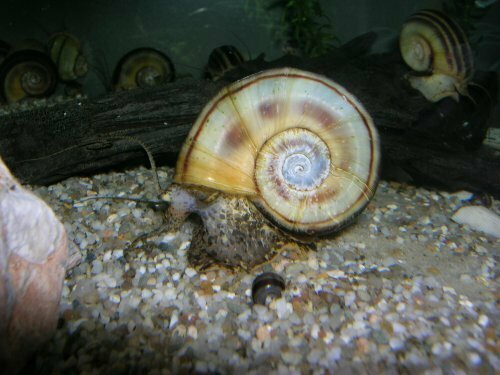
Giant Ramshorn Snail
Marisa cornuarietis
Marisa cornuarietis, common name the Colombian ramshorn apple snail, is a species of large freshwater snail with an operculum, an aquatic gastropod mollusc in the family Ampullariidae, the apple snail family.
These snails are popular in aquariums, and are also used in the wild as a biological control agent.
From the article Marisa cornuarietis on Wikipedia (CC BY-SA), quoted section by section
Description
Although Marisa snails superficially resemble the great ramshorn snail because of the planispiral coiling of their shells, they are not at all closely related to true ramshorn snails in the family Planorbidae. This is an easily recognizable species: the shell is flat-coiled (planispiral). The shell color varies from pale to darker red or brown or more vivid shades of those colors, and is fairly often striped. The shell diameter is usually 35–50 mm (2 in) or even larger.
Range & habitat
It is widespread in northern South America, although the type locality is unknown. The giant ramshorn snail is native to northern South America and Central America, including Bolivia, Brazil, Colombia, Costa Rica, French Guiana, Guyana, Panama, Suriname, Trinidad and Tobago and Venezuela.
Wikipedia: “Indigenous distribution”
What it does
This species has gills as well as a lung, to ensure efficient underwater respiration even in condition of low levels of dissolved oxygen.
Habitat. This snail prefers still or slow-moving fresh water, depending on the availability of aquatic vegetation as a food source.
Feeding habits. This species eats aquatic plants, algae, dead fish and snails. Easily adaptable to captivity, this snail may invade and damage aquarium vegetation. It is practically omnivorous, and feeds on animal and vegetal detritus. This snail acts as a useful aquarium scavenger when it is not excessively numerous. Studies revealed that this species can retard the growth of water hyacinths by feeding on the roots of the plants. It has been suggested that the snail be used as weed-control agent in the canals of south Florida.
Life cycle. A gonochoric species, it lays eggs in characteristic disk-shape clutches, adhering to various substrates. Unlike some other apple snails, this snail lays its eggs below the waterline.
Wikipedia: “Ecology”
Where it lives
Recorded sightings
—
geo-referenced records in GBIF, from museums, herbaria and field observers.
Drag the globe to turn it. Dots are where records exist, not a range map; darker means more records.
In the stacks
Searching the stacks…
Every page naming Marisa cornuarietis in the Biodiversity Heritage Library →
This page is assembled live from iNaturalist, GBIF, Wikipedia, the Source Library and the Internet Archive. It is not yet part of the hand-edited codex. iNaturalist taxon 150778.