- Animals
- ›Molluscs
- ›Gastropods
- ›Heterobranchs
- ›Euthyneura
- ›Tectipleura
- ›Eupulmonata
- ›Common Land Snails and Slugs
- ›Helicina
- ›Orthalicoidei
- ›Orthalicoidea
- ›Orthalicidae
- ›Orthalicinae
- ›Orthalicus
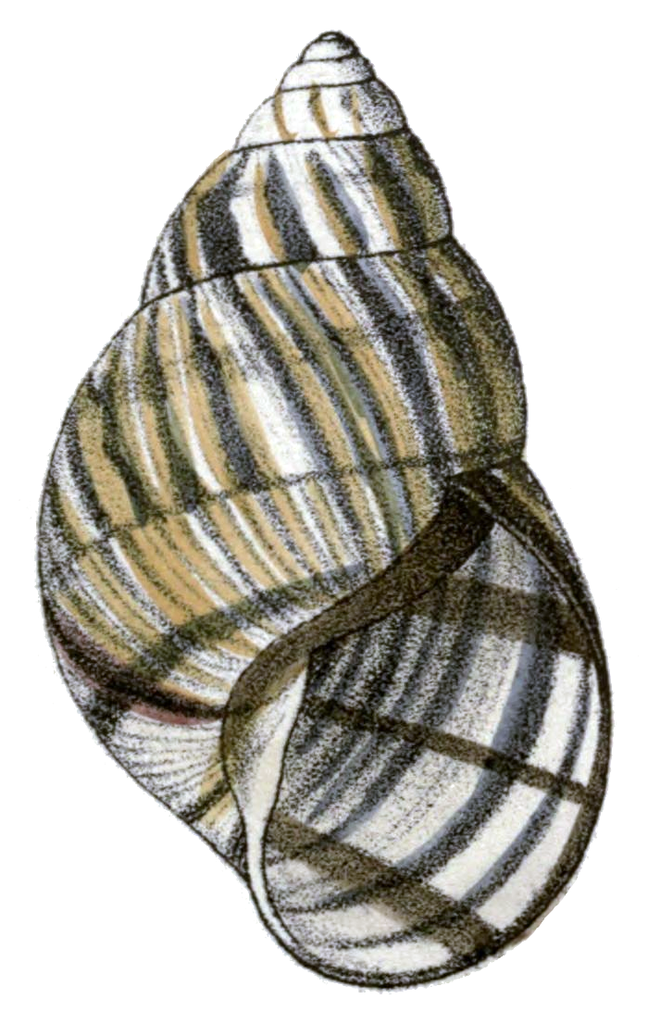
Florida Keys Tree Snail
Orthalicus reses
Orthalicus reses, the Stock Island tree snail or the Florida tree snail, is a species of large tropical air-breathing tree snail, a terrestrial pulmonate gastropod mollusk in the family Orthalicidae. It was first described in 1830 by the American naturalist Thomas Say. The holotype, a specimen probably collected in Key West, was subsequently lost. Over a hundred years later, in 1946, the American biologist Henry Augustus Pilsbry redescribed the species using a specimen from Stock Island, Florida. Orthalicus reses has two subspecies, O. reses reses and O. reses nosodryas. The validity of these two taxa is still being discussed, but some experts argue that considering them as independent units may be important for management purposes.
The Stock Island tree snail has a large conical shell (45–55 mm in length) with variable thickness, generally lighter and more translucent than other species of Orthalicus. It is colored white to buff, with weakly developed spiral bands and several flame-like, purple-brown axial stripes. The subspecies O. reses reses and O. reses nosodryas can be distinguished from one another based on the different color patterns of the apical whorl, columella, and parietal callus.
From the article Orthalicus reses on Wikipedia (CC BY-SA), quoted section by section
Description
Orthalicus reses is a snail with a large, conical shell that is approximately 45 to 55 mm in length. The thickness of the shell varies, but is usually more lightweight and translucent than other species of Orthalicus. The external ground color of the shell is white to buff, with three poorly developed spiral bands and several flame-like purple-brown axial stripes that stop at the lower of the spiral bands. The axial stripes are typically narrower than their whitish interspaces and do not fork near the upper suture. There are two to three white apical whorls. The last whorl contains two to four darker brown growth-rest varices. The columella and parietal callus are white or faint chestnut brown. The nominate subspecies Orthalicus reses reses is distinguished from the supposed subspecies Orthalicus reses nesodryas by the lighter color pattern of the apical whorl, columella, and parietal callus. These characteristics are chestnut-brown or darker in Orthalicus reses nesodryas.
Range & habitat
Henry Augustus Pilsbry suggested, in 1946, that Orthalicus reses reses arrived in Florida from Central America and the Caribbean shortly after the emergence of the Florida peninsula in the late Pleistocene. Snails that were sealed in place on floating tropical trees may have been cast ashore on the Florida peninsula by high winds and hurricanes. This form of dispersal has been suggested for both Orthalicus and Liguus, but the exact origin of these species is still in question. In 1972, Craig suggested that populations of Orthalicus arrived directly across the Gulf of Mexico from Central America, but the mode of transportation and whether dispersal occurred as a single event or multiple events was not known. No one knows when Orthalicus reses reses arrived in the Lower Keys. Historically, the Stock Island tree snail was believed to have a very limited distribution, being found only in tropical hardwood hammocks on Stock Island and Key West; although it may have been found in other hammock areas in the Lower Keys. The distribution has since been artificially extended by collectors, who have introduced them to Key Largo and the southernmost parts of mainland Florida. Orthalicus reses nesodryas has a broader range, occurring throughout the Florida Keys from Sugarloaf Key north. …
Wikipedia: “Distribution”
What it does
Orthalicus reses reses snails are active mainly during the wet season, i.e. May through November, during which time breeding, feeding, and dispersal takes place. Dry periods (December through April) are spent in aestivation, during which time the snail forms a tight sealed barrier between the aperture and a tree trunk or branch. Snails secrete this mucus seal (an epiphragm) that cements their shell to a tree in order to protect them from desiccation during the dry period. Snails may come out of aestivation briefly to feed during dry-season rains, and also may go into aestivation during summer dry spells.
Wikipedia: “Behavior”
Where it lives
Recorded sightings
—
geo-referenced records in GBIF, from museums, herbaria and field observers.
Drag the globe to turn it. Dots are where records exist, not a range map; darker means more records.
In the stacks
Searching the stacks…
Every page naming Orthalicus reses in the Biodiversity Heritage Library →
This page is assembled live from iNaturalist, GBIF, Wikipedia, the Source Library and the Internet Archive. It is not yet part of the hand-edited codex. iNaturalist taxon 150905.