- Plants
- ›Vascular Plants
- ›flowering plants
- ›Dicots
- ›Sunflowers, Bellflowers, Fanflowers, and Allies
- ›Sunflowers, Daisies, Asters, and Allies
- ›Thistles and Allies
- ›Cardueae
- ›Thistles and Burdocks
- ›Cirsium
- ›Altissima
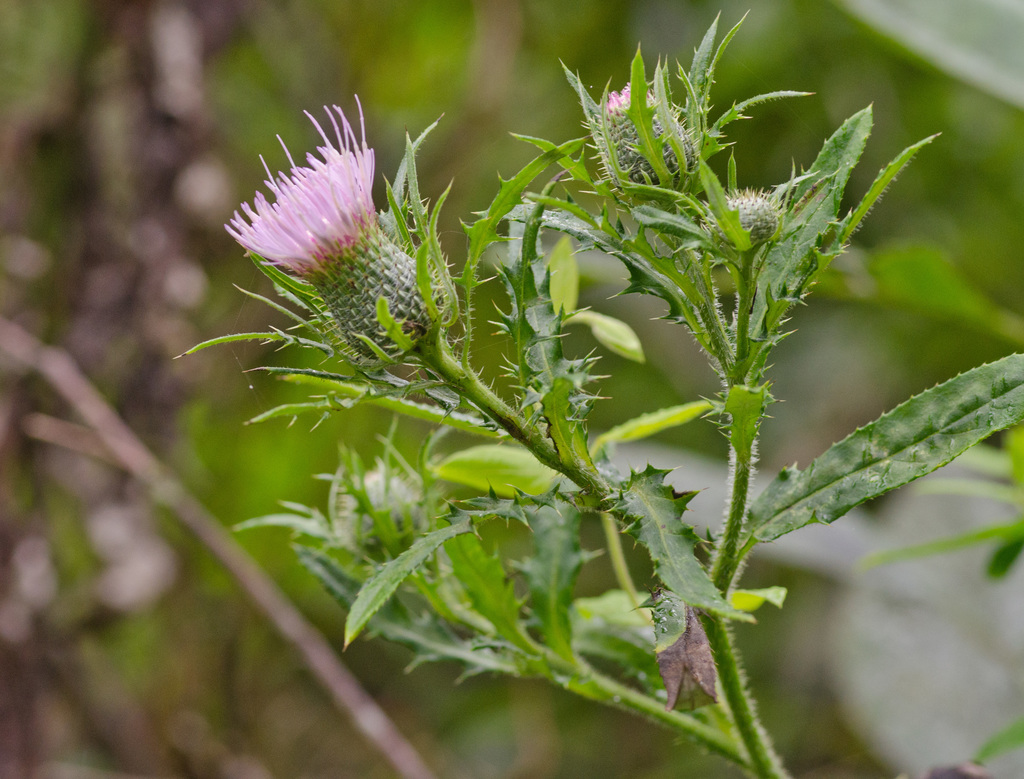
Tall Thistle
Cirsium altissimum
Cirsium altissimum is a North American species of plants in the thistle tribe within the sunflower family. Common name is tall thistle or roadside thistle. The species is native to the eastern and Central United States, with a range extending from Massachusetts west to North Dakota and south to Texas and the Florida Panhandle.
From the article Cirsium altissimum on Wikipedia (CC BY-SA), quoted section by section
Description
Cirsium altissimum is, as the name implies, a tall herb, sometimes reaching as much as 400 cm (13 ft) in sunny areas and 150 cm (5 ft) in the shade. It is a biennial or perennial plant, blooming only once before dying. In its first year, the plant appears as a rosette of leaves, slightly hairy, with small spines along the leaf margins. The rosette measures up to about 30 cm (1 ft) across. The plant has a long slender taproot, measuring 15 cm (6 in) or more. In its second year, the plant starts as a rosette of leaves with longer hairs than the previous year, plus stout spines. In addition to the previous year's tap root, there are now shallow, sinewy, radiating roots. The second year plant grows tall, tough stems that are densely covered with stiff hairs. Large plants have some branches along the upper portion of their stems. The leaves along the stem are alternate and measure up to 23 cm (9 in) long and 8 cm (3 in) wide. Leaves vary in shape, with larger leaves generally lanceolate, and smaller leaves elliptic. They could be uncut to deeply pinnately lobed, varying from plant-to-plant and even on the same plant. There is often a spine at the pointed tip of each lobe or dentate tooth. Leaves have flattened white hairs on their upper surface and a dense mat of white-woolly hairs on their lower surface. They are sessile or clasp the stem slightly. …
Range & habitat
C. altissimum has a native range in the United States extending from Massachusetts west to North Dakota and south to Texas and the Florida Panhandle. The species grows in prairies, open woodlands, and disturbed sites.
Wikipedia: “Distribution and habitat”
What it does
Flowers bloom June to October. It is an important nectar source for many bees, butterflies, and moths, and it is the larval host for the swamp metalmark (Calephelis muticum) and painted lady (Vanessa cardui) butterflies. Many birds, including the American goldfinch eat the seeds.
== References ==
Wikipedia: “Ecology”
In human culture
The genus name Cirsium comes from the Greek word, kirsos, for "swollen vein" because the plants were previously used to reduce swelling. The specific epithet altissimum is Latin for "tallest".
Wikipedia: “Etymology”
Where it lives
Recorded sightings
—
geo-referenced records in GBIF, from museums, herbaria and field observers.
Drag the globe to turn it. Dots are where records exist, not a range map; darker means more records.
In the old herbals & bestiaries

In the stacks
Searching the stacks…
Every page naming Cirsium altissimum in the Biodiversity Heritage Library →
This page is assembled live from iNaturalist, GBIF, Wikipedia, the Source Library and the Internet Archive. It is not yet part of the hand-edited codex. iNaturalist taxon 152132.