On eBird ↗
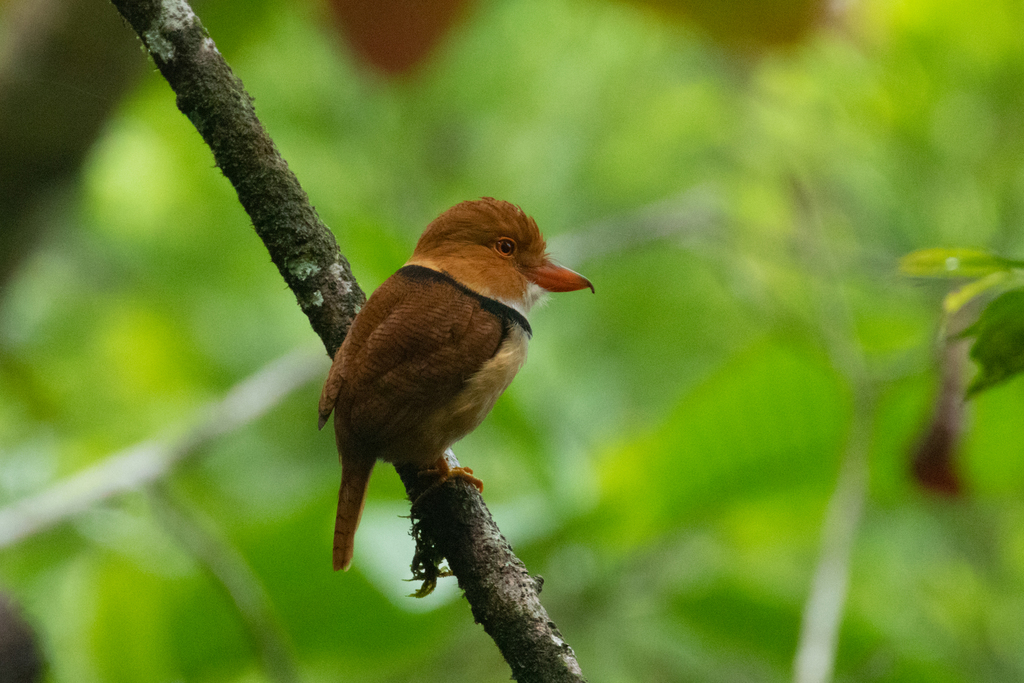
Collared Puffbird
Live sightings near you, the range map, bar charts of when it is seen, and Macaulay Library photos and recordings.
Collared Puffbird
Bucco capensis
The collared puffbird (Bucco capensis) is a species of bird in the family Bucconidae, the puffbirds, nunlets, and nunbirds. It is found in Bolivia, Brazil, Colombia, Ecuador, French Guiana, Guyana, Peru, Suriname, and Venezuela.
From the article Collared puffbird on Wikipedia (CC BY-SA), quoted section by section
Description
The collared puffbird is about 19 cm (7.5 in) long and weighs 46 to 62 g (1.6 to 2.2 oz). Its head and back are dark rufous, the rump a lighter rufous, and the tail orange-chestnut with narrow black bars. The folded wing shows fine black barring on a brown background. The chin and throat are white to buffy white that extend around the nape as a thin buffy line. Below them are a wide black collar that encircles the chest and upper back. The lower breast and the center of the belly are buffy white that darkens to dull orange on the flanks and vent. The eye is surrounded by bare orange-yellow skin; the eye color can be whitish, orange, or vermilion. The bill is mostly orange with some dusky on the maxilla. The feet can be light green, orange, or brown.
Range & habitat
The collared puffbird is found in most of the Amazon Basin, from southeastern Colombia south through eastern Ecuador and Peru to northern Bolivia and east through southern Venezuela, the Guianas, and northern Brazil. In Brazil it is found as far east as Belém and south into Mato Grosso. It inhabits humid primary terra firme forest, drier hilly country, and also várzea forest in the lower Amazon. In elevation it ranges from sea level to 1,700 m (5,600 ft) but is usually found below 1,000 m (3,300 ft).
Wikipedia: “Distribution and habitat”
What it does
The collared puffbird hunts by sallying from a shaded perch to pluck prey from foliage, bark, or the forest floor. Its prey includes lizards, snakes, frogs, and several types of large insects. It sometimes joins mixed-species foraging flocks and less often follows army ant swarms.
Wikipedia: “Feeding”
Listen
Looking for field recordings…
Where it lives
Recorded sightings
—
geo-referenced records in GBIF, from museums, herbaria and field observers.
Drag the globe to turn it. Dots are where records exist, not a range map; darker means more records.
In the stacks
Searching the stacks…
Every page naming Bucco capensis in the Biodiversity Heritage Library →
This page is assembled live from iNaturalist, GBIF, Wikipedia, the Source Library and the Internet Archive. It is not yet part of the hand-edited codex. iNaturalist taxon 1534.