- Plants
- ›Vascular Plants
- ›flowering plants
- ›Dicots
- ›Mustards, Capers, and Allies
- ›mustard family
- ›Brassicoideae
- ›Arabodae
- ›Alysseae
- ›Odontarrhena
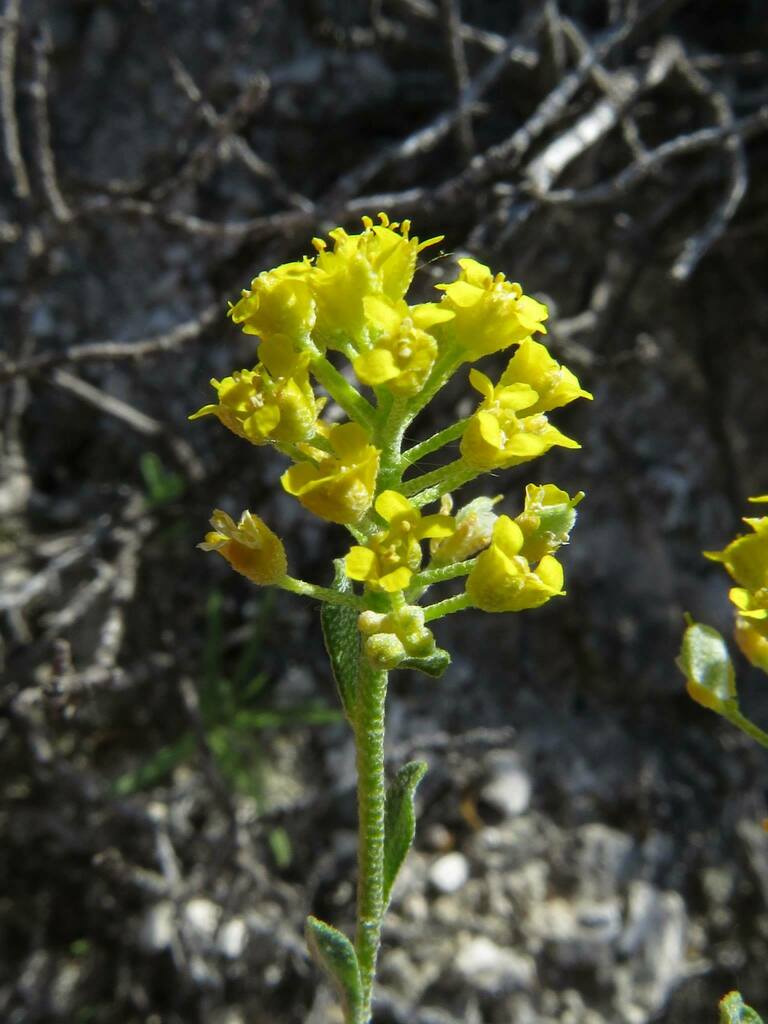
Odontarrhena serpyllifolia
Alyssum serpyllifolium, the thyme-leaved alison, is a species of flowering plant in the family Brassicaceae, native to the western Mediterranean region. It is adapted to serpentine soils. The Royal Horticultural Society recommends it for rock gardens.
From the article Alyssum serpyllifolium on Wikipedia (CC BY-SA), quoted section by section
Description
The flower color is yellow with green stems. It consists of lance-shaped leaves and requires dry soil and drained areas. This plant is often used to help observe the relationship between hyperaccumulating plants which store and absorb metals in their tissues, vs. non-hyperaccumulating plants. If soil is contaminated with high concentrations of metals this is likely because of mineral rock weathering or as a result of industrialization. The discovery of the plant's abilities has led to an easier process of detoxification of plant soil caused by mineral rock weathering or industrialization.
Range & habitat
It is from the family Brassicaceae and is found in southwestern Europe. Alyssum serpyllifolium is mainly found in the Iberian Peninsula, Northeastern Portugal, and Spain.
Wikipedia: “Distribution”
Where it lives
Recorded sightings
—
geo-referenced records in GBIF, from museums, herbaria and field observers.
Drag the globe to turn it. Dots are where records exist, not a range map; darker means more records.
In the stacks
Searching the stacks…
Every page naming Odontarrhena serpyllifolia in the Biodiversity Heritage Library →
This page is assembled live from iNaturalist, GBIF, Wikipedia, the Source Library and the Internet Archive. It is not yet part of the hand-edited codex. iNaturalist taxon 1540163.