- Fungi Including Lichens
- ›Ascomycete Fungi
- ›Sac Fungi and Lichens
- ›Common Lichens
- ›Shield Lichens, Sunburst Lichens, Rosette Lichens, and Allies
- ›Lecideales
- ›Lecideaceae
- ›Lecidea
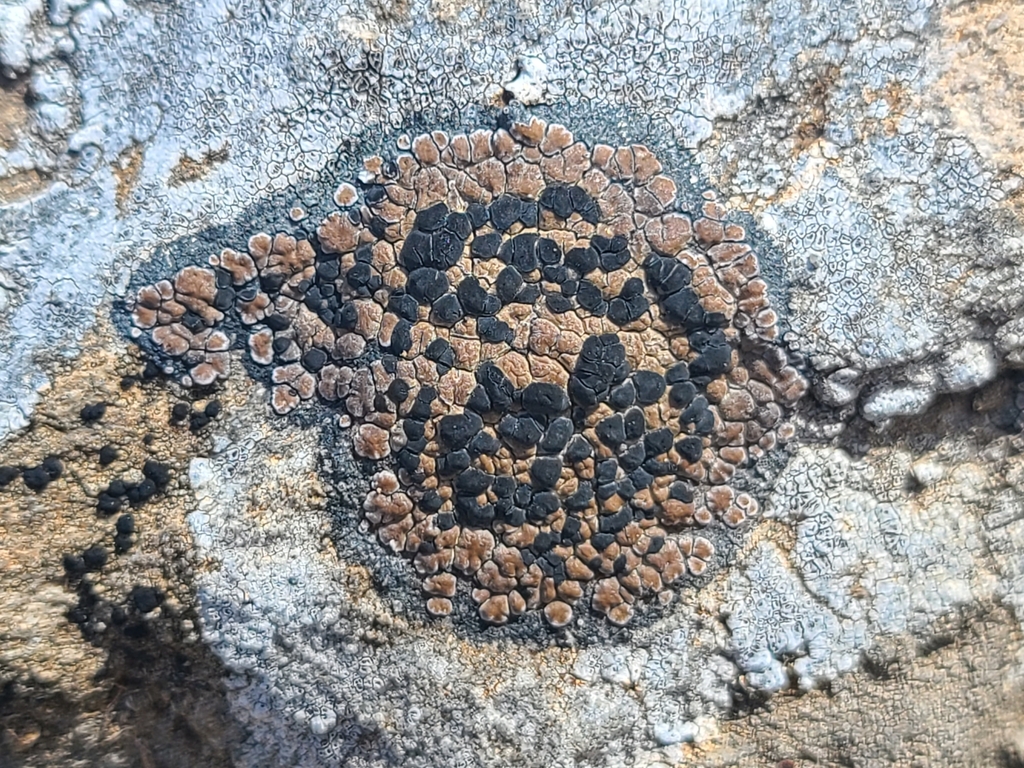
Lecidea fuscoatra
Lecidea fuscoatra is a species of saxicolous (rock-dwelling) crustose lichen in the family Lecideaceae. This widespread species is found across Europe, North America, North Africa, and Asia. First described by Carl Linnaeus in 1753, it forms a thin crust that breaks into small, shiny, tile-like patches ranging from whitish grey to pale brown, typically outlined by a black border of fungal tissue. The lichen produces small black disc-shaped fruiting bodies that are often nestled between the crustal patches and contain eight colourless ascospores per spore sac. It grows primarily on acidic rocks such as granite and sandstone, and is particularly common in northern boreal regions, though it also readily colonises worked stone structures in coastal areas. The species can be distinguished from similar-looking lichens by its distinctive areolate (tile-like) thallus structure that forms discrete patches from early growth, and by its positive reaction to the C spot test due to the presence of gyrophoric acid.
From the article Lecidea fuscoatra on Wikipedia (CC BY-SA), quoted section by section
Description
Lecidea fuscoatra forms a thin crust that breaks into many small, tile-like patches (an areolate thallus). The surface is shiny and whitish grey to pale yellow-brown or grey-brown, each patch usually up to about 3 mm across and flat to slightly rounded. A black border of fungal tissue (the prothallus) may outline the patches. Just above the pigmented outer skin lies a thin layer of dead, colourless cells (an epinecral layer), and the inner white layer (medulla) does not turn blue with iodine.
The fruiting bodies are small black discs (apothecia) 0.5–2(–3) mm wide that are typically sunk into, or seated between, the patches; they are flat to slightly domed and may be dusted with a grey frost (pruina). The disc keeps a slightly raised, persistent rim (the true exciple) that, under the microscope, is built from chains of rounded cells—brown on the outside, colourless within—and it gives a pink reaction in the C test. The uppermost film on the disc (epithecium) is olive-green to olive-brown and becomes more olivaceous in KOH; the spore-bearing layer (hymenium) is 40–60 μm tall; and the tissue beneath (hypothecium) is dark brown to black and often forms a short, stalk-like base. The supporting threads (paraphyses) are mostly unbranched, 1.5–2 μm thick, with tips to 3(–5) μm that can be tinged olive-brown. The spore sacs (asci) measure 45–55 × 8–15 μm and contain eight spores. …
Range & habitat
Lecidea fuscoatra is widespread, reported from Europe, North Africa, North America, and Asia. Within Europe it is more frequent on natural, generally acidic rocks (e.g., granite and sandstone) and is relatively common in boreal regions. It has also been recorded growing on hornfels in the Sudety Mountains of Poland. In Galicia (north-west Spain), L. fuscoatra has been recorded on granite church masonry exposed to marine aerosols, for example at the Church of Santa María das Areas (Fisterra), where it occurs on both vertical walls (apse) and horizontal elements, showing that the species readily colonises worked stone in coastal settings.
Wikipedia: “Habitat and distribution”
What it does
Several species of lichenicolous (lichen-dwelling) fungi have been recorded growing on Lecidea fuscoatra. These include Endococcus rugulosus, Opegrapha maligna, Polycoccum kerneri, Llimoniella fuscoatrae, Roselliniella lecideae, and Sagediopsis barbara.
Wikipedia: “Species interactions”
Where it lives
Recorded sightings
—
geo-referenced records in GBIF, from museums, herbaria and field observers.
Drag the globe to turn it. Dots are where records exist, not a range map; darker means more records.
In the stacks
Searching the stacks…
Every page naming Lecidea fuscoatra in the Biodiversity Heritage Library →
This page is assembled live from iNaturalist, GBIF, Wikipedia, the Source Library and the Internet Archive. It is not yet part of the hand-edited codex. iNaturalist taxon 154105.