- Plants
- ›Vascular Plants
- ›flowering plants
- ›Dicots
- ›pinks, cactuses, and allies
- ›Stone plants
- ›Seapurslane Subfamily
- ›Sesuvieae
- ›Sesuvium
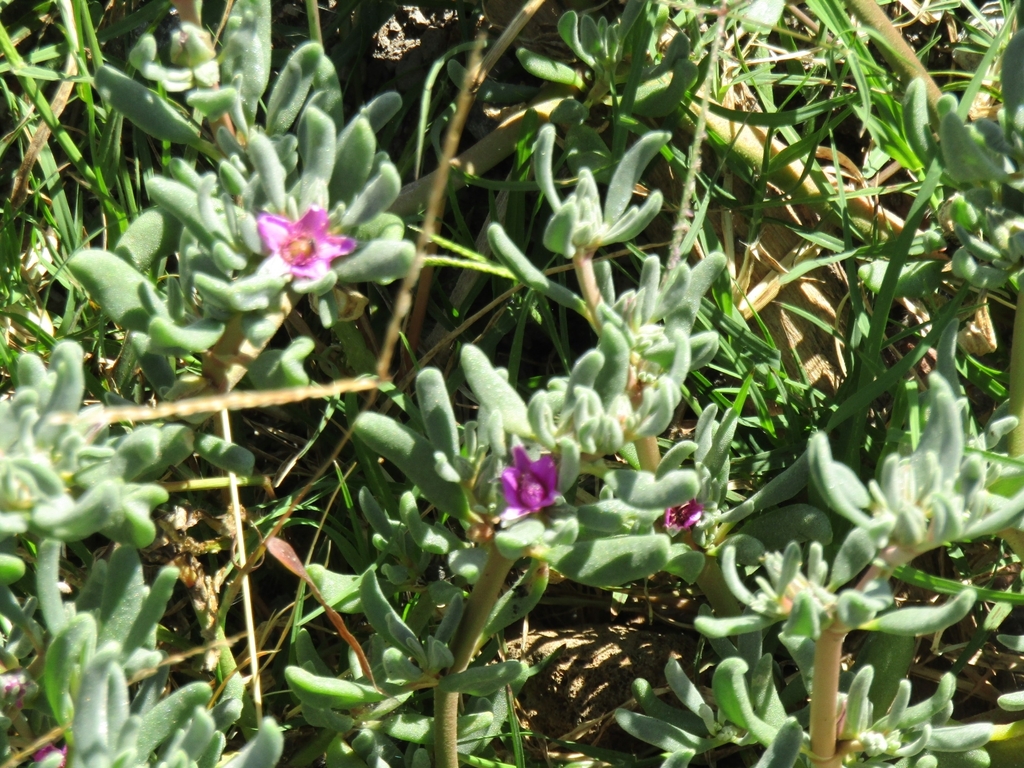
Sesuvium revolutifolium
Sesuvium portulacastrum is a sprawling perennial herb in the family Aizoaceae that grows in coastal and mangrove areas throughout much of the world. It grows in sandy clay, coastal limestone and sandstone, tidal flats and salt marshes, throughout much of the world. It is native to Africa, Asia, Australia, Hawai`i, North America and South America, and has naturalised in many places where it is not indigenous.
It is commonly known as shoreline purslane or (ambiguously) "sea purslane," in English, dampalit in Tagalog and 海马齿 hǎimǎchǐ in Chinese.
From the article Sesuvium portulacastrum on Wikipedia (CC BY-SA), quoted section by section
Description
Sesuvium portulacastrum is a vine up to 30 centimetres (12 in) high, with thick, smooth stems up to 1 metre (3.3 ft) long. It has smooth, fleshy, glossy green leaves that are linear or lanceolate, from 1–7 centimetres (0.39–2.76 in) long and 2–1.5 centimetres (0.79–0.59 in) wide. Its flowers bud from the leaf axils. They are small, 0.5 centimetres (0.20 in) in diameter and pink or purple in colour. They close at nighttime or when the sky is cloudy. They are pollinated by bees and moths. The fruit is a round capsule, it has tiny black seeds that do not float.
In medicine
Fatty acid composition:- palmitic acid (31.18%), oleic acid (21.15%), linolenic acid (14.18%) linoleic acid (10.63%), myristic acid (6.91%) and behenic acid (2.42%) The plant extract showed antibacterial and anticandidal activities and moderate antifungal activity.
Wikipedia: “Chemistry and medicine”
Where it lives
Recorded sightings
—
geo-referenced records in GBIF, from museums, herbaria and field observers.
Drag the globe to turn it. Dots are where records exist, not a range map; darker means more records.
In the stacks
Searching the stacks…
Every page naming Sesuvium revolutifolium in the Biodiversity Heritage Library →
This page is assembled live from iNaturalist, GBIF, Wikipedia, the Source Library and the Internet Archive. It is not yet part of the hand-edited codex. iNaturalist taxon 1543680.