- Plants
- ›Vascular Plants
- ›flowering plants
- ›Dicots
- ›pinks, cactuses, and allies
- ›Sundew Family
- ›Drosera
- ›Ergaleium
- ›Luniferae
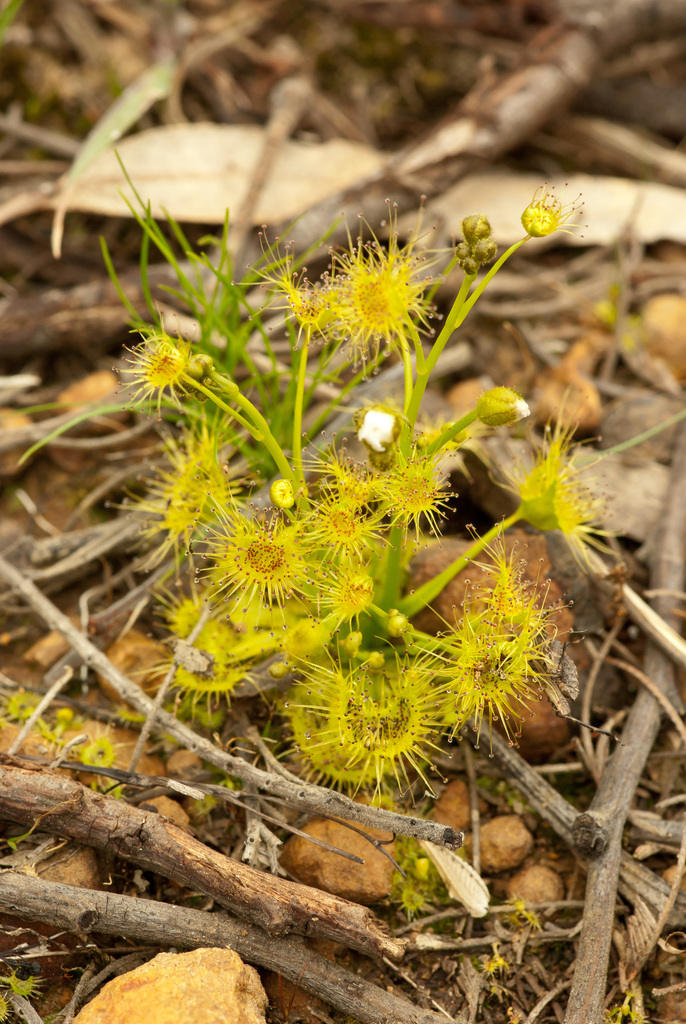
Grassland Sundew
Drosera hookeri
Drosera hookeri, the grassland sundew is an shortly erect perennial tuberous species in the carnivorous plant genus Drosera. Drosera hookeri is found in south-eastern Australia. Although the holotype was collected in Tasmania, its distribution also includes Victoria, New South Wales and South Australia. This species has a complex taxonomic history, and its specific epithet acknowledges the original recognition of the taxon by Joseph Dalton Hooker. Hooker originally called his species Drosera foliosa Hook.f. ex Planch. in...
From the article Drosera hookeri on Wikipedia (CC BY-SA), quoted section by section
Description
Drosera hookeri is a perennial tuberous herb. Its underground tuber is white and generally found 2 – 5 cm under the soil surface. Its aerial parts range from 5 – 10 cm in height, normally yellow-green to distinctly yellow in colour. Drosera hookeri has a well-developed rosette of lunate to semi-orbicular leaves at the soil surface, as well as lunate cauline leaves. The aerial stem is normally branched multiple times from the base of the plant. Flowers are white, and can appear very close to the basal leaf rosette. The seeds are black and cylindrical.
Range & habitat
Drosera hookeri is typically a plant of winter-wet, summer-dry grasslands and grassy woodlands. It frequently co-occurs with other species in the D. peltata complex.
Wikipedia: “Habitat and distribution”
In human culture
This species has a complex taxonomic history, and its specific epithet acknowledges the original recognition of the taxon by Joseph Dalton Hooker. Hooker originally called his species Drosera foliosa Hook.f. ex Planch. in 1848, a name that was illegitimate as it had previously been used to describe a different species (Drosera foliosa Elliott 1824). The nomenclature of D. hookeri was later clarified and the taxonomic concept significantly broadened to include most of the south-eastern Australian and New Zealand forms of the species complex that includes Drosera peltata. Like other tuber sundews, D. hookeri aestivates as an underground tuber to survive summer drought.
Wikipedia: “Botanical history”
Where it lives
Recorded sightings
—
geo-referenced records in GBIF, from museums, herbaria and field observers.
Drag the globe to turn it. Dots are where records exist, not a range map; darker means more records.
In the stacks
Searching the stacks…
Every page naming Drosera hookeri in the Biodiversity Heritage Library →
This page is assembled live from iNaturalist, GBIF, Wikipedia, the Source Library and the Internet Archive. It is not yet part of the hand-edited codex. iNaturalist taxon 154709.