- Fungi Including Lichens
- ›Basidiomycete Fungi
- ›Higher Basidiomycetes
- ›Mushrooms, Bracket Fungi, Puffballs, and Allies
- ›Russulales
- ›Milkcaps, Brittlegills and Allies
- ›Russula
- ›Russula
- ›Xerampelinae
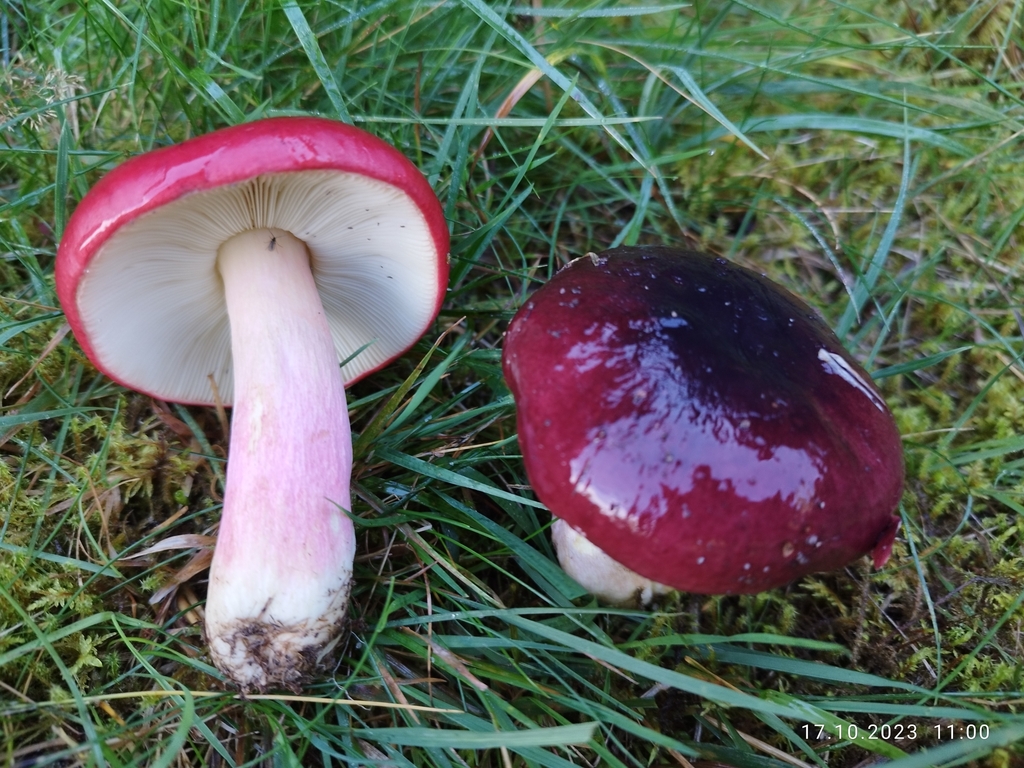
Shellfish-scented Russula
Russula xerampelina
Russula xerampelina, also commonly known as the shrimp russula, crab brittlegill, or shrimp mushroom, is a basidiomycete mushroom of the brittlegill genus Russula. Two subspecies are recognised. The fruiting bodies appear in coniferous woodlands in autumn in northern Europe and North America. Their caps are coloured various shades of wine-red, purple to green. Mild tasting and edible, it is one of the most highly regarded brittlegills for the table. It is also notable for smelling of shellfish or crab when fresh.
From the article Russula xerampelina on Wikipedia (CC BY-SA), quoted section by section
Description
Russula xerampelina has a characteristic odour of boiled crab or shrimp. Trimethylamine and its precursor, trimethylamine N-oxide, are the source of this mushroom's distinct odour. The cap is 5–20 cm (2–8 in) wide, domed, flat, or with a slightly depressed centre, and sticky. The colour is variable, most commonly purple to wine-red, or greenish, and darker towards the centre of the cap. There are fine grooves up to 1 cm long running perpendicular to the margin. The stipe is 4–12 cm (1.5–4.5 in) long, 1.5–4 cm (0.5–1.5 in) wide, cylindrical, white or sometimes with a reddish blush, bruising brown. The gills have a mild to rather bitter taste, narrowly spaced, and turn creamy-yellow on aging specimens. The spore print is creamy-yellow to ochre. The oval spores measure 8.8–9.9 by 6.7–7.8 μm and are covered with 1 μm spines. This Russula has been divided into several similar species by some mycologists. However, they all have the singular dark green colour reaction to iron salts (iron(II) sulfate) when applied to the flesh and smell of shellfish. This aroma is quite distinct and becomes stronger with age.
Similar species. More reddish-capped forms could be confused with the sickener (R. emetica), although the latter always has a white stipe and gills; greener-capped species may resemble R. aeruginea. Many other species in the genus are similar, e.g. R. …
Range & habitat
Russula xerampelina is widely distributed; quite common in northern temperate zones, and often ranging into the Arctic Circle, it also ranges south to Costa Rica. In North America, it appears from July to October to the east and October to January in the west. Variety tenuicarnosa has been found on sandy soils under pine in Slovakia and northern Italy in Trentino. It grows solitary, or in groups with conifers, and seems to have a preference for Douglas fir, or more rarely pine trees or larch. It is sometimes found in deciduous woods, such as beech and oak. Adults of the pleasing fungus beetle Tritoma angulata have been recorded from this fungus, but it does not seem to be a regular food source for them.
Wikipedia: “Distribution and ecology”
At the table
The flavor is mild. This russula is considered one of the best edible species of its genus, although the shellfish smell will persist even when cooking. This is less pleasant in older specimens. The young caps are said to be superb stuffed with any suitable ingredients, and are rarely maggoty.
Wikipedia: “Uses”
Where it lives
Recorded sightings
—
geo-referenced records in GBIF, from museums, herbaria and field observers.
Drag the globe to turn it. Dots are where records exist, not a range map; darker means more records.
In the stacks
Searching the stacks…
Every page naming Russula xerampelina in the Biodiversity Heritage Library →
This page is assembled live from iNaturalist, GBIF, Wikipedia, the Source Library and the Internet Archive. It is not yet part of the hand-edited codex. iNaturalist taxon 154875.