- Animals
- ›Arthropods
- ›Hexapods
- ›Insects
- ›Winged and Once-winged Insects
- ›Flies
- ›Brachyceran Flies
- ›Cyclorrhaphan Flies
- ›Schizophoran Flies
- ›Calyptrate Flies
- ›Bot Flies, Blow Flies, and Allies
- ›Blow Flies
- ›Luciliinae
- ›Luciliini
- ›Lucilia
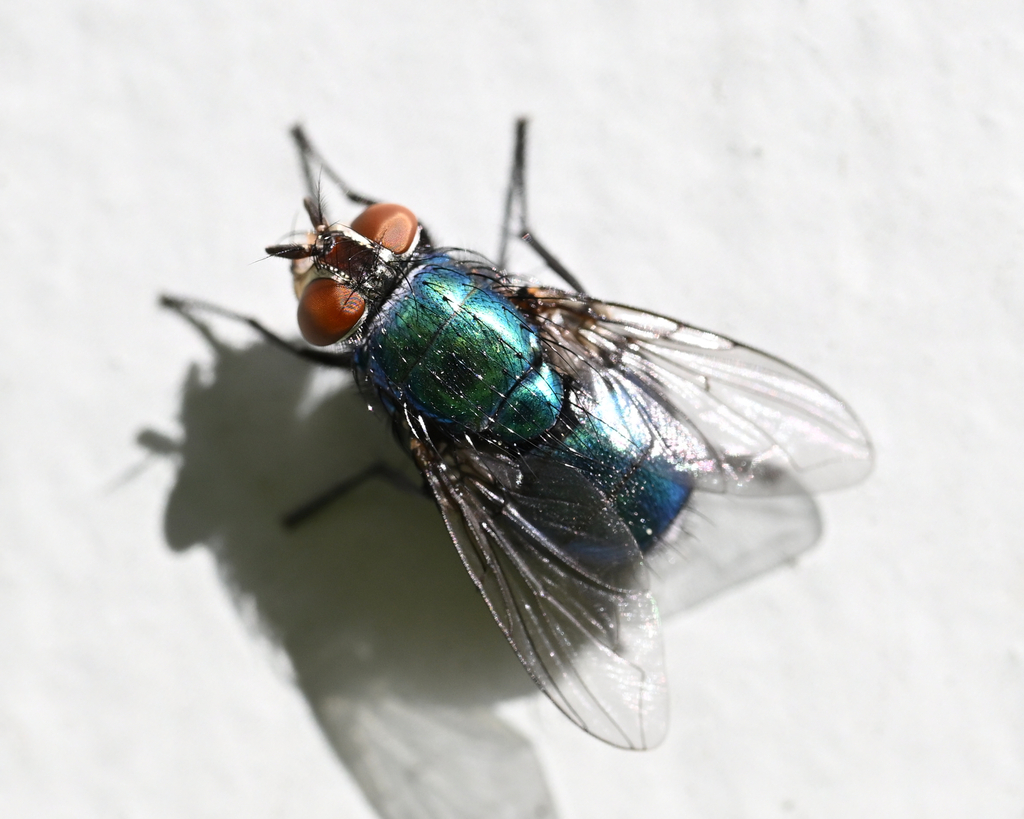
Lucilia thatuna
Lucilia thatuna belongs to the family Calliphoridae, the species most commonly referred to as the blowflies, and the genus Lucilia. Along with several other species of Lucilia, L. thatuna is commonly referred to as a green bottle fly. L. thatuna is very scarce and not much is known about this particular fly. It has been noted to reside in mountainous regions of the northwestern United States.
From the article Lucilia thatuna on Wikipedia (CC BY-SA), quoted section by section
Description
Although other species in the genus Lucilia are called "green bottle flies," L. thatuna can be identified by a shiny, bluish thorax and abdomen (Whitworth 2006). The mature adult, also known as an imago, generally ranges from 4.5 to 10 mm in length (Byrd 2001). Size is strongly correlated with the availability of nutrient rich food and environmental conditions (Florin 2001). Adult females tend to be slightly larger than males, with smaller eyes placed more laterally on the head and the ocellar triangle not surpassing the halfway point to the lunule. The narrow frons on the male distinguishes it from other common species such as Lucilia cuprina and Lucilia sericata. Other distinguishing characteristics include the presence of three postacrostichal setae and the first flaellomere broader in width than the parafacial at the level of the lunule (Whitworth 2006).
Wikipedia: “Morphology”
What it does
Once an adult female has fully developed eggs in her ovaries, she will follow the scent of decay to suitable carrion on which to deposit her eggs. It is theorized that females will feed on the protein secreted from the carrion before depositing a possible 200 eggs through her ovipositor onto carrion. Depending on temperature, the eggs will usually hatch within a day producing the first instar larvae. These larvae will feed continuously upon the decomposing carcass until they are large enough to molt and enter the second instar. This process is repeated again for the third and final instar after which, the larva leaves the corpse to pupate. During this time, L. thatuna actively rearranges its physical composition to emerge as an adult fly after approximately two weeks depending on temperature (Byrd 2001).
Wikipedia: “Life cycle and development”
In human culture
The genus Lucilia was first identified in 1830 by Jean-Baptiste Robineau-Desvoidy, a French entomologist and physician. In 1926, American entomologist Julie Bockman identified the species Lucilia thatuna during his work with the U.S. Bureau of Entomology. The species was also referred to as Bufolucilia thatuna and Phaenicia thatuna until 1991 when Knut Rognes synonymized these genera names with Lucilia. This species can be identified through the Keys to the Genera and Species of Blowflies (Diptera: Calliphoridae) of America North of Mexico (Whitworth 2006).
Wikipedia: “Taxonomy and history”
Listen
Looking for field recordings…
Where it lives
Recorded sightings
—
geo-referenced records in GBIF, from museums, herbaria and field observers.
Drag the globe to turn it. Dots are where records exist, not a range map; darker means more records.
In the stacks
Searching the stacks…
Every page naming Lucilia thatuna in the Biodiversity Heritage Library →
This page is assembled live from iNaturalist, GBIF, Wikipedia, the Source Library and the Internet Archive. It is not yet part of the hand-edited codex. iNaturalist taxon 1552886.