On eBird ↗
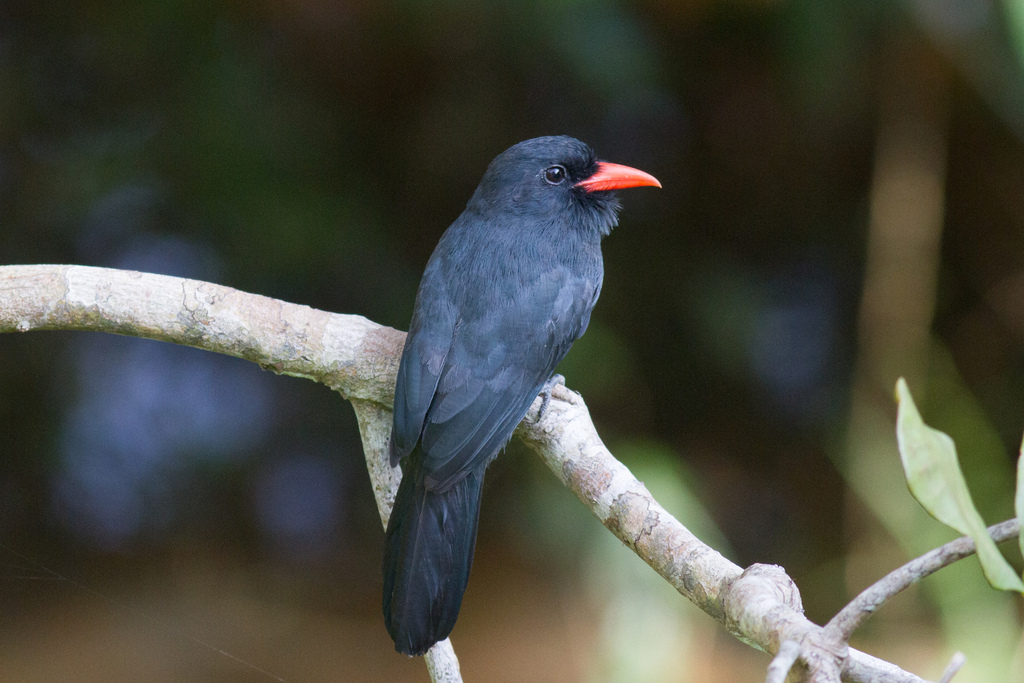
Black-fronted Nunbird
Live sightings near you, the range map, bar charts of when it is seen, and Macaulay Library photos and recordings.
Black-fronted Nunbird
Monasa nigrifrons
The black-fronted nunbird (Monasa nigrifrons) is a species of bird in the family Bucconidae, the puffbirds, nunlets, and nunbirds. It is found in Bolivia, Brazil, Colombia, Ecuador, and Peru.
From the article Black-fronted nunbird on Wikipedia (CC BY-SA), quoted section by section
Description
The black-fronted nunbird is 26 to 29 cm (10 to 11 in) long and weighs 68 to 98 g (2.4 to 3.5 oz). The adult of the nominate subspecies is mostly sooty black that is darkest around the bill (the "front"). The rear part of the body is blue-gray and the tail blue-black. The bill is red, the eye dark, and the legs black. M. n. canescens is slightly paler and grayer than the nominate. The juvenile of both is a dirty slate gray with irregular reddish marks.
Range & habitat
The nominate subspecies of black-fronted nunbird is widespread in the Amazon Basin. It is found in southeastern Colombia, eastern Ecuador, eastern Peru, and much of Brazil. In Brazil it occurs north of the Amazon as far east as the Rio Negro and south of the Amazon as far east as Pará and Alagoas states and south to eastern Mato Grosso do Sul and western São Paulo states. M. n. canescens is found only in eastern Bolivia. The black-fronted nunbird inhabits a variety of landscapes, but favors trees and bamboo along the margins of rivers and lakes. Principal forest types include várzea, igapó and gallery. It is also found in secondary forest, swampy river islands, transitional forest, and mid-succession to mature floodplain forest. Unlike many other nunbirds, it shuns terra firme forest. In elevation it is found from sea level to 1,000 m (3,300 ft).
Wikipedia: “Distribution and habitat”
What it does
The black-fronted nunbird takes most of its prey in flight, though it also picks it from the ground and foliage up to about 6 m (20 ft) above it. Its diet is mostly insects and also includes other arthropods and small lizards and amphibians. It follows troops of primates and army ant swarms to capture prey dislodged by them, and sometimes also joins mixed-species foraging flocks.
Wikipedia: “Feeding”
Listen
Looking for field recordings…
Where it lives
Recorded sightings
—
geo-referenced records in GBIF, from museums, herbaria and field observers.
Drag the globe to turn it. Dots are where records exist, not a range map; darker means more records.
In the stacks
Searching the stacks…
Every page naming Monasa nigrifrons in the Biodiversity Heritage Library →
This page is assembled live from iNaturalist, GBIF, Wikipedia, the Source Library and the Internet Archive. It is not yet part of the hand-edited codex. iNaturalist taxon 1559.