- Plants
- ›Vascular Plants
- ›flowering plants
- ›monocots
- ›Agaves, Orchids, Irises, and Allies
- ›agave and allies
- ›cabbage tree subfamily
- ›Lomandra
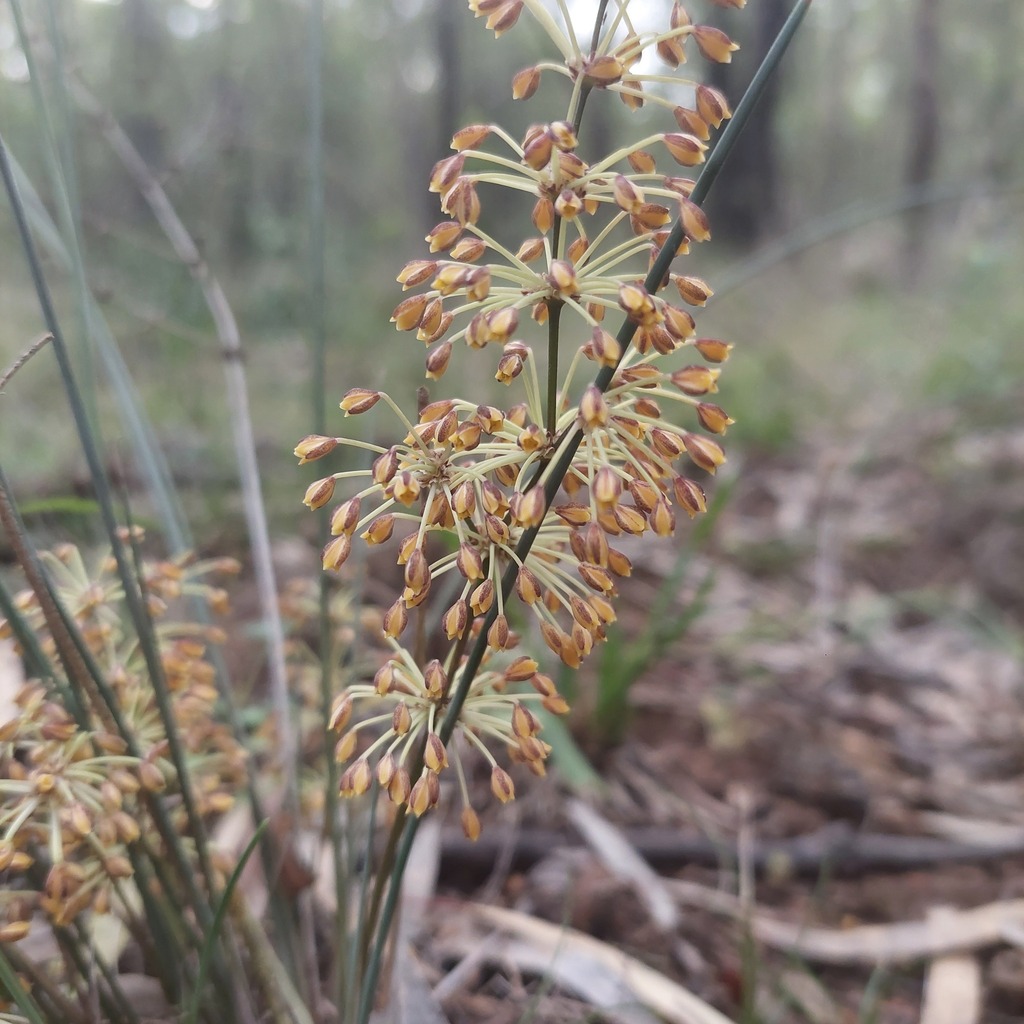
Lomandra briggsiana
Lomandra briggsiana is a species of plant in the Asparagaceae family, first described in 2023 by the Australian botanists Russell Barrett and Trevor Wilson. The species epithet, briggsiana, honours botanist Barbara Briggs.
From the article Lomandra briggsiana on Wikipedia (CC BY-SA), quoted section by section
Description
It is a perennial plant, endemic to New South Wales. The greyish green, finely ribbed leaves are terete, and 15–45 cm long, and generally 1–1.5 mm wide. The male inflorescence has either one or two branches and the flower clusters are whorled, with the flowers on 1-4mm long pedicels. The female inflorescence is similar but unbranched and having sessile flowers. This species is similar to Lomandra beaniana but the male inflorescence of L. beaniana has long branchlets. It differs from Lomandra multiflora by its terete, glaucous leaves and its erect rhizomes, and it differs from Lomandra decomposita by its terete leaves, and from L. ramosissima by its terete leaves and white to cream leaf sheaths.
Range & habitat
It has been found from the Capertee Valley to Tamworth and the Barrington Tops, growing generally in woodlands.
Wikipedia: “Distribution”
Where it lives
Recorded sightings
—
geo-referenced records in GBIF, from museums, herbaria and field observers.
Drag the globe to turn it. Dots are where records exist, not a range map; darker means more records.
In the stacks
Searching the stacks…
Every page naming Lomandra briggsiana in the Biodiversity Heritage Library →
This page is assembled live from iNaturalist, GBIF, Wikipedia, the Source Library and the Internet Archive. It is not yet part of the hand-edited codex. iNaturalist taxon 1576093.