- Animals
- ›Arthropods
- ›Hexapods
- ›Insects
- ›Winged and Once-winged Insects
- ›Ants, Bees, Wasps, and Sawflies
- ›Narrow-waisted Wasps, Ants, and Bees
- ›Proctotrupomorpha
- ›Chalcidoid Wasps
- ›Eulophidae
- ›Entedoninae
- ›Chrysonotomyia
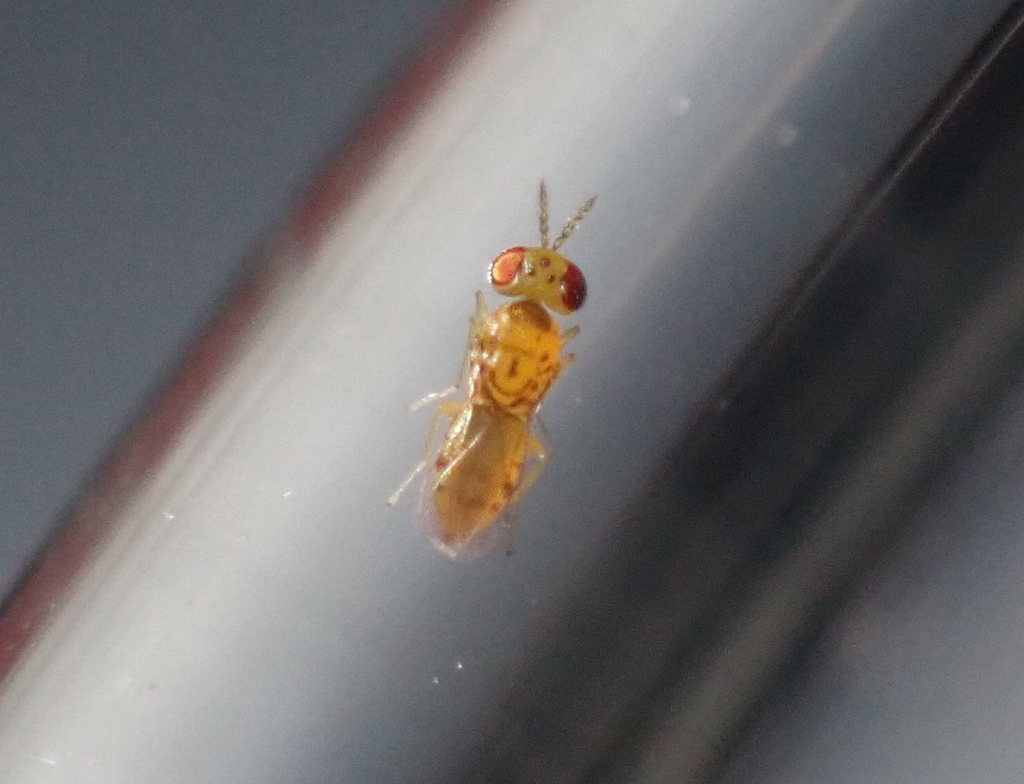
Chrysonotomyia susbelli
Chrysonotomyia susbelli is a species of parasitoid wasp in the family Eulophidae. First described in 2024, it is the first species of Chrysonotomyia known to parasitize Cynipid gall wasps and the 6th species known from America north of Mexico. So far, it is only known from Rice University in Houston, Texas. Its description attracted local and international media attention.
From the article Chrysonotomyia susbelli on Wikipedia (CC BY-SA), quoted section by section
Description
Chrysonotomyia susbelli is a tiny wasp, with females measuring 1.0–1.2 mm (0.039–0.047 in) and males measuring 0.9 mm (0.035 in). The upper half of the thorax is golden yellow, with various dark brown markings dorsally. These markings include a metallic brown band at the front of the mesonotum. The lower half of the thorax is pale white, creating a distinct countershading with the top half. The antennae have a pale scape and a light yellow pedicel with the inner apical two-thirds dark brown. The remaining antennal segments are darker yellow with the final segment dark brown. The eyes are pink. The abdomen, similar to the thorax, is golden yellow above with dark brown banding and pale white below. The male C. susbelli is very similar to the female except for its smaller size and more intensely colored dark brown markings.
In human culture
The specific epithet susbelli roughly translates to "war pig" in Latin, in reference to the mascot of Wiess College, a residential college at Rice University. Wiess's official colors are very similar to C. susbelli's dorsal coloration.
Wikipedia: “Etymology”
Listen
Looking for field recordings…
Where it lives
Recorded sightings
—
geo-referenced records in GBIF, from museums, herbaria and field observers.
Drag the globe to turn it. Dots are where records exist, not a range map; darker means more records.
In the stacks
Searching the stacks…
Every page naming Chrysonotomyia susbelli in the Biodiversity Heritage Library →
This page is assembled live from iNaturalist, GBIF, Wikipedia, the Source Library and the Internet Archive. It is not yet part of the hand-edited codex. iNaturalist taxon 1576501.