On eBird ↗
Tahiti Swallow
Live sightings near you, the range map, bar charts of when it is seen, and Macaulay Library photos and recordings.
Tahiti Swallow
Hirundo tahitica
The Tahiti swallow (Hirundo tahitica) is a small passerine bird in the swallow family Hirundinidae. It is found on the islands of Moorea and Tahiti in French Polynesia. It was formerly considered to be conspecific with the Pacific swallow.
From the article Tahiti swallow on Wikipedia (CC BY-SA), quoted section by section
Description
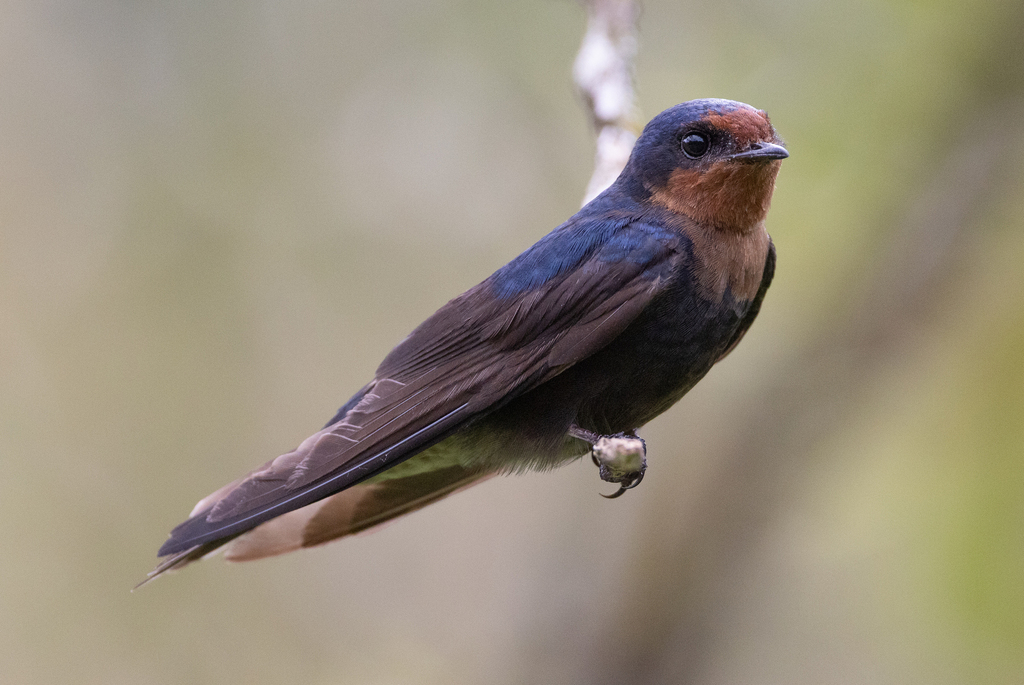
This species is a small swallow at 13 cm (5.1 in) in length. It has a blue-black back and crown with browner wings and tail, a red face and throat, and dusky underparts. It differs from the barn swallow and the closely related welcome swallow in its shorter and less forked tail.
What it does
The Tahiti swallow builds a neat cup-shaped nest, constructed with mud pellets collected in the beak, under a cliff ledge or on man-made structures such as a building, bridge or tunnel. The nest is lined with softer material, and the clutch is two to three eggs. It is similar in behaviour to other aerial insectivores, such as other swallows and the unrelated swifts. It is a fast flyer and feeds on insects, especially flies, while airborne.
== References ==
Wikipedia: “Behaviour”
Listen
Looking for field recordings…
Where it lives
Recorded sightings
—
geo-referenced records in GBIF, from museums, herbaria and field observers.
Drag the globe to turn it. Dots are where records exist, not a range map; darker means more records.
In the stacks
Searching the stacks…
Every page naming Hirundo tahitica in the Biodiversity Heritage Library →
This page is assembled live from iNaturalist, GBIF, Wikipedia, the Source Library and the Internet Archive. It is not yet part of the hand-edited codex. iNaturalist taxon 1578966.