- Plants
- ›Vascular Plants
- ›flowering plants
- ›monocots
- ›grasses, sedges, cattails, and allies
- ›grasses
- ›Pooideae
- ›Wheats, ryes, barleys and relatives
- ›barleys, ryes, and relatives
- ›Agropyron
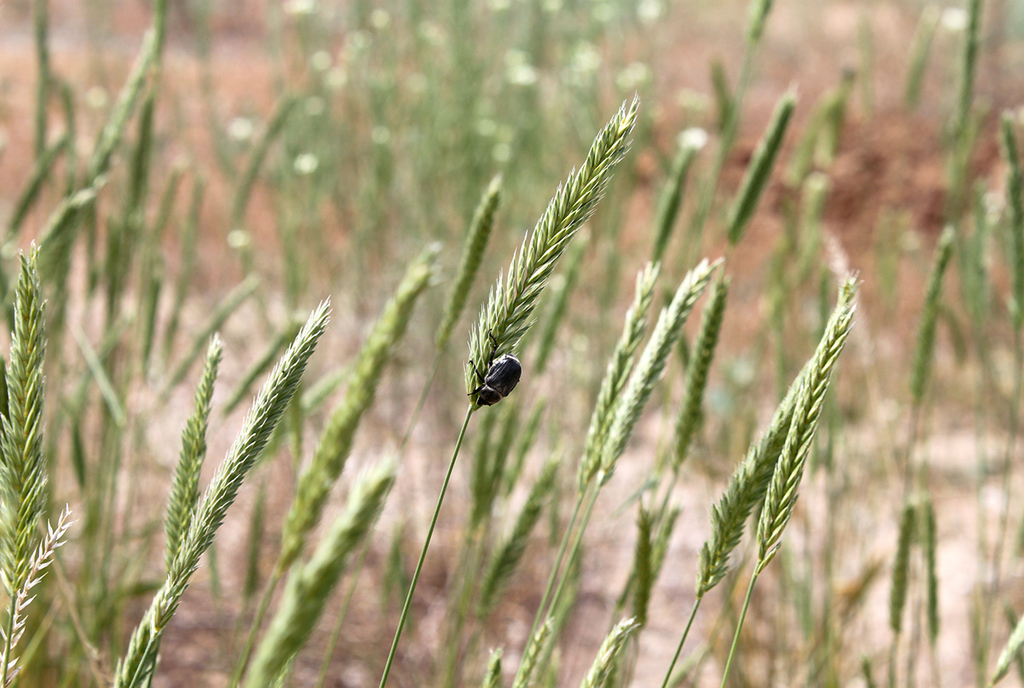
Clustered Wheat Grass
Agropyron desertorum
Agropyron desertorum (clustered wheat grass, desert crested wheatgrass, desert wheatgrass, standard crested wheatgrass; syn. Agropyron cristatum subsp. desertorum (Fisch. ex Link) A. Löve, Agropyron cristatum var. desertorum (Fisch. ex Link) Dorn) is a plant species in the family Poaceae which was originally from Russian and Siberian steppes until it was introduced to the United States from there between 1907 and 1913. Prior to its introduction it was believed that Desert wheatgrass and crested wheatgrass are different species. Currently it can still be found in Central and Western United States, except for Idaho, Kansas, Louisiana, Minnesota, Oklahoma, and Washington.
From the article Agropyron desertorum on Wikipedia (CC BY-SA), quoted section by section
How it is grown
Agropyron desertorum is a perennial crop that is grown in areas across North America. Since it can be regrown over many years, A. desertorum has become a useful crop within the agricultural field. This plant species is a type of crested wheatgrass that is used as a common grazing crop. It is especially used for beef cattle that are raised for human food production. A study was performed to test the specific cattle grazing preferences for different types of crested wheatgrass. Diploid cultivars of crested wheatgrasses were compared to tetraploid cultivars of Agropyron desertorum. The varying ploidy numbers of the plants resulted in inherent differences between the plants and subsequently, specific grazing preferences for the cattle. The study showed that the cattle significantly preferred the tetraploid cultivars for grazing, as opposed to the diploid cultivars. Thus, Agropyron desertorum can be used to better raise beef cattle and increase pasture utilization on the cattle farms.
Wikipedia: “Agricultural significance”
Where it lives
Recorded sightings
—
geo-referenced records in GBIF, from museums, herbaria and field observers.
Drag the globe to turn it. Dots are where records exist, not a range map; darker means more records.
In the stacks
Searching the stacks…
Every page naming Agropyron desertorum in the Biodiversity Heritage Library →
This page is assembled live from iNaturalist, GBIF, Wikipedia, the Source Library and the Internet Archive. It is not yet part of the hand-edited codex. iNaturalist taxon 158128.