- Plants
- ›Vascular Plants
- ›flowering plants
- ›Dicots
- ›Soapberries, Cashews, Mahoganies, and Allies
- ›soapberry family
- ›Alectryon
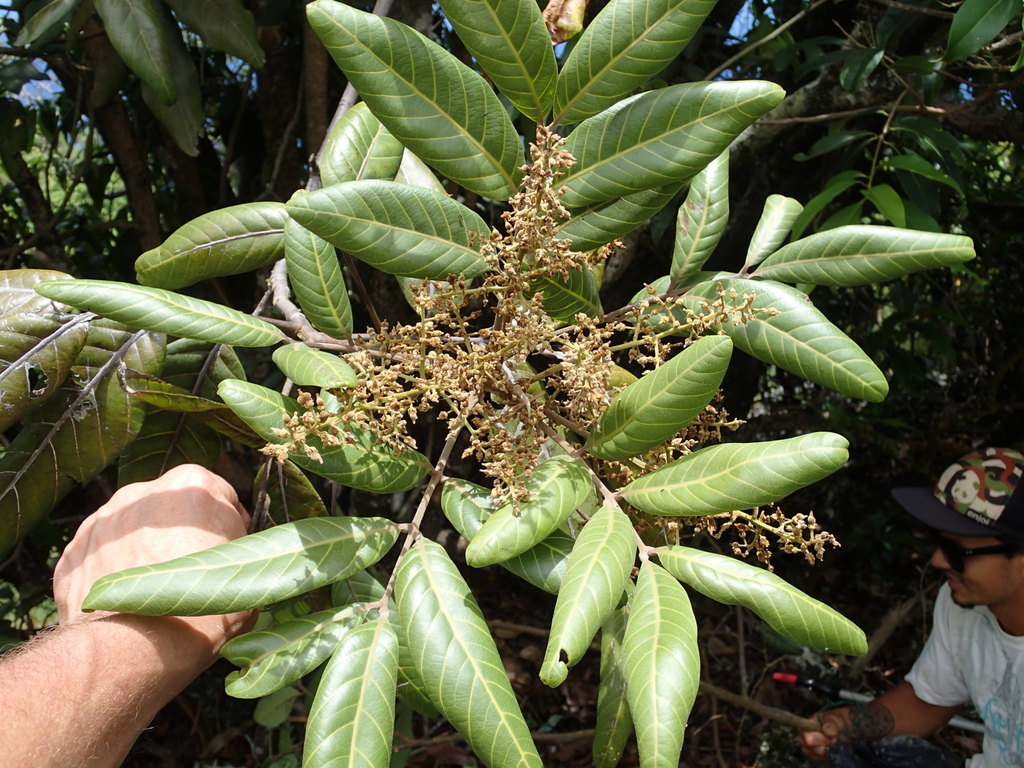
Mahoe
Alectryon macrococcus
Alectryon macrococcus, known as ʻAlaʻalahua or Māhoe in Hawaiian, is a slow-growing flowering tree in the soapberry family, Sapindaceae, that is endemic to mesic forests on the islands of Kauaʻi, Oʻahu, Molokaʻi, and Maui in Hawaii.
From the article Alectryon macrococcus on Wikipedia (CC BY-SA), quoted section by section
Description
This tree grows to an average of 6–7.6 m (20–25 ft), with a trunk diameter of 15–20 cm (5.9–7.9 in), and can reach a maximum height of about 11 m (36 ft). Mature trees are typically multi-trunked. The bark is reddish-brown or brown, with a sinewy appearance and a somewhat rough texture. The wood of Alectryon macrococcus is hard, dark yellowish-brown, and very tough. It has compound leaves about 3–30 cm (1.2–11.8 in) in length, each being made up of two to five pairs of oval-shaped, net-veined leaflets which grow 10–25 cm (3.9–9.8 in) long and 5–12 cm (2.0–4.7 in) wide. The upper surface of these leaflets is smooth and glossy. Branchlets, flowers, and the emerging and young leaves of both varieties have a dense covering of silky-brown hairs. In mature leaves of A. macrococcus var. auwahiensis, the underside of leaflets has a dense covering of rust-colored hairs, while mature leaves of A. macrococcus var. macrococcus have either very sparse or no hairs on the undersides. Flowers are borne on branched clusters up to 30 cm long, and are either perfect, with both male and female reproductive parts, or male. Trees in cultivation have been reported to flower for the first time at around 15 years of age, at which point they were 6 m (20 ft) tall with singular, 14 cm (5.5 in) diameter trunks. …
Range & habitat
Alectryon macrococcus inhabits mesic forests at elevations of 365–1,035 m (1,200–3,400 ft) on Kauaʻi, Oʻahu, Molokaʻi and western Maui. Historically, A. macrococcus var. macrococcus was widespread on the leeward sides of the Hawaiian Islands, but its population has been severely reduced. On Kauaʻi, it was reported near Makaweli in initial surveys, and can be found from Olokele Canyon to Kalalau Valley. It is reportedly uncommon on Oʻahu, where it is known from both the leeward and windward sides of the Waianae Range, the Mākaha Valley, and from two historical records in the Koʻolau Range. Soon after being documented on Molokaʻi in 1913, it was considered to be practically extinct there, and is extirpated from the type locality; today it has only been reported from the western region of East Molokaʻi, and only ten plants are thought to remain. On Maui, it is found in valleys and gulches on the eastern, western, and southern slopes of the West Maui Mountains, although less than twenty plants were recorded on Maui between 1973 and 2003. Alectryon macrococcus var. auwahiensis is found only on the leeward side of east Maui, in the Hawaiian tropical dry forests of Haleakalā's southern slopes at elevations between 360–1,070 m (1,180–3,510 ft). It grows in, and has been historically recorded from, the Auwahi forest and near Pahihi Gulch. …
Wikipedia: “Distribution”
What it does
Alectryon macrococcus is a slow-growing, relatively long-lived tree which grows in various dry to mesic lowland forest types, where it inhabits various north-facing gulch bottoms or lower gulch slopes. It is adapted to periodic droughts. It grows alongside hame (Antidesma platyphyllum), ʻahakea (Bobea sandwicensis), olopua (Notelaea sandwicensis), hōʻawa (Pittosporum confertiflorum, Pittosporum glabrum), ʻālaʻa (Planchonella sandwicensis), and maua (Xylosma spp.). A. macrococcus var. auwahiensis is found on slopes and gulches of mesic to wetter mesic and upper dryland lowland ohia lehua (Metrosideros polymorpha) and lama (Diospyros sandwicensis) forest. It grows alongside akoko (Chamaesyce spp.), olopua (Nestegis sandwicensis), alani (Melicope hawaiiensis), kōlea lau nui (Myrsine lessertiana), ʻiliahi (Santalum spp.), and kōpiko (Psychotria spp.). Little is known about the life history and ecology of Alectryon macrococcus. The flowering period of the plant is unknown, although it has been observed flowering as late as November. It is likely pollinated by insects. It has also been suggested that seeds for Alectryon macrococcus var. macrococcus may have been historically dispersed by the large, flightless ducks extant prior to the arrival of humans to the Hawaiian Islands. …
Wikipedia: “Habitat and ecology”
At the table
Rock reported that Native Hawaiians ate the fleshy, light-tasting fruits and mildly flavored seeds, although the wood was not known to be widely used. The Hawaiian name of Alectryon macrococcus, māhoe, meant "twins", and likely referred to the fruits of the tree, which often form in pairs.
Wikipedia: “Uses”
Where it lives
Recorded sightings
—
geo-referenced records in GBIF, from museums, herbaria and field observers.
Drag the globe to turn it. Dots are where records exist, not a range map; darker means more records.
In the stacks
Searching the stacks…
Every page naming Alectryon macrococcus in the Biodiversity Heritage Library →
This page is assembled live from iNaturalist, GBIF, Wikipedia, the Source Library and the Internet Archive. It is not yet part of the hand-edited codex. iNaturalist taxon 158152.