- Plants
- ›Vascular Plants
- ›flowering plants
- ›monocots
- ›Agaves, Orchids, Irises, and Allies
- ›amaryllis, onions, and allies
- ›onion subfamily
- ›Allieae
- ›Allium
- ›Allium
- ›Codonoprasum
- ›Codonoprasum
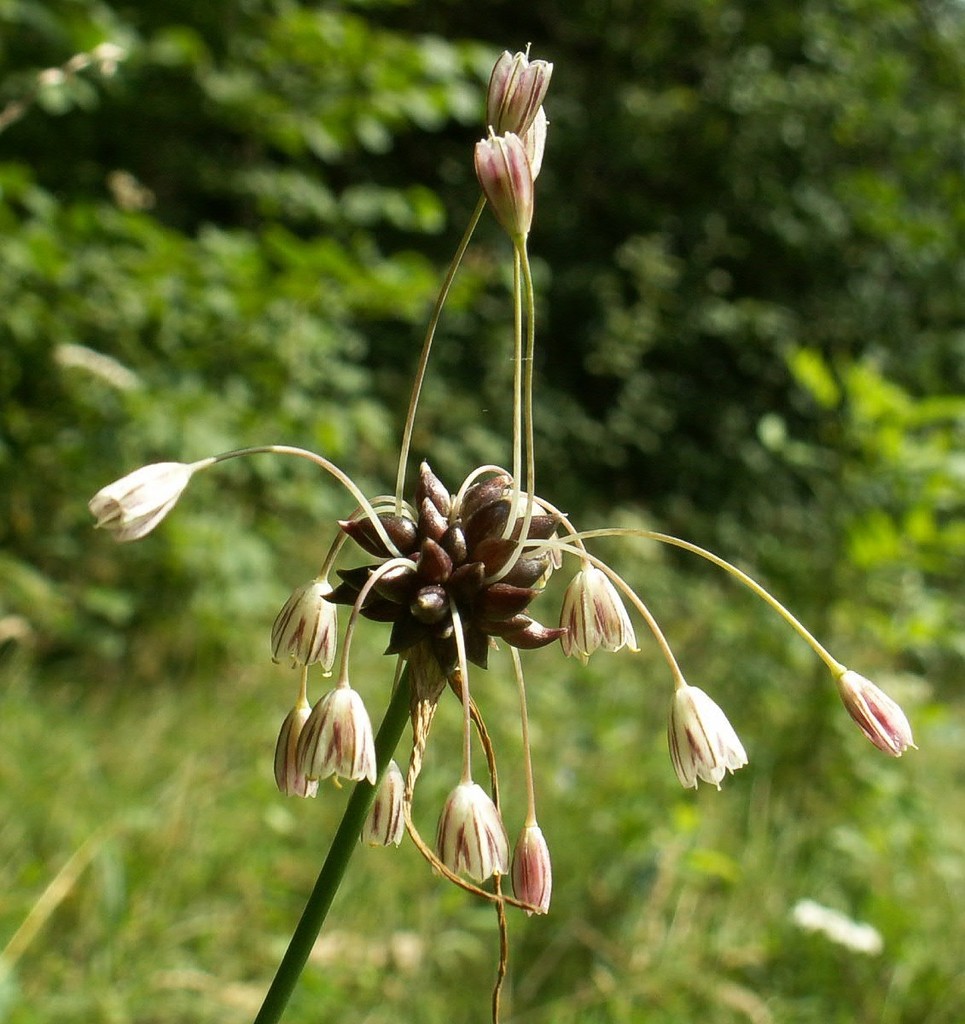
field garlic
Allium oleraceum
Allium oleraceum, the field garlic, is a Eurasian species of wild onion. It is a bulbous perennial that grows wild in dry places, reaching 30 centimetres (12 in) in height. It reproduces by seed, bulbs and by the production of small bulblets in the flower head (similarly to Allium vineale). Unlike A. vineale, it is very rare with A. oleraceum to find flower-heads containing bulbils only. In addition, the spathe in A. oleraceum is in two parts.
Its specific epithet oleraceum means "vegetable/herbal" in Latin and is a form of holeraceus (oleraceus).
From the article Allium oleraceum on Wikipedia (CC BY-SA), quoted section by section
Description
Allium oleraceum grows to a height of about 12 in (30 cm). The underground bulb is up to 0.8 in (2 cm) in diameter. The main stem is usually rounded, but is occasionally flattened, and bears two to four leaves and a terminal inflorescence composed of a number of small, stalked, pinkish-brown flowers and sometimes a few bulblets. The papery bracts have long points which often much overtop the flowers, the stamens of which do not protrude.
Range & habitat
Allium oleraceum is widespread across most of Europe, with additional populations in Turkey and the Caucasus. It is sparingly naturalised in scattered locations in North America. In the United Kingdom, A. oleraceum is found in dry, grassy places, usually steeply sloping and calcareous soils, and on open sunny banks in river floodplains. A. oleraceum is scattered throughout England and very scattered in Wales, Scotland and Ireland. Erosion of coastal areas leads to a reduction in the available habitat for this species, leading to population declines. The highest altitude from which it has been recorded in Britain is 365 m (1,200 ft) in Dovedale, Derbyshire. Allium oleraceum subsp. girerdii was formerly included, but is now classified as Allium oporinanthum.
Wikipedia: “Distribution”
Where it lives
Recorded sightings
—
geo-referenced records in GBIF, from museums, herbaria and field observers.
Drag the globe to turn it. Dots are where records exist, not a range map; darker means more records.
In the old herbals & bestiaries

Notable Commentaries on the History of Plants
Leonhart Fuchs · 1549 · p.770

Herbarium Portatile, Oder Behendes Kräuter- und Gewächs-Buch: Darinn nicht allein 1363. so wol Einheimische als Außländndische Kräuter mit Lateinisch und Deutscher Benennung abgebildet, sondern auch die meisten, so in der Medicin gebräuchlich, kürtzlich erkläret werden
Panckow, Thomas · 1656 · p.86
In the stacks
Searching the stacks…
Every page naming Allium oleraceum in the Biodiversity Heritage Library →
This page is assembled live from iNaturalist, GBIF, Wikipedia, the Source Library and the Internet Archive. It is not yet part of the hand-edited codex. iNaturalist taxon 158185.