- Plants
- ›Vascular Plants
- ›flowering plants
- ›Dicots
- ›beeches, oaks, walnuts, and allies
- ›birch family
- ›Alnus
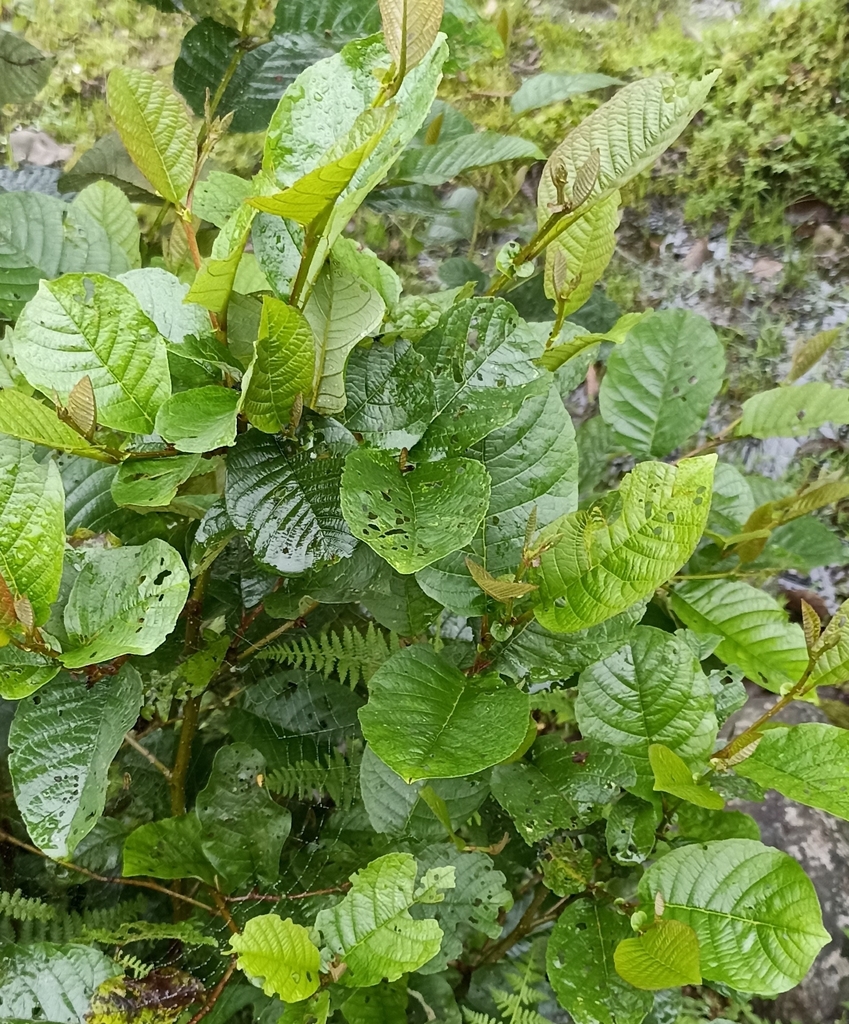
Nepal Alder
Alnus nepalensis
Alnus nepalensis is a large alder tree found in the subtropical highlands of the Himalayas. The tree is called Utis in Nepali and Nepalese alder in English. It is used in land reclamation, as firewood and for making charcoal. It is the state tree of the Indian state of Nagaland.
From the article Alnus nepalensis on Wikipedia (CC BY-SA), quoted section by section
Description
Alnus nepalensis is a large deciduous alder with silver-gray bark that reaches up to 30 m in height and 60 cm in diameter. The leaves are alternate, simple, shallowly toothed, with prominent veins parallel to each other, 7–16 cm long and 5–10 cm broad. The flowers are catkins, with the male and female flowers separate but produced on the same tree. The male flowers are 10 to 25 cm (4 to 10 in) long and pendulous, while the female flowers are erect, 1 to 2 cm (0.4 to 0.8 in), with up to eight together in axillary racemes. Unusually for an alder, they are produced in the autumn, with the seeds maturing the following year.
Range & habitat
It occurs throughout the Himalaya at 500–3000 m of elevation from Pakistan through India, Nepal and Bhutan to Yunnan in southwest China. It grows best on deep volcanic loamy soils, but also grows on clay, sand and gravel. It tolerates a wide variety of soil types and grows well in very wet areas. It needs plenty of moisture in the soil and prefers streamside locations, but also grows on slopes.
Wikipedia: “Distribution”
At the table
The tree grows quickly and is sometimes planted as erosion control on hillsides and for land recovery in shifting cultivation. It has nodules on the roots which fix nitrogen. The wood is moderately soft. It is occasionally used for making boxes and in light construction but is mainly used as firewood, when it burns evenly but rather rapidly, and for making charcoal. Currently, this tree species is preferred by different indigenous ethnic groups such as H'mong, Nung and Thu Lao in Simacai district, Lao Cai province, Northern Vietnam to regreen and enrich the forest by local knowledge (SPERI, CENDI).
Wikipedia: “Uses”
Where it lives
Recorded sightings
—
geo-referenced records in GBIF, from museums, herbaria and field observers.
Drag the globe to turn it. Dots are where records exist, not a range map; darker means more records.
In the stacks
Searching the stacks…
Every page naming Alnus nepalensis in the Biodiversity Heritage Library →
This page is assembled live from iNaturalist, GBIF, Wikipedia, the Source Library and the Internet Archive. It is not yet part of the hand-edited codex. iNaturalist taxon 158201.